
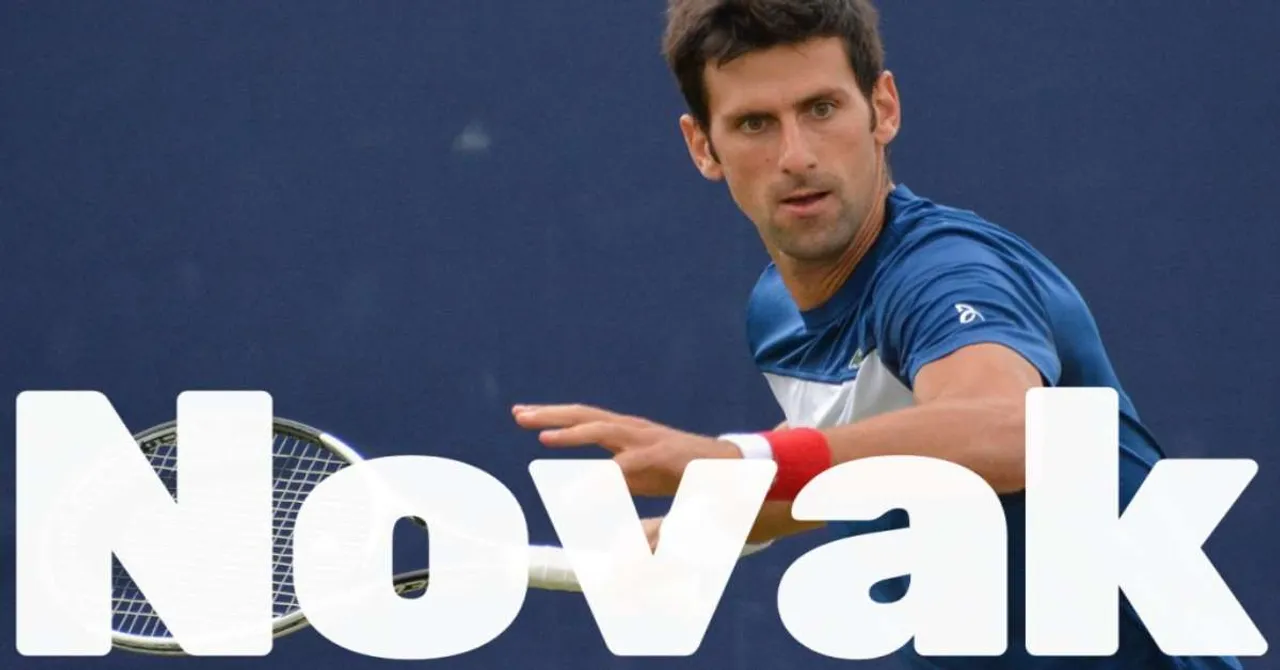
Novak Djokovic: The Greatest Tennis Player of All Time?
Novak Djokovic is the most decorated men’s tennis player in history, holding the all-time record of 24 Grand Slam singles titles and 428 weeks at world No. 1. His career has redefined what greatness looks like in professional tennis, and his relentless pursuit of every major record has placed him at the center of the GOAT debate for over a decade.
What makes Djokovic’s story so compelling isn’t just the numbers. It’s the journey from war-torn Belgrade to the summit of a sport traditionally dominated by Western European nations. Along the way, he broke through the Federer-Nadal duopoly, rewrote the record books, and built a legacy that will be studied for generations.
Novak Djokovic
From War-Torn Belgrade to Tennis Stardom
Novak Djokovic was born in Belgrade, Serbia, on May 22, 1987. He picked up a tennis racket at age four, and his natural talent was obvious almost immediately. He grew up alongside two younger brothers, Marko and Djordje, who also became professional tennis players.
His parents, Srdjan and Dijana, ran a family sports business that included three restaurants and a tennis academy. Djokovic’s father, uncle, and aunt were all professional skiers. Srdjan originally wanted Novak to pursue soccer or skiing, but tennis won out early.
Even during the NATO bombing of Belgrade in 1999, when his family sheltered in basements at night, the young Djokovic refused to stop practicing. He has spoken openly about how those hardships fueled his determination to succeed through tennis.
The bombing made me hungry for success. It gave me a sense of urgency that has never left me.
Discovered by Jelena Gencic
Serbian tennis legend Jelena Gencic spotted six-year-old Djokovic at his parents’ sports facility in 1993. She reportedly told his parents, “This boy will be one of the best tennis players ever.” Gencic worked with Novak for the next six years, laying the technical and mental foundations for his career.
At 13, Djokovic moved to the Pilic Tennis Academy in Munich, Germany, to compete at a higher level. By 14, he was a triple European champion in singles, doubles, and teams. He chose not to continue formal education after high school, turning professional in 2003 at age 16.
Career Achievements and Records
Djokovic’s trophy cabinet is staggering in both depth and breadth. No male player in the Open Era has matched his combination of Grand Slam titles, Masters 1000 victories, and weeks at No. 1.
Grand Slam Breakdown
Djokovic’s 24 majors are spread across all four Grand Slams, making him the ultimate all-surface champion:
- Australian Open (10 titles): His most dominant Slam. No player, male or female, has won more titles in Melbourne.
- French Open (3 titles): His 2016 Roland Garros victory completed the Career Grand Slam, making him only the eighth man in history to achieve this milestone.
- Wimbledon (7 titles): He won four consecutive titles from 2018 to 2022, cementing himself as one of the greatest grass court players ever.
- US Open (4 titles): His most recent came in 2023, giving him 24 overall and sole ownership of the all-time men’s record.
Other Landmark Records
- First man to win all nine ATP Masters 1000 events, a feat requiring elite performance across every surface and condition
- Career Golden Masters holder, having won each Masters event at least once
- Olympic gold medalist at the 2024 Paris Games, completing the Career Golden Slam
- Over 1,100 career match wins, one of the highest totals in ATP history
- Ranked 46th on Forbes’ list of the World’s Highest-Paid Athletes (2021)
The nine Masters 1000 events are played on hard courts, clay, and indoor surfaces across three continents. Winning all nine requires a player to be genuinely world-class on every surface, not just a specialist. Only Djokovic has done it.
Playing Style: The Ultimate Counter-Puncher
From a coaching perspective, Djokovic’s game is built on three pillars: defensive excellence, elite return of serve, and unmatched mental resilience. He may not have the most powerful forehand or the flashiest shot-making, but his ability to absorb pressure and redirect it back at opponents is unrivaled.
What Makes His Game Special
- Return of serve: Widely considered the best returner in tennis history. He stands closer to the baseline than almost any other player, cutting down reaction time and taking the serve early.
- Two-handed backhand: His backhand is both a weapon and a shield. He hits it flat, with topspin, and as a slice, adjusting effortlessly to any tactical situation.
- Flexibility and movement: Djokovic’s near-superhuman flexibility allows him to reach shots that other players simply cannot. His signature splits are not just spectacular, they buy him extra time to recover court position.
- Mental toughness: He has won more five-set matches and saved more match points than virtually any player in history. When the pressure mounts, Djokovic typically gets better.
Weaknesses and Vulnerabilities
No player is perfect, and Djokovic does have patterns that opponents try to exploit:
- Serve inconsistency: While his serve has improved dramatically over the years, it remains a notch below the elite weapons of players like John Isner or Ivo Karlovic. Under extreme pressure, double faults can creep in.
- Crowd dynamics: Djokovic has openly struggled with hostile crowds, particularly at the US Open. While he has largely learned to channel this energy, it has cost him in crucial moments.
- Physical maintenance: His lean frame requires meticulous dietary and recovery routines. When his body is not at 100%, his movement advantage can diminish significantly.
Watch where Djokovic stands when returning serve. He positions himself inside or right on the baseline, taking the ball early and giving the server less time. Recreational players can adopt this aggressive return stance to put immediate pressure on opponents, even without Djokovic-level reflexes.
The Big Three Rivalries
Djokovic’s career cannot be understood without examining his rivalries with Roger Federer and Rafael Nadal. The “Big Three” era produced arguably the greatest period of competition in tennis history.
60 career meetings, the most in the Open Era
50 career meetings across 15 years
Djokovic vs. Nadal
This is the most played rivalry in Open Era history at 60 matches. Djokovic leads 31-29 overall, but Nadal dominates on clay (20-8). Their battles at the French Open and Australian Open have produced some of the greatest matches ever played, including the legendary 2012 Australian Open final that lasted 5 hours and 53 minutes.
Djokovic vs. Federer
Djokovic holds a 27-23 edge over Federer. Their most dramatic encounter came in the 2019 Wimbledon final, where Djokovic saved two championship points before winning in a fifth-set tiebreak. That match is widely regarded as one of the greatest Wimbledon finals of all time.
Each member of the Big Three built his game around a different core strength. Federer relied on offensive variety, Nadal on physical intensity and topspin, and Djokovic on defensive solidity and return quality. Identifying which archetype fits your natural tendencies can help you develop a more coherent game plan. Check out our techniques section for drills that target each style.
Personal Life and Off-Court Interests
Djokovic married his long-term partner, Jelena Ristic, in 2014. They have two children: Stefan (born 2014) and Tara (born 2017). The family also includes two dogs, Pierre and Tesla.
Beyond tennis, Djokovic is passionate about yoga, meditation, and nutrition. He famously adopted a gluten-free, plant-based diet after discovering a gluten intolerance in 2010, crediting the dietary change with transforming his endurance and recovery. He owns the restaurant chain Novak Cafe & Restaurant across Serbia and a plant-based restaurant in Monaco.
Languages and Public Persona
Djokovic speaks seven languages fluently: Serbian, English, Italian, French, Spanish, German, and Slovak. His multilingual abilities have made him a fan favorite at tournaments worldwide, where he frequently conducts post-match interviews in the local language.
His warm, playful personality earned him the nickname “Djoker,” a blend of his surname and “joker.” He is well-known for his hilarious on-court impersonations of fellow players, including Nadal, Federer, and Serena Williams.
The Novak Djokovic Foundation
Djokovic established his foundation in 2007 to champion early childhood education, particularly in Serbia, where only about half of all children have access to preschool. The foundation has built and renovated dozens of schools and supported educational programs across the country.
I want every child in Serbia to have the opportunity I had, to dream big and have the support to chase those dreams.
The GOAT Debate: Where Djokovic Stands
The question of who is the greatest men’s tennis player of all time may never be settled definitively. But the statistical case for Djokovic is the strongest of any player in history.
He leads the all-time records in Grand Slam titles (24), weeks at No. 1 (428), and Masters 1000 titles (40). He is the only man to achieve a Career Golden Masters, and as of 2024, he holds the Career Golden Slam with his Olympic gold in Paris. These are not marginal advantages. They represent a sustained level of dominance that stretches across nearly two decades.
What separates Djokovic from his rivals in this debate is longevity at the very top. He won his first Grand Slam in 2008 and his most recent in 2023, a span of 15 years. During that time, he adapted his game to counter every generational shift in playing style, from Federer’s elegance to Nadal’s physicality to the power of the Next Gen.
Federer’s supporters point to his artistry, sportsmanship, and the 237 consecutive weeks at No. 1. Nadal’s fans highlight his 14 French Opens and unmatched dominance on a single surface. Djokovic’s argument rests on sheer statistical superiority across every measurable category. All three have legitimate claims, and that’s what made this era so extraordinary. Explore the full records page for more context.
Social Media and Links
Stay connected with Djokovic through his official channels:
Final Thoughts
Whether or not you believe Novak Djokovic is the greatest of all time, his impact on professional tennis is beyond dispute. He shattered records that many thought would stand for decades, he elevated the physical and mental standards of the sport, and he did it all while overcoming obstacles that would have derailed most careers before they began.
For tennis fans and aspiring players alike, Djokovic’s career offers a masterclass in resilience, adaptability, and the relentless pursuit of improvement. If you want to explore how the pro tour has evolved during this incredible era, or compare Djokovic’s stats with other legends on our stats page, there is always more to discover.
Have questions about Djokovic’s career or playing style? Drop us a message through our contact page.
Frequently Asked Questions
How many Grand Slams has Novak Djokovic won?
What is Novak Djokovic's playing style?
What is Djokovic's head-to-head record against Federer and Nadal?
What languages does Novak Djokovic speak?
Has Djokovic won an Olympic gold medal?
More in Tennis Players
Rafael Nadal: The King of Clay Who Redefined Tennis
Complete Rafael Nadal biography covering his 22 Grand Slams, 14 French Open titles, playing style, rivalries, and lasting impact on professional tennis.
Roger Federer: The Greatest Tennis Player of All Time?
Explore Roger Federer's career, 20 Grand Slam titles, playing style, and lasting impact on tennis. Complete bio with stats, records, and key rivalries.
Naomi Osaka: Career, Playing Style, and Legacy
Explore Naomi Osaka's career, 4 Grand Slam titles, powerful playing style, and cultural impact. The first Japanese woman to reach world No. 1.
Serena Williams: The Greatest Female Tennis Player Ever
Discover Serena Williams' journey from Compton to 23 Grand Slam titles, her dominant playing style, and what made her the greatest female tennis player ever.