
Tennis Fitness: Exercises, Drills, and Training That Actually Work
Tennis fitness is the foundation that allows every technical skill you’ve developed to hold up under the pressure of match play.
You can perfect your forehand, build a reliable serve, and develop sharp strategy, but none of it holds up if your legs give out in the second set. I’ve watched countless players lose matches they should have won simply because their fitness couldn’t keep pace with their shot-making ability.
Tennis demands a unique blend of anaerobic power, lateral agility, and endurance. Players like Novak Djokovic, Iga Swiatek, and Carlos Alcaraz don’t just hit great shots. They maintain their shot quality deep into the third set because their conditioning allows it. The physical side of the game is what separates players who compete from players who merely participate.
Your focus sharpens when your body isn’t fighting fatigue. Strong fitness supports your mental game by keeping you alert and composed when points matter most. It also protects you from injuries caused by muscle imbalances, poor flexibility, and accumulated fatigue over long matches.
Below are seven proven areas of tennis fitness training I’ve used with my students and applied in my own game over the years. Each section includes practical exercises you can start using this week.
1. Consistency: Build the Habit First
Only 8% of people stick with their New Year’s resolutions, and most quit within two weeks. The reason is almost always the same: they start with an unrealistic plan. Setting ambitious goals while relaxing at home is easy. Maintaining a 45-minute daily routine when you’re sore and busy is another matter entirely.
Take the opposite approach. Make the habit so small it feels absurd not to do it. A focused 10-minute speed and agility session done consistently beats an ambitious 30-minute routine you abandon after a week.
Commit to just 10 minutes of focused footwork or agility work per session. That adds up to over two hours per month of targeted training. Once the habit sticks for 3-4 weeks, add five minutes. Small, consistent effort compounds into real improvement.
I’ve seen too many players set a goal of training 3-4 times per week for 30 minutes, fatigue after ten days, take a few days off, and never return to the routine. Begin small, lock in the habit, and then build. Progress comes from what you do repeatedly, not from one heroic session.
2. Flexibility: Dynamic Before, Static After
There is broad consensus among sports scientists that dynamic movements before intense activity improve performance and reduce injury risk. Deep, static stretches should only come after your session. Doing static stretches before play can actually increase injury risk and reduce power output, something many recreational players still get wrong.
Tennis players change direction explosively with minimal rest, loading joints and muscles in ways that demand a thorough warm-up. Dynamic stretching prepares the entire body for those demands.

Dynamic vs. Static Stretching
Before play (dynamic): Engage and release each stretch repeatedly to warm up the targeted muscle group. Think arm circles, leg swings, walking lunges with rotation, and lateral shuffles. These movements raise your core temperature and prime your neuromuscular system for explosive work.
After play (static): Hold each stretch for 20-30 seconds during your cool-down. Focus on the hip flexors, hamstrings, shoulders, and forearms, the areas that take the most punishment during a match.
Upper-body stretches are especially important for tennis players. Elbow, forearm, wrist, and shoulder discomfort are common among active players. Include wrist flexor and extensor stretches in every cool-down to help prevent tennis elbow.
3. HIIT: Train Like You Play
The fast pace of tennis demands explosive movement and quick recovery. Getting into the ideal position for every shot requires precise, powerful footwork. This means explosiveness should be prioritized over steady-state endurance training.
Recent research has confirmed what many coaches suspected for years: long, slow treadmill sessions don’t match the interval-based demands of match play. HIIT (High-Intensity Interval Training) mirrors the actual energy systems tennis uses far more effectively.
HIIT involves short bursts of maximum effort followed by longer rest periods. A typical protocol might look like sprinting on a treadmill for 15 seconds, then resting for 45 seconds, repeated for eight rounds. That’s only two minutes of all-out running, but the training effect on your anaerobic system is substantial.
HIIT sessions should be short and intense, not long and moderate. If you can comfortably complete more than 8-10 rounds, you’re not working hard enough during the effort phases. Push yourself during the work intervals and use the rest periods fully.
These workouts are ideal when you don’t have time for a full gym session. However, consult your doctor before starting any high-intensity program, particularly if you haven’t trained at this level before.
4. Strength: Build Explosive Power
Tennis-specific strength training builds muscles with explosive ability, allowing you to serve faster, use ground reaction forces more effectively, move around the court quicker, and sustain performance across long matches.
Let me address a common misconception: strength training will not make you slower, tighter, or less agile. Research on Olympic weightlifters shows they have among the highest levels of explosive power while being second only to gymnasts in flexibility. Rafael Nadal and Serena Williams are proof that serious strength work enhances, rather than limits, on-court performance.
Here are five exercises that deliver real results for tennis players.
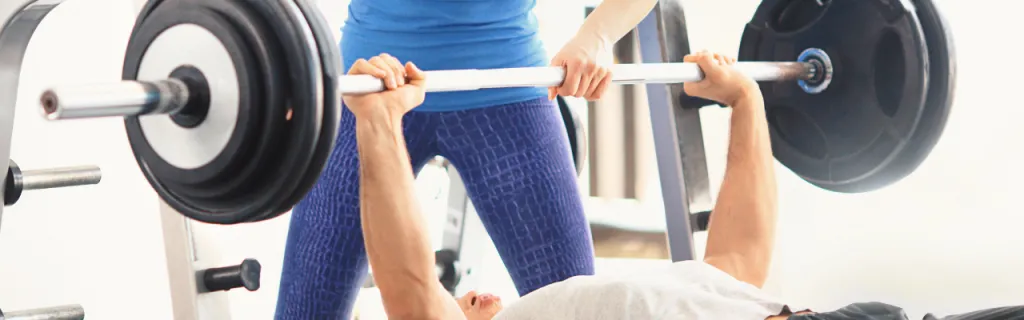
Bench Press
The bench press works the chest, triceps, and shoulders, all critical for a powerful serve. When performed correctly, it’s one of the best upper-body strength exercises available. Focus on controlled reps with moderate weight rather than maxing out.
Goblet Squat
Squats are essential for lower-body strength, and goblet squats are an excellent variation for players at any level. Hold a dumbbell or kettlebell at chest height and squat with control. This exercise builds the leg drive that powers your movement on court and adds stability to your split step.
Box Jumps
Box jumps train your body for the explosive jumping and landing movements tennis requires, with lower joint impact than plyometrics on flat ground. They build shock absorption capacity in your feet and legs, which is essential for preventing lower-body injuries. The exercise targets glutes, quadriceps, core, and arms simultaneously.
Lateral Lunge
Many conventional strength programs ignore lateral movement, yet it’s one of the most critical components of tennis footwork. Lateral lunges engage the glutes, hip abductors, knees, and hips. Once you’ve nailed the movement pattern, add free weights like dumbbells, kettlebells, or resistance bands to increase difficulty.
Medicine Ball Slams
A full-body exercise that builds core strength directly applicable to your strokes. The explosive force you generate when slamming the ball translates to more powerful forehands and backhands on court. Medicine ball slams require minimal technique and carry a low injury risk, making them accessible for players at any training level.
5. Agility: Change Direction with Control
Agility allows you to change direction quickly while maintaining balance and body control under pressure. These drills should be performed while holding your racket and at match-level intensity. Focus on three things: acceleration, movement speed, and controlled deceleration.
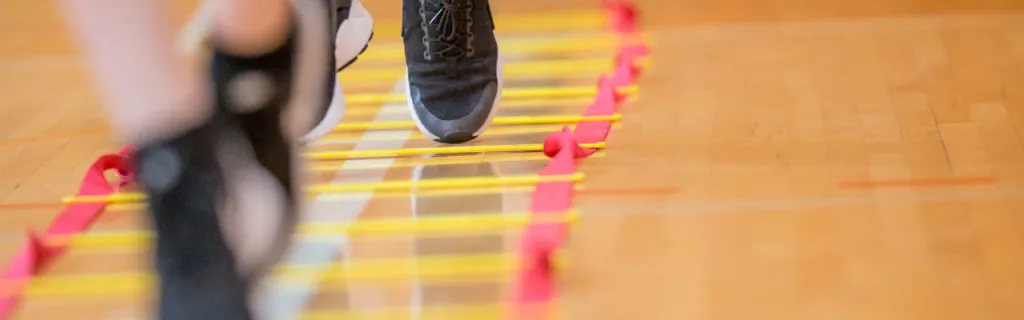
Agility Ladder High Knees
IntermediateThis drill builds the fast-twitch footwork you need for explosive first steps on court. The ladder forces precise foot placement under speed, training the same neural patterns used during rapid baseline exchanges.
- Set the ladder flat on the court
- Run through with high knees, alternating left and right leg
- Keep your chest up and arms pumping throughout
- Focus on quick ground contact, not height
Cone Touch Shuffles
IntermediateThis mirrors the lateral recovery movements you make dozens of times per match. Staying low through the shuffle trains the wide base and bent knees that allow you to change direction without losing balance.
- Place two cones 8 feet apart
- Shuffle laterally between the cones
- Touch each cone with your hand while staying low
- Keep your weight on the balls of your feet
Court-Length Hurdle Sprints
AdvancedHurdle sprints build the explosive acceleration you need to chase down drop shots and short balls. The obstacles force you to lift your knees rather than shuffling, which translates to more powerful first steps during rallies.
- Place hurdles along the court, spaced a few feet apart
- Sprint over them without touching or knocking them over
- Drive your knees up and maintain a forward lean
- Walk back slowly between reps to recover
Cone Figure-8 to Sprint
AdvancedThis drill combines tight directional changes with straight-line speed, replicating the transition from defensive scrambling to an aggressive approach shot. The figure-8 forces constant weight transfer before you explode forward.
- Place two cones 4 feet apart
- Run around them twice in a figure-8 pattern
- Immediately sprint the full length of the court
- Jog back and repeat 4-6 times
Jump rope is another excellent agility tool. Vary your technique: regular jumps, split jumps, side-to-side, forward and back, hip twists, high knees, and single-leg hops. Even five minutes of focused rope work improves coordination, timing, and foot speed.
6. Coordination and Reaction
Coordination
Tennis players frequently undervalue coordination training. The ability to take quick, precise adjustment steps before contact separates good movers from great ones.
I see this problem constantly in my coaching: players take either lazy shuffle steps or oversized power steps when approaching the ball. Neither works consistently. The goal is small, controlled steps while maintaining a wide base, allowing you to make fine adjustments right up until contact.
Next time you watch a professional match, focus on the player’s feet in the last two steps before contact. You’ll notice rapid, small adjustment steps that position them precisely. Practice this by rallying from the baseline and counting your adjustment steps before each hit.
Reaction Training
Improving your reaction time directly improves your anticipation, your ability to read and predict where the next shot is going. Reaction exercises should push you beyond your comfort zone to stimulate the nervous system and force faster processing.
Keep reaction training sessions short: 5-10 minutes at maximum intensity. Longer sessions lead to diminishing returns as fatigue dulls the very neural responses you’re trying to sharpen.
Ball Drop
BeginnerThis drill trains both visual processing and explosive first-step acceleration. The randomized drop timing prevents you from anticipating, forcing a genuine reactive sprint every rep.
- Your partner stands 15 feet away holding a ball above their shoulder
- They drop the ball at a random moment
- Sprint forward and catch it before the second bounce
- Return to starting position and repeat 8-10 times
Two-Ball Split Step
IntermediateThis adds a decision-making layer to the reaction drill. You must read which ball is falling, choose a direction, and execute, replicating the split-second reads you make when returning serve or reacting to a passing shot.
- Your partner stands 15 feet away with a ball in each hand at chest height
- They drop one ball randomly
- Identify which hand released, split step, and move to catch it
- Catch the ball before the second bounce
Blind Reaction
AdvancedThis forces you to react to sound rather than sight, developing a completely different dimension of court awareness. It sharpens the auditory cues you unconsciously use during play, like the sound of the ball off your opponent’s strings.
- Stand facing away from your partner, who is about 60 feet behind you
- Your partner tosses the ball so it bounces near you
- When you hear the bounce, turn and locate the ball
- Catch it before the second bounce
7. Recovery: Where Adaptation Happens
Recovery is where your body actually adapts and gets stronger. Training breaks muscle fibers down; rest builds them back up stronger. If recovery is inadequate, your body doesn’t strengthen and injury risk increases.
Overtraining and nagging injuries are clear signals that you’re not giving your body enough time to recover from the demands you’re placing on it. I’ve learned this lesson the hard way myself, and I’ve watched many competitive players push through fatigue only to end up sidelined for weeks.
Effective recovery methods include:
- Foam rolling for self-myofascial release
- Massage and percussion guns for deep tissue work
- Hydro therapy including contrast showers (alternating hot and cold)
- Compression therapy and electrical muscle stimulation
- Proper nutrition tailored to your training load
- Sleep of 7-9 hours per night, the single most important recovery tool
- Rest days with at least one full day off per week
Roger Federer reportedly slept 10-12 hours per night during his career. Research consistently shows that sleep is the most powerful recovery tool available. If you’re training hard but sleeping poorly, you’re undermining your own progress.

Final Thoughts
Improving your tennis fitness is a gradual process that rewards patience and consistency above all else. You won’t go from struggling in the second set to dominating in the third overnight. Set small, specific goals, stick with them for 4-6 weeks, and build from there.
Do not get discouraged if results aren’t visible within a few days. Real physical adaptation takes months, not weeks. But if you commit to a balanced program covering flexibility, strength, HIIT, agility, reaction training, and proper recovery, you will become a measurably better tennis player. Your health will thank you for it too.
Extra Resources
For more in-depth reading, check out the ITF and USTA sites for exercises and drills to complement the training outlined above.
Frequently Asked Questions
How often should tennis players do fitness training?
Should tennis players lift heavy weights?
What is the best warm-up routine before a tennis match?
How can I improve my footwork speed on the tennis court?
Is running good training for tennis?
More in How To Play Tennis
The 10 And Under Tennis Program
Learn how the USTA 10 and under tennis program uses smaller courts, lighter rackets, and low-compression balls to help kids build real skills and love the game.

College Tennis: How To Get Recruited By Your Dream College
Practical guide to getting recruited for college tennis, from UTR ratings to recruiting videos. Tips that actually help you stand out.

Tennis Nutrition: What to Eat Before, During & After a Match
Fuel your tennis game with the right nutrition. Pre-match meals, on-court hydration, post-match recovery foods, and what the pros actually eat.
How to Become a Pro Tennis Player
A realistic guide to becoming a professional tennis player, from starting young and getting coached to competing on the Challenger Tour.

8 Science-Backed Health Benefits of Playing Tennis
Tennis cuts cardiovascular mortality by 56%, builds bone density, burns 400-600 cal/hr, and sharpens your brain. Here are 8 proven health benefits of playing tennis.
How To Make Your High School Tennis Team | 5 Tryout Tips From a Coach
A tennis coach breaks down exactly what tryout coaches look for and how to prepare your strokes, fitness, doubles game, and mental toughness.