Best Tennis Training Equipment: 9 Aids That Actually Work
The right training aid teaches your body what words cannot, building muscle memory through visual and kinesthetic feedback that sticks.
After years of coaching, I have learned that verbal instruction alone has limits. I can tell a player to “brush up on the ball” a hundred times, but five minutes with a training device that forces the correct motion teaches topspin faster than an hour of explanation. The best tennis training aids work because they engage the two learning channels that matter most in sports: seeing and feeling.
This guide covers 9 training aids I use in my own coaching sessions, from topspin trainers and serve mechanics tools to footwork equipment and grip trainers. Each one targets a specific skill and provides the kind of immediate feedback that accelerates improvement at every level.
1Top Pick$$
TopspinPro
The fastest way to learn topspin on all groundstrokes
Best for
Players struggling with flat shots who need topspin
The single best device for teaching topspin groundstrokes at any level
Best for: Players who hit flat and want to develop topspin
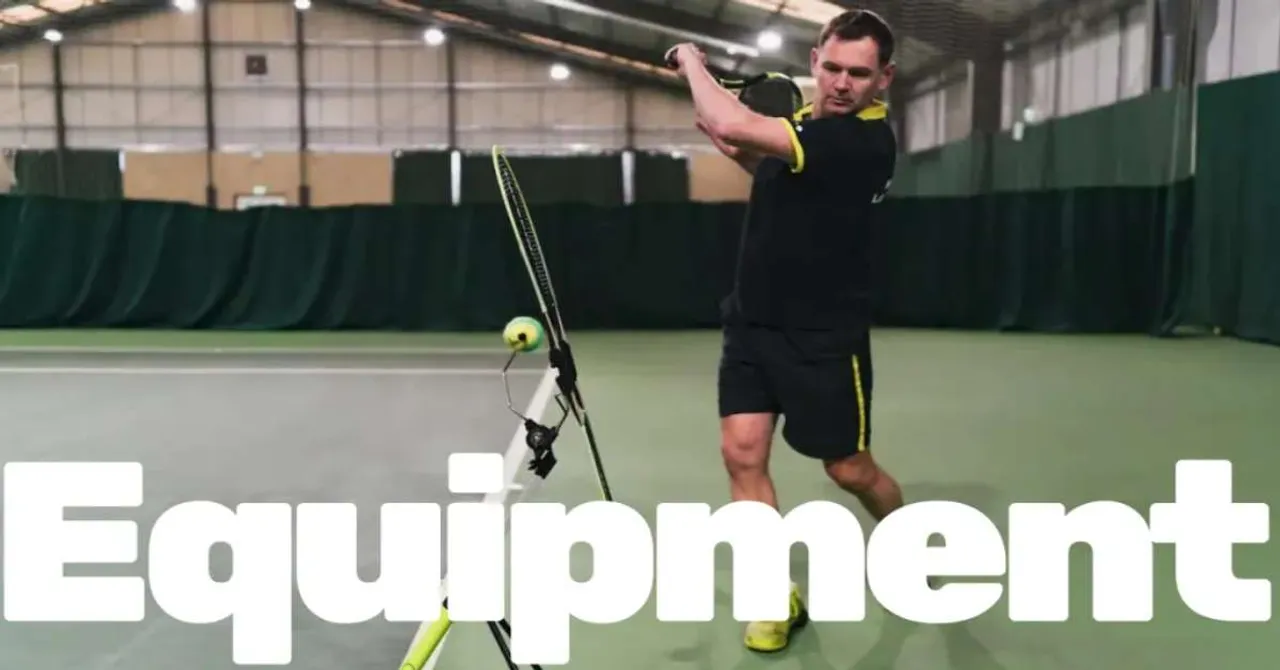
The TopspinPro is the training aid I recommend most often to students who struggle with flat shots. It works by positioning a spinning ball at the correct contact point and forcing you to brush up through the strike zone with the proper racket path. After just a few sessions, most players start producing noticeable topspin on their groundstrokes without consciously thinking about technique.
What makes the TopspinPro effective is its simplicity. There are no batteries, apps, or complicated instructions. You set it up, grab your racket, and start swinging. The device gives immediate visual feedback through the ball’s rotation, so you know instantly whether your stroke path is correct. You will not be producing Rafael Nadal-level RPMs, but I have seen players who struggled with topspin for years develop reliable spin within two to three weeks of daily practice.
Best for: Any player who hits predominantly flat groundstrokes and wants to add topspin to their game.
The most versatile training aid for building sweet-spot accuracy off the court
Best for: Visual learners who want to practice in any location
The Eye Coach Pro works on a simple principle: if you can consistently hit the sweet spot off the court, you will hit it more consistently on the court. The device holds a ball at four different height positions, allowing you to practice forehands, backhands, volleys, and overheads. The included 15+ drills and 17 instructional videos provide a structured training program that takes only 10 minutes per day.
Heights
4 adjustable positions
Drills
15+ stroke-specific drills
Videos
17 instructional included
Support
Personal training from expert staff
Pros
Practice all strokes anywhere, regardless of weather
I recommend the Eye Coach to players who cannot get to the court as often as they would like. Bad weather, limited court availability, or a busy schedule do not have to mean zero practice. Ten minutes in your garage or backyard builds the same muscle memory patterns that transfer directly to match play. The key is consistency: daily short sessions produce far better results than occasional long ones.
Best for: Players at all levels who want a structured off-court training program for sweet-spot accuracy.
Teaches proper serve mechanics through natural biomechanics rather than verbal instruction
Best for: Beginners and intermediates who want a reliable, fluid serve
The serve is the most technically complex stroke in tennis, and the ServeMaster simplifies the learning process by guiding your arm through the correct motion. Rather than trying to coordinate multiple moving parts from verbal cues alone, the device uses physical feedback to groove the proper swing path. It works equally well for groundstrokes and overheads, making it a versatile addition to any training kit.
Age Range
5+ years
Skill Level
Beginner to intermediate
Strokes
Serve, groundstrokes, overheads
Use
On or off court
Pros
Teaches correct serve motion using natural biomechanics
I have used the ServeMaster to bring more players up to speed on serve mechanics than any other device. Beginners who feel awkward and uncoordinated during the serve motion develop a fluid, repeatable action within a few weeks of practice. The device is also lightweight enough for juniors as young as five to use effectively.
Best for: Beginners and intermediates who want to develop a consistent, mechanically sound serve.
Trains the correct wrist position that powers all major strokes
Best for: Players who break their wrist on contact or suffer from tennis elbow
The PermaWrist conditions your wrist to maintain the correct 90-degree angle between racket and forearm during contact. This position is critical for power transfer on forehands, backhands, and volleys. The device also shifts impact force away from the elbow to the wrist, which can help alleviate tennis elbow symptoms.
Proper wrist position is one of those fundamentals that many players never fully develop. The PermaWrist is a passive training aid: you strap it on and hit normally. Over time, your muscles learn the correct position without conscious effort. I keep a few in my coaching bag for students who consistently break their wrist at contact.
Best for: Players who collapse their wrist on groundstrokes or who deal with elbow pain from poor wrist mechanics.
The simplest way to teach the continental grip and proper finger positioning
Best for: Beginners struggling with grip changes and the continental grip
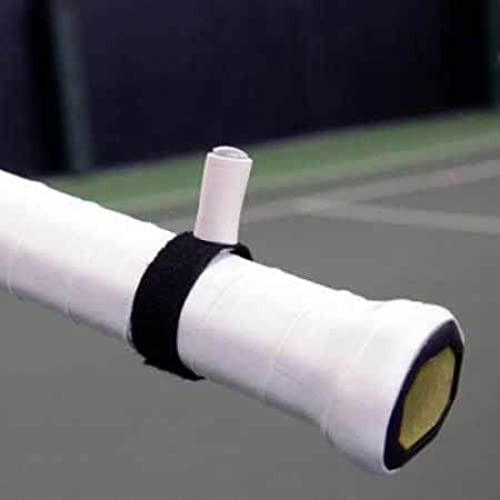
The continental grip is essential for serves, volleys, and overheads, but many beginners struggle to find it consistently. The Start Rite Grip Trainer attaches to the racket handle and guides your hand into the correct position by separating the index and middle fingers. It works without adding bulk to the handle, so the grip size feels natural.
Quantity
3-pack
Fit
Attaches to any racket handle
Sports
Tennis, pickleball, padel
Durability
High-quality rubber
Pros
Teaches continental grip positioning quickly
Does not increase effective grip size
Works across multiple racket sports
Cons
Only addresses grip placement, not stroke mechanics
May feel unusual at first for players with established habits
As a coach, teaching the continental grip is one of the most repetitive parts of working with beginners. The Start Rite eliminates most of that friction. Players can feel the correct hand position immediately, and the muscle memory builds quickly with regular practice. The 3-pack is useful because you can keep one on multiple rackets or share with practice partners.
Best for: Beginners who need to develop the continental grip for serves and net play.
Clean strokes mean nothing if your feet cannot get you into position. The next two training aids target the athletic foundation that supports every shot.
Forces proper knee bend and athletic stance through resistance band training
Best for: Players who stand too upright and lack explosive lower-body movement
“Bend your knees” might be the most repeated instruction in tennis coaching, and the most consistently ignored. The Flex Trainer solves this problem by using resistance bands that connect your waist to your ankles, making it physically easier to stay low than to stand upright. The bands provide constant feedback, and over time, the athletic stance becomes a natural habit.
Bands
6 included (3 resistance levels)
Fit
Adjustable Velcro straps
Use
On-court and off-court
Sports
Multi-sport compatible
Pros
Builds athletic low stance through physical feedback
Three resistance levels grow with the player
Doubles as an excellent leg workout
Cons
Takes several sessions to feel comfortable wearing
I use the Flex Trainer with students who chronically stand tall during rallies. The three resistance levels let you start with light tension and increase as your leg strength builds. Beyond improving your tennis stance, the Flex Trainer provides a genuine leg workout that builds the endurance needed for long matches. It works for any sport that requires a low, athletic position.
Best for: Players who struggle to maintain proper knee bend and want to build a more athletic court presence.
Pair Footwork Training with On-Court Drills
Use the agility ladder and Flex Trainer during your warm-up before hitting, not as a separate workout. When you move from footwork drills directly into rally practice, your body carries the movement patterns into your strokes. This transfers the training to match situations much faster than isolated fitness sessions.
A complete footwork and agility kit for building explosive court movement
Best for: Players who want faster feet and better court coverage
Footwork is the foundation of good tennis, and this all-in-one agility set provides everything you need to develop quicker, more explosive movement. The speed ladder builds coordination and fast feet, the cones set up directional drills, and the resistance bands and jump rope add conditioning elements that translate directly to court movement.
You do not need a court to use this equipment. A driveway, park, or backyard works perfectly. I recommend running ladder drills for 10 minutes before hitting sessions to activate the fast-twitch muscle fibers you need for split steps and recovery. The set is also useful for practicing alone when you do not have a hitting partner.
Best for: Players at any level who want to improve court speed, agility, and overall athletic conditioning.
Once your footwork and fitness are in good shape, these final two aids let you work on ball-striking precision without needing a partner or a court.
A sturdy rebounder that lets you practice rallying and hand-eye coordination solo
Best for: Players who want solo hitting practice without a court or partner
The Ahari tennis ball rebounder provides a way to practice hitting when you have no partner and no court. The ball is attached to a weighted base by an elastic string, so it returns after each hit. The heavy-duty metal base uses non-skid rubber grips to stay planted without needing water or sand fill, which sets it apart from cheaper alternatives that tip over constantly.
Base
Heavy-duty metal with non-skid rubber
Balls
3 replacement balls and strings included
Setup
No water or sand fill needed
Space
6 ft radius minimum
Pros
Heavy-duty base stays stable without water or sand fill
Elastic return trains compact swing preparation and reflexes
Three replacement balls extend the lifespan significantly
Cons
Limited to short-range hitting within 6 ft
Ball trajectory differs from live hitting on court
The rebounder is best used for building hand-eye coordination, timing, and quick reflexes rather than developing full strokes. The ball returns at an unpredictable angle, which trains reaction time and compact swing preparation. It works well as a warm-up tool or as a supplement to regular court practice, not as a replacement for hitting with real trajectory and pace.
Best for: Solo practitioners who want a convenient way to work on timing and coordination at home.
A reduced-size training racket that forces precise sweet-spot contact
Best for: Players who want to sharpen their accuracy and consistency
The Toalson Sweet Area Racket uses a simple but effective concept: a racket head that is only 60 square inches instead of the standard 95 to 110. When you practice with this smaller hitting area, your brain and muscles learn to find the center of the strings consistently. Switch back to your regular racket, and the sweet spot feels enormous.
Weight
280g (9.9 oz)
Head Size
60 sq in (vs. 100 sq in standard)
Length
27 in (standard)
Material
Graphite and glass fiber
Pros
60 sq in head forces dead-center contact every swing
Standard 27-in length preserves natural stroke mechanics
Graphite/glass fiber frame matches the feel of a real racket
Cons
Premium price for a training tool
Frustrating for beginners who miss the small head frequently
This is a training aid for intermediate and advanced players who want to sharpen their precision. Beginners will find the small head frustrating, but players who already make consistent contact will notice a real improvement in accuracy after a few sessions. I use it during warm-up rallies with advanced students to keep their focus on clean ball-striking.
Best for: Intermediate and advanced players who want to improve consistency and sweet-spot accuracy.
How to Get the Most from Training Aids
The 10-Minute Rule
Commit to 10 minutes of focused practice with one training aid per day rather than occasional 30-minute sessions. Muscle memory builds through frequency, not duration. A player who uses the TopspinPro for 10 minutes every day for a month will develop better topspin than someone who uses it for an hour once a week.
Build a Training Rotation
Rather than buying every training aid at once, start with the one that addresses your biggest weakness. If you hit flat groundstrokes, start with the TopspinPro. If your serve is inconsistent, start with the ServeMaster. Once that skill improves, add another tool to your rotation. A good coaching session can help identify which skill needs the most attention.
Combine Aids with Court Practice
Training aids work best when paired with real hitting. Use them during warm-up or as focused skill work before transitioning to live ball drills. The muscle memory you build off the court needs to be reinforced in match-like conditions to become reliable under pressure.
Final Thoughts
Training aids are not shortcuts, but they are accelerators. The TopspinPro, Eye Coach Pro, and ServeMaster address the three most common technical weaknesses I see in club players: flat groundstrokes, inconsistent sweet-spot contact, and unreliable serves. Pairing any one of these with daily 10-minute practice sessions can produce noticeable improvement within a few weeks.
For players who want to improve their overall athleticism on court, the Flex Trainer and agility set provide the footwork and conditioning foundation that supports every stroke. The key is choosing the training aid that matches your current biggest weakness, committing to consistent practice, and combining your off-court work with regular on-court play. No training aid replaces match experience, but the right one can make your court time significantly more productive.
As an Amazon Associate we earn from qualifying purchases.
Frequently Asked Questions
What is the best tennis training aid for beginners?
The Billie Jean King's Eye Coach Pro is the best starting point for beginners. It teaches sweet-spot contact and proper swing path through visual and kinesthetic feedback, and it works for all strokes. The TopspinPro is another strong choice if the beginner specifically struggles with generating topspin.
Can training aids really improve your tennis game?
The best training aids accelerate learning by providing immediate physical feedback that verbal coaching alone cannot deliver. They work because they engage your visual and kinesthetic learning systems, building muscle memory through repetition. Combining training aids with regular on-court practice and coaching produces the fastest improvement.
What training equipment do I need to practice tennis alone?
A tennis ball rebounder lets you practice rallying without a partner. Add a TopspinPro for topspin work and a ServeMaster for serve mechanics, and you can run a productive solo session covering all major strokes. An agility ladder and resistance bands round out the fitness side.
How often should I use tennis training aids?
Short, consistent sessions produce better results than occasional long ones. Aim for 10 to 15 minutes daily with each training aid rather than an hour once a week. The muscle memory patterns you build through daily repetition transfer more reliably to match play.