Best Junior Tennis Rackets for Ages 3 to 12+ (2026)
Choosing the right junior tennis racket is the single biggest equipment decision a tennis parent makes, and getting the size wrong can slow your child’s development or even cause injury.
As a coach, I have watched hundreds of kids show up to their first lesson swinging a racket that is too heavy, too long, or too short. The right racket lets a young player develop proper technique naturally, while the wrong one forces bad habits that take years to unlearn. Junior rackets are sized by length (19 to 27 inches) to match a child’s height and strength at each stage of development.
This guide covers the best junior tennis rackets for every age group, from first-time 3-year-olds to competitive 12-year-olds ready for their first adult frame. I have personally tested or coached with every racket on this list.
1Best 27-Inch$$$
WILSON Blade 98 V6
Classic control racket with modern spin and power for advanced juniors transitioning to adult frames
At this stage, juniors are transitioning to full-size adult rackets. The key is finding a frame that matches their physical development and playing style without overwhelming them with weight. I typically recommend starting with a lighter adult racket (under 11.5 oz) and moving up as they get stronger.
The gold standard for juniors stepping into adult rackets
Best for: Competitive juniors ages 12+ with developed strokes
The Wilson Blade 98 V6 comes pre-strung and features the braided graphite and basalt composition that gives it a flexible, responsive feel. At 11.3 ounces, it sits in the sweet spot for strong juniors who need real feedback from their racket. The 325+ swingweight delivers serious power once a player can generate enough racket speed.
Players who hit with a mix of topspin and flat shots will find the 16x19 string pattern forgiving without sacrificing control. The headlight balance makes it maneuverable despite its weight, which is exactly what developing players need.
The Blade 98 V6 is the same frame many college players use, so juniors who grow into it have a racket that will serve them for years. If your child finds it too heavy, consider the Blade 100L, which uses the same technology in a lighter package.
Best for: Tournament-level juniors with solid fundamentals who are ready for a serious adult racket.
Versatile power racket trusted by touring pros at every level
Best for: All-round juniors ages 12+ who want easy power
The Babolat Pure Drive is one of the most popular rackets on the professional tour, and for good reason. Its 100 sq in head provides a generous sweet spot, and the frame generates impressive power even on mishits. For juniors who are still building consistency, that extra forgiveness helps keep rallies going and confidence high.
At 10.6 ounces, it is noticeably lighter than the Blade 98, making it a better fit for juniors who have not yet built up their arm strength. The trade-off is slightly less precision on touch shots, but most juniors at this level benefit more from power and forgiveness.
Length
27 in
Head Size
100 sq in
Weight
10.6 oz
String Pattern
16x19
Pros
Forgiving 100 sq in head
Generates power on off-center hits
Lighter than the Blade 98
Cons
Less feel and control than the Blade 98
Can amplify bad habits for players who rely on the racket's power
The Pure Drive works particularly well for baseliners who like to hit with pace from the back of the court. It pairs well with a polyester string for added spin control.
Best for: Juniors transitioning to adult rackets who want power and forgiveness over raw control.
Transitioning to an Adult Racket
Do not rush the jump from a 26-inch to a 27-inch racket. I have seen many 11-year-olds struggle with full-size frames because their parents wanted them to “grow into it.” A junior who can dominate with a 26-inch racket will develop faster than one fighting a too-heavy adult frame. Wait until they can swing the adult racket comfortably for a full practice session.
Best Junior Rackets for Ages 11+ (26-Inch)
The 26-inch category is where junior rackets start to feel like real tennis rackets. These frames offer genuine spin potential, decent power, and enough control for competitive play. Most serious juniors spend one to two years in this size before moving to a full 27-inch frame.
The go-to spin racket for competitive juniors, modeled after Nadal's Pure Aero
Best for: Aggressive baseliners ages 11+
The Babolat Pure Aero Junior 26 is the junior version of Rafael Nadal’s racket, and it lives up to its pedigree. The Aeromodular2 beam shape cuts through the air efficiently, while the FSI Spin technology in the string bed generates impressive topspin. For juniors who like to rip forehands and play aggressive baseline tennis, this racket feels like a natural extension of their game.
At 8.8 ounces, it is light enough for most 11-year-olds to swing comfortably for a full match. The open 16x19 string pattern adds extra spin but sacrifices some control on flat shots, so this racket rewards players who have committed to a topspin-heavy game.
Length
26 in
Head Size
100 sq in
Weight
8.8 oz
String Pattern
16x19
Pros
Aeromodular2 beam maximizes spin
FSI Spin technology adds bite on topspin
Lightweight at 8.8 oz
Cons
100 sq in head can feel imprecise for flat hitters
Small grip may challenge two-handed backhand players
If your child idolizes Nadal or Alcaraz, the Pure Aero Junior will make them feel like they are wielding the same weapon. Pair it with a multifilament string for comfort, or a thin-gauge poly if they are already generating plenty of their own power.
Best for: Topspin-oriented juniors who play an aggressive baseline game.
Balanced all-court racket with easy power for developing juniors
Best for: All-round juniors ages 11+ who want versatility
The Babolat Pure Drive Junior 26 offers a more balanced playing experience than the spin-heavy Pure Aero. Where the Aero excels at topspin, the Pure Drive Junior handles flat shots, volleys, and serves with equal competence. It is the racket I recommend most often for juniors who have not yet settled on a specific playing style.
The 8.8 oz weight matches the Pure Aero, but the frame delivers a more neutral response, making it easier for developing players to experiment with different shot types and find their natural game.
Comfortable, modern racket with great vibration dampening for developing juniors
Best for: Intermediate juniors ages 9 to 11
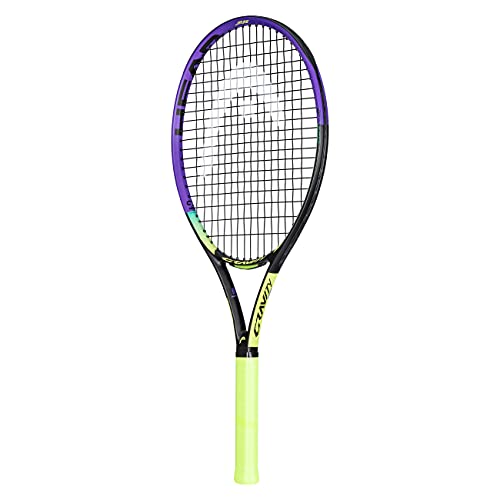
The HEAD IG Gravity 26 borrows its design language from the adult Gravity line favored by Alexander Zverev. The carbon composite frame provides more feel and feedback than aluminum alternatives, which helps juniors develop touch and shot awareness. It is lighter and more forgiving than the Babolat frames, making it a solid choice for players who are still building arm strength.
The Gravity 26 works best for juniors who want comfort and feel over raw power, especially those who like to play varied tennis with drop shots, angles, and net approaches.
Best for: Developing juniors who prioritize feel and comfort over maximum power.
Best Junior Rackets for Ages 8 to 10 (25-Inch)
This is where most kids start taking tennis seriously. The 25-inch size fits players 50 to 55 inches tall, and the rackets in this category offer a meaningful upgrade from the aluminum starter frames younger kids use. Look for lightweight composite or graphite frames with head-light balance.
The best all-around 25-inch racket with superior vibration dampening
Best for: Beginners and intermediate juniors ages 8 to 10
The HEAD IG Gravity 25 is my top pick in the 25-inch category because it gets the fundamentals right. The DampPlus technology genuinely reduces vibration on off-center hits, which matters for young arms that are still developing. At 8.1 ounces with a head-light balance, it swings easily without feeling flimsy.
The carbon composite frame gives this racket more feel than aluminum alternatives. Kids who start with the Gravity 25 develop better touch and ball awareness because the racket actually transmits useful feedback through the handle.
Length
25 in
Head Size
100 sq in
Weight
8.1 oz
Frame Material
Carbon Composite
Pros
DampPlus technology absorbs vibration
Lightweight carbon composite frame
Head light balance for easy swings
Cons
May feel too basic for tournament-level 10-year-olds
I have had great results pairing this racket with orange-dot or green-dot balls for 8 to 9-year-olds who are transitioning to full-court play. The lightweight frame lets them focus on technique rather than just getting the racket to the ball.
Best for: Junior players ages 8 to 10 who are moving beyond the very basics and need a racket that supports technical development.
Speed-focused junior racket with Innegra technology for shock absorption
Best for: Developing juniors ages 9 to 11 who want a fast-swinging frame
The HEAD IG Speed 26 Junior brings Innegra technology from the adult Speed line, which adds stability on impact without increasing weight. For juniors who swing fast and hit hard for their age, the extra frame stability helps maintain control on aggressive shots. The DampPlus system works alongside Innegra to keep vibrations in check.
This racket suits juniors who already show signs of being aggressive, hard-hitting players. The Speed cosmetics (matching Novak Djokovic’s adult line) are a nice bonus for motivation.
Lightweight graphite-aluminum hybrid with surprising power for young players
Best for: Juniors ages 9 to 10 who want a Babolat Aero feel
The Babolat Aero Junior 25 brings the Pure Aero’s spin-friendly design philosophy down to the 25-inch size. The graphite-aluminum hybrid frame keeps weight low while providing enough stiffness for decent power. Juniors who will eventually move to the Pure Aero 26 get a natural stepping stone with familiar feel and balance.
The open string pattern generates more spin than the HEAD alternatives, which benefits kids who are already developing topspin technique. It pairs naturally with the low-compression balls used in 10-and-under programs.
Length
25 in
Head Size
100 sq in
Weight
8.1 oz
Frame Material
Graphite/Aluminum
Pros
Babolat Aero DNA for spin potential
Graphite-aluminum mix balances weight and power
Familiar Aero cosmetics
Cons
Aluminum component reduces feel compared to full-graphite options
Best for: Spin-oriented juniors ages 9 to 10 who want to build toward the Babolat Aero lineup.
Choosing Between Graphite and Aluminum Beginner
For kids under 8, aluminum rackets are fine. They are cheap, durable, and light enough for small players. Once a child starts taking lessons or playing regularly (ages 8 to 10), invest in a composite or graphite frame. The improvement in feel and feedback is real, and it helps them develop proper technique faster. Budget $40 to $80 for a good composite junior racket.
Best Junior Rackets for Ages 6 to 8 (23-Inch)
At this age, fun comes first. A 23-inch racket needs to be light, durable, and forgiving. Aluminum frames dominate this category because they handle the inevitable drops, scrapes, and frustrated tosses that come with learning. Do not overspend here, as your child will outgrow this racket in 12 to 18 months.
Reliable, well-balanced starter racket with Djokovic-inspired cosmetics
Best for: Beginners ages 6 to 8
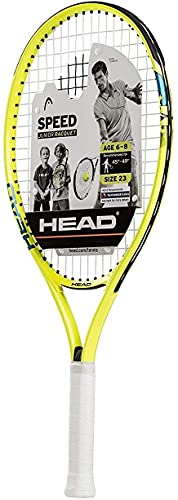
The HEAD Speed Kids 23 is the racket I reach for when a 6 or 7-year-old shows up to their first lesson. The aluminum o-beam frame is nearly indestructible, and the head-light balance makes it easy for small hands to control. At 7.2 ounces, it is light enough for even the smallest players in this age range. The 16x19 string pattern offers good spin potential for kids learning to swing up on the ball.
The Djokovic-inspired black cosmetics give this racket a premium look despite its budget-friendly price. Kids who feel like they are using a “real” racket tend to practice more enthusiastically.
Length
23 in
Head Size
93 sq in
Weight
7.2 oz
Frame Material
Aluminum
Pros
Durable aluminum o-beam construction
Head light balance for easy handling
Speed series cosmetics kids love
Cons
Aluminum offers limited feel compared to composite
Classic Federer-branded junior racket with solid construction
Best for: Young beginners ages 7 to 8 who love Roger Federer
The Wilson Roger Federer 23 uses AirLite Alloy construction for a lightweight frame that still handles the rough treatment young players dish out. The QuadriForm Technology stabilizes the racket during the swing, which helps beginners make more consistent contact. The bumper guard protects the frame when kids inevitably scrape it along the court surface.
For families with a Federer fan in the house, this racket delivers a fun connection to their hero. The classic Wilson design with sleek accents makes it an attractive option at a very reasonable price.
Solid aluminum starter with a comfortable head-light balance
Best for: Beginners ages 6 to 8 trying tennis for the first time
The HEAD Instinct Kids 23 is another solid entry from HEAD’s junior lineup. It shares the aluminum o-beam construction and head-light balance of the Speed series but comes in the Instinct cosmetic scheme. The racket handles well for beginners and holds up to the daily use that comes with a child who catches the tennis bug.
This is a practical choice when the Speed series is out of stock or when your child prefers the Instinct look. Performance-wise, you will not notice a significant difference at this level.
Length
23 in
Head Size
95 sq in
Weight
7.4 oz
Frame Material
Aluminum
Pros
Head light balance reduces vibration
Aluminum construction is very durable
Available in 21, 23, and 25 inch sizes
Cons
Less widely available than the Speed series
Plain cosmetics compared to Speed or Wilson options
Best for: Beginners ages 6 to 8 who want a HEAD racket in the Instinct colorway.
Best Junior Rackets for Ages 3 to 5 (19 to 21-Inch)
For the youngest players, the priority is keeping the racket as light and short as possible. At this age, tennis is really about hand-eye coordination and having fun. Any racket that a 3 to 5-year-old can hold and swing without struggling is the right racket. Red foam balls and mini-nets make the biggest difference at this stage, not the racket.
Best 21-inch racket for tiny players just starting their tennis journey
Best for: First-time players ages 4 to 5
The HEAD Speed 21 is the smallest racket in HEAD’s Speed lineup, and it is perfectly sized for 4 to 5-year-olds between 40 and 45 inches tall. The aluminum o-beam frame is tough enough to survive being dropped, dragged, and occasionally used as a sword. At 6.7 ounces, it is one of the lightest options available, which matters when a child’s arm gets tired after 15 minutes of play.
The head-light balance helps small hands control the racket, and the 93 sq in head provides a reasonable sweet spot for beginners learning to make contact with the ball.
Budget-friendly 19-inch starter kit with cover, overgrip, and dampener included
Best for: Toddlers ages 2 to 5 trying tennis for the first time
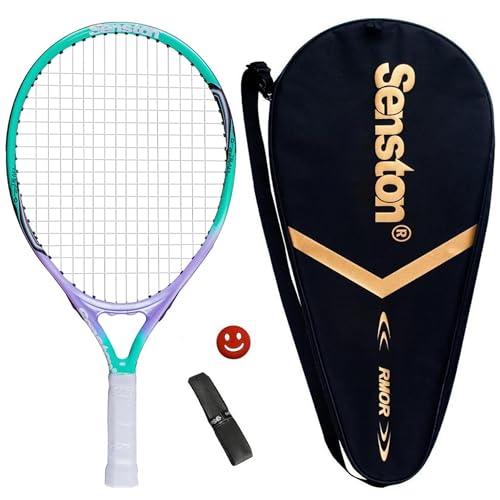
The Senston 19-inch Junior comes as a complete starter kit with a racquet cover, overgrip, and vibration dampener. The aluminum one-piece construction makes it surprisingly sturdy for a budget racket. At 19 inches, this is the smallest standard racket size and fits children under 40 inches tall, typically ages 2 to 4.
For parents testing whether their toddler has any interest in tennis, this kit offers excellent value. If the child takes to it, you can upgrade to a HEAD or Wilson in the 21-inch size within a few months.
Fun, colorful starter racket with included coaching videos
Best for: Children ages 3 to 5 who need an engaging introduction to tennis
The Street Tennis Club racket takes a different approach by bundling coaching resources with the racket itself. The included video lessons, curated by accredited tennis coaches, walk parents through basic drills and technique. This makes it a great option for families without easy access to junior tennis programs.
The aluminum frame with thick polyester strings is built for durability. The grippy neoprene handle stays secure in small, sweaty hands, though it feels different from the traditional overgrip texture that older juniors use.
Length
19 in
Frame Material
Aluminum
Includes
Coaching videos
Strings
Thick polyester
Pros
Included coaching videos from accredited pros
Durable aluminum frame
Fun graphics appeal to young kids
Cons
Neoprene grip may feel different than traditional overgrip
Best for: Families who want coaching guidance bundled with their child’s first racket.
Racket Sizing Chart for Juniors
Age
Height
Racket Length
4 years or younger
40 inches or shorter
19 inches
4 to 5 years
40 to 45 inches
21 inches
6 to 8 years
45 to 50 inches
23 inches
9 to 10 years
50 to 55 inches
25 inches
11 to 12 years
55 to 60 inches
26 inches
12 or older
60 inches or taller
27 inches
Height Over Age Beginner
Always size by height, not age. A tall 8-year-old may need a 25-inch racket, while a smaller 10-year-old might still do best with a 23-inch. Have your child stand with the racket tip touching the ground. If they can comfortably wrap their fingers around the handle without bending their wrist, the length is right. When in doubt, go shorter. A slightly short racket is far better than one that is too long.
How to Choose the Right Junior Tennis Racket
Frame Material
Junior Racket Materials
Aluminum
Cheapest option ($15-$40)
Very durable, handles drops
Less feel and feedback
Best for ages 3-8 / beginners
Composite
Mid-range ($40-$80)
Good balance of feel and durability
Carbon fiber blended with other materials
Best for ages 8-11 / intermediate
Graphite
Premium ($80-$150+)
Best feel and power transfer
Lighter for the same strength
Best for ages 11+ / competitive
Weight and Balance
Junior rackets range from about 6.5 ounces (19-inch models) to 11+ ounces (27-inch adult frames). The general rule: if your child’s arm gets tired before the end of a lesson, the racket is too heavy. Head-light balance is preferred for juniors because it makes the racket easier to maneuver and reduces strain on developing arms.
Head Size
Larger head sizes (95 to 100 sq in) provide a bigger sweet spot, which means more forgiving contact. For juniors under 12, a larger head almost always makes more sense. Only advanced competitive juniors benefit from the precision of smaller head sizes (under 98 sq in).
String Pattern
Most junior rackets come with a 16x19 open string pattern, which generates more spin and power. This is ideal for developing players. Do not worry about string choice until your child is playing competitively with a 25-inch or larger racket. At that point, see our string guide for recommendations.
Final Thoughts
The right junior racket matches your child’s current size and skill level, not the level you hope they will reach next year. I have coached kids who made huge leaps in improvement simply by switching to a properly sized racket with appropriate weight.
For most families, the HEAD Gravity 25 (ages 8 to 10), Babolat Pure Aero 26 (ages 11+), or Wilson Blade 98 (ages 12+) cover the key transition points beautifully. Start with these and adjust based on your child’s playing style and physical development.
If your child is just beginning, grab an affordable aluminum racket in the right size, sign up for group lessons, and let them fall in love with the game. The equipment upgrades will follow naturally as their skills and commitment grow. Check out our 10-and-under tennis guide for more on getting young players started the right way.
As an Amazon Associate we earn from qualifying purchases.
Frequently Asked Questions
What size tennis racket does my child need?
Racket size depends on your child's height more than age. Children under 40 inches tall need a 19-inch racket. Kids 40 to 45 inches tall use 21-inch, 45 to 50 inches use 23-inch, 50 to 55 inches use 25-inch, and 55 to 60 inches use 26-inch. Once they reach 60 inches or taller, they can move to a full 27-inch adult frame.
When should a junior switch to an adult racket?
Most juniors transition to a 27-inch adult racket around age 12 or 13, once they are at least 60 inches tall and can comfortably swing a heavier frame. If they can maintain good technique and generate consistent power with a 26-inch racket, they are likely ready for the move up.
Should I buy a pre-strung junior racket or string it separately?
Pre-strung rackets are perfectly fine for beginners and intermediate juniors. The factory strings handle the lower power levels of younger players well. Once a junior starts competing seriously (usually around ages 11 to 12), consider getting a racket strung with a string and tension suited to their playing style.
How much should I spend on a junior tennis racket?
For beginners under age 8, a $20 to $40 aluminum racket works well since they will outgrow it quickly. Intermediate juniors ages 8 to 11 benefit from $40 to $80 composite frames. Competitive players ages 12 and up should invest $80 to $150 in a quality graphite racket that supports their development.