
Glossary: All Tennis Terms & Definitions Explained
A tennis glossary is an alphabetical list of tennis terminology with definitions, covering everything from scoring and shot types to court positions and tournament formats.
Tennis has its own language. When you’re starting out, hearing “deuce,” “love,” or “ad court” for the first time can feel like learning a foreign language. Even experienced club players occasionally encounter terms they can’t quite define. I put this glossary together as a comprehensive reference you can bookmark and come back to whenever you need clarity on a specific term.
If you’re completely new to the sport, you might want to start with our guides on tennis rules and how scoring works before diving into the full glossary.
Ace
A serve that lands in the service box and is a clean winner, with the receiving player unable to make any contact with the ball. Players with big serves, like John Isner and Ivo Karlovic, have built entire careers around aces.
Action
A synonym for spin. Action refers to the rotation of the ball as it moves through the air, affecting its trajectory and bounce. You’ll often hear coaches say “put more action on the ball,” meaning add more spin.
Ad Court
The left side of the court from the perspective of the player receiving serve. It’s called the ad court because advantage points are played from this side. The ad court is where many of the most pressure-filled points in tennis are decided.
All
A term used when both players have the same score within a game, from 15-15 (15-all) to 30-30 (30-all). When the score reaches 40-40, it’s called deuce instead.
All-Court Player
A player who combines elements of every tennis style, whether offensive baseliner, defensive counter-puncher, or serve-and-volleyer. Roger Federer is the classic example. All-court players adapt their approach based on the opponent and situation, making them unpredictable and difficult to strategize against.
Approach Shot
A hard, deep shot into the opponent’s court that allows the player to move forward toward the net. The goal is to put the opponent on the defensive so you can finish the point with a volley or overhead. A well-placed approach shot is essential for any serve-and-volley strategy.
At Net
Describes a player’s position close to the net. “She’s at net” means the player has moved forward from the baseline, typically looking to hit volleys.
ATP
The Association of Tennis Professionals, the governing body for men’s professional tennis. The ATP manages the men’s tour calendar, rankings, and tournament regulations. Learn more about tennis organizations.
Australian Formation
A doubles tactic where the net player positions directly across from the opposing net player instead of diagonally, while the server stands closer to the center mark. This formation disrupts the returner’s usual crosscourt target and forces them to adjust mid-rally.
Backhand
A stroke hit from the non-dominant side of the body, with the back of the hand facing the direction of the shot. Players hit backhands with either one or two hands on the racquet. Novak Djokovic’s two-handed backhand is widely considered the best in tennis history. Read our full backhand guide.
Backspin
Reverse rotation on the ball, created by a slice or chop stroke. Backspin generates an upward force (Magnus effect) that keeps the ball airborne longer and produces a low, skidding bounce. It’s a key ingredient in drop shots and defensive slices.
Bagel
Slang for winning or losing a set 6-0. The zero resembles the shape of a bagel. Getting “bageled” at any level stings, and it happens even on the pro tour.
Ball Abuse
Intentionally hitting a ball out of the court enclosure, hitting a ball dangerously or recklessly within the court, or hitting a ball with negligent disregard for the consequences. Ball abuse violations can result in code violations, point penalties, or even default from a match.
Ball Toss
The action of throwing the ball into the air at the start of the serve motion. A consistent ball toss is one of the most important and underrated parts of a reliable serve.
Baseline
The line running parallel to the net at the back of the court, farthest from the net. This is where players hit groundstrokes and serves from. Understanding baseline play is fundamental to the modern game.
Baseline Judge
An official stationed on the baseline who determines whether shots land in or out. With the adoption of electronic line-calling systems like Hawk-Eye Live, baseline judges have become increasingly rare on the professional tour.
Baseliner
A player whose primary strategy is to compete from the baseline, hitting groundstrokes and wearing down opponents from the back of the court. Rafael Nadal is the ultimate example. Most modern professionals are predominantly baseliners.
Big Serve
A serve with so much pace or spin that it overwhelms the returner, regardless of placement. Players like Serena Williams and Nick Kyrgios are known for serves that regularly exceed 200 km/h (125 mph).
Bounce
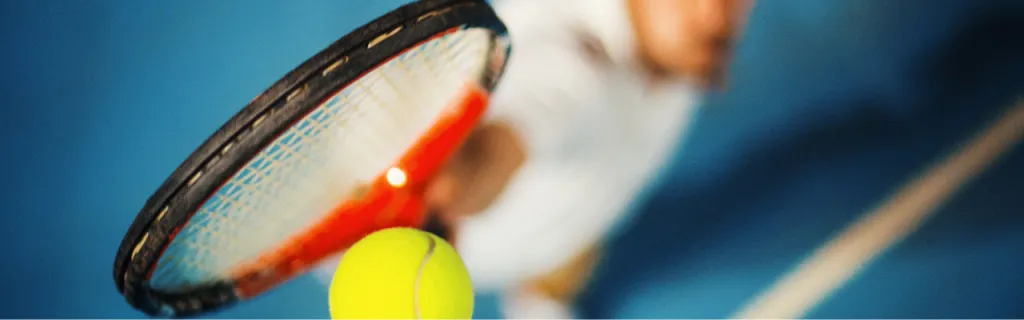
The ball’s upward movement after hitting the ground. The height and direction of the bounce are affected by the court surface, weather, spin, and shot power. Clay courts produce a higher bounce than grass courts, which is why court surfaces play such a significant role in tennis strategy.
Breadstick
Slang for a 6-1 set score. The “1” in the scoreline resembles the shape of a breadstick. Less humiliating than a bagel, but not by much.
Break (or Break of Serve)
Winning a game as the receiving player or team. Since the server holds a natural advantage, breaking serve is a pivotal moment in any match and often determines the outcome of a set.
Breaker
A colloquial shorthand for tiebreak.
Break Point
A situation where the receiving player needs just one more point to break serve. Break points are among the most high-pressure moments in tennis, and converting them consistently separates good players from great ones.
Buggy Whip
A forehand where the racquet finishes up and over the head rather than across the body. Rafael Nadal popularized this technique, and it’s particularly effective for generating heavy topspin on balls hit from open stances or on the run.
Bye
The automatic advancement of a seeded player or team from one round to the next without playing an opponent. In Grand Slams, the top seeds receive first-round byes in qualifying, and in smaller tournaments, top seeds often receive main-draw byes.
Calendar Slam
Winning all four Grand Slams (Australian Open, French Open, Wimbledon, US Open) in the same calendar year. Rod Laver achieved this twice (1962, 1969), and Steffi Graf completed the Calendar Golden Slam in 1988 by also winning Olympic gold.
Call
A decision by a player or court official as to whether a ball landed in or out. With electronic line-calling now standard at most professional events, disputed calls have become less common.
Career Golden Slam
Winning all four Grand Slam titles plus an Olympic gold medal over the course of a career (not necessarily in the same year). Andre Agassi, Rafael Nadal, Serena Williams, and Novak Djokovic have all achieved this.
Carpet
An indoor court surface that is no longer used on the ATP Tour or at Grand Slams. Carpet courts played fast with low bounces. They were phased out in 2009 to reduce the number of surfaces players needed to adapt to.
Carry
An illegal shot where the ball is held or carried on the racquet strings rather than cleanly struck. Carries are rare but can happen on very soft touch shots near the net.
Carve
Hitting a groundstroke with a combination of underspin and sidespin. The carve adds sideways movement to a sliced shot, making the bounce less predictable for the opponent.
Center Court
The venue’s premier court, typically with the largest seating capacity and reserved for the most high-profile matches. At Wimbledon, Centre Court is one of the most famous sports arenas in the world.
Centerline Judge
An official responsible for watching the center service line to determine whether serves land in the correct service box.
Center Mark
A short mark that divides the baseline in half, running perpendicular to the net. The center mark defines the boundary players cannot cross when serving. You must stand to one side of it when hitting your serve.
Chair
The raised seat where the chair umpire officiates the match. Also used as shorthand for the umpire themselves, as in “the chair ruled the shot was good.”
Challenge
A player’s request for an electronic review of a line call using Hawk-Eye or similar ball-tracking technology. Players typically receive a limited number of incorrect challenges per set.
Changeover
The 90-second rest period when players switch ends of the court after every odd-numbered game. Changeovers are when you’ll see players hydrate, towel off, and receive brief coaching (where permitted).
Chip
A short, controlled shot using underspin to block the ball back into play. Often used to neutralize a powerful serve and keep the return low.
Chip and Charge
A tactic where the returner hits a low slice return and immediately rushes the net looking for a volley. This aggressive approach was common in the serve-and-volley era and is still effective as an occasional surprise tactic.
Chop
A downward stroke that generates heavy backspin. The chopping motion cuts sharply under the ball, producing a low, skidding trajectory.
Clay Court
A court surface made of crushed brick, stone, shale, or other mineral aggregate. Clay courts are slower and produce a higher bounce than hard or grass courts. The French Open is the most prestigious clay court event.
Clean Winner
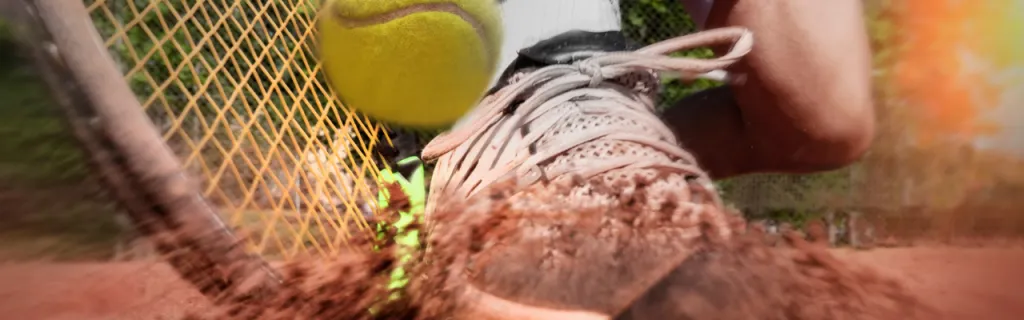
A shot that the opponent cannot reach at all. Unlike a forced error, a clean winner is entirely about the quality of the shot rather than the opponent’s positioning.
Closed Racket
Holding the racquet so the hitting surface angles downward. A closed racket face helps direct the ball lower over the net and is useful for hitting with topspin.
Closed Stance
A hitting position where the player’s body is parallel to the baseline, with their back partially turned toward the opponent. This was the traditional stance for groundstrokes before the open stance became dominant in the modern game.
Counterpuncher
A defensive baseliner who retrieves nearly every ball and relies on the opponent’s errors rather than hitting winners. Counterpunchers thrive on consistency and court coverage. Learn more about playing styles in our strategy guide.
Court (or Tennis Court)
The rectangular playing area where a tennis match takes place. The standard court measures 78 feet long by 27 feet wide for singles and 36 feet wide for doubles. See our court dimensions guide for detailed measurements.
Crosscourt Shot
A shot hit diagonally across the court from one side to the other. Crosscourt shots travel over the lowest part of the net and have more court to land in, making them the highest-percentage shot in tennis.
Cut
Hitting the ball with a short, downward slicing motion that imparts backspin and sometimes sidespin. Similar to a carve but typically with a more compact swing.
Cyclops
A now-retired computer system that used infrared beams to determine whether serves were in or out. Cyclops was a fixture at Wimbledon for decades before being replaced by Hawk-Eye technology.
Dampener
A small rubber accessory attached to the strings of a racquet to reduce vibration on contact. Dampeners don’t change power or spin, but many players prefer the muted feel and sound they produce.
Daisy Cutter
A shot that skids along the court or takes an extremely low bounce. Daisy cutters are particularly effective on grass courts, where the surface naturally keeps the ball low.
Davis Cup
The premier international men’s team tennis competition, running annually since 1900. National teams compete in a knockout format, making it one of the oldest and most prestigious events in tennis.
Deep Shot
A shot that lands near the opponent’s baseline, pushing them back and limiting their offensive options. Consistently hitting deep is one of the most effective strategies at every level of the game.
Default
Disqualification from a match or tournament for code violations. Novak Djokovic’s default at the 2020 US Open for accidentally hitting a line judge with a ball remains one of the most high-profile examples.
Deuce
The score when a game is tied at 40-40. From deuce, a player must win two consecutive points to take the game: the first for advantage, the second to close it out.
Deuce Court
The right side of the court. Players serve from this side on the first point of each game and on all deuce points. It’s the side where right-handed players can hit their forehand on the return.
Dink
A very soft return with minimal pace, intended to drop just over the net on the opponent’s side. Dinks can be effective as surprise shots or to disrupt the rhythm of a hard-hitting opponent.
Dirtballer
Slang for a clay court specialist, a player who excels on the slow, high-bouncing clay surface. Rafael Nadal, with his 14 French Open titles, is the greatest dirtballer in tennis history.
Double Bagel
A match where the winner wins 6-0, 6-0 (or 6-0, 6-0, 6-0 in best-of-five). A complete shutout. It’s a rare and dominant result at any level.
Double Fault
Occurs when both the first and second serve fail to land in the correct service box. A double fault costs the server the point and is one of the most frustrating errors in tennis.
Double Hit
Striking the ball twice in a single stroke. Under the rules, a double hit on a single continuous swing is actually legal. It only results in a lost point if the player deliberately hits the ball twice.
Doubles
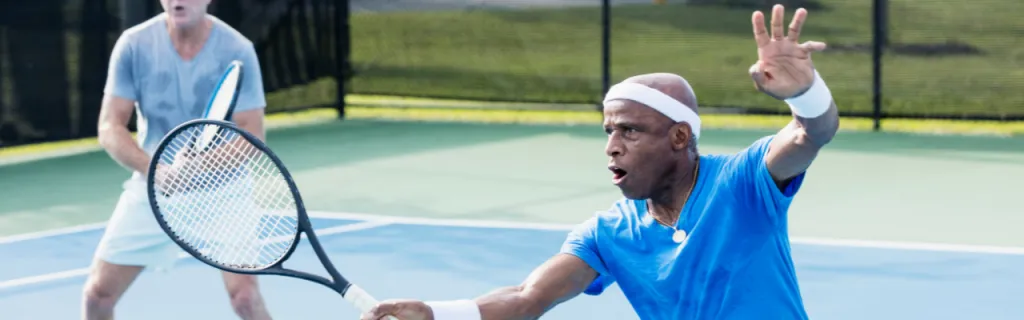
A match format with four players, two per side. Doubles tennis uses the wider court (including the alleys) and requires strong communication, net skills, and coordinated positioning.
Doubles Court
The full playing area for a doubles match, measuring 78 feet long by 36 feet wide. This includes the two 4.5-foot alleys on either side that are out of bounds during singles play.
Down the Line
A shot hit straight along the sideline rather than crosscourt. Down-the-line shots carry more risk because the net is higher at the sideline and there’s less court to work with, but they can be devastating winners when executed well.
Drag Volley
A volley hit with backspin, “dragging” the racquet face under the ball at contact. This technique keeps the volley low and makes it harder for the opponent to hit an aggressive passing shot.
Draw
The bracket or schedule of a tournament, showing which players face each other in each round. Seedings and a random selection process determine the draw.
Drop Shot
A softly hit shot designed to land just over the net and bounce as little as possible, pulling the opponent forward from the baseline. Read our drop shot guide for technique tips.
Drop Volley
A drop shot executed on a volley, hit so delicately that it barely clears the net and dies on the opponent’s side. One of the most difficult shots in tennis to execute consistently.
Error
A missed shot or lost point that results entirely from the player’s own mistake, not from the opponent’s skill. Also called an “unforced error.” Reducing unforced errors is one of the fastest ways to improve your match results.
Exhibition
A match or tournament played for entertainment or charity rather than official ranking points or prize money. Exhibitions often feature retired legends or creative formats that wouldn’t appear in official competition.
Fault
A serve that fails to land in the correct service box. The server gets two attempts per point, so a single fault simply means taking a second serve.
Fed Cup (Billie Jean King Cup)
The premier international women’s team tennis competition, launched in 1963 as the Federation Cup. It was renamed the Billie Jean King Cup in 2020. With over 100 nations competing, it is the largest annual international team event in women’s sport.
Fifteen (or Five)
The first point scored by either player in a game. Tennis uses the unique progression of 15, 30, 40 rather than 1, 2, 3. Learn more about the quirks of tennis scoring.
First Flight
The trajectory of the ball between leaving the racquet and its first bounce. The first flight is where spin has the greatest visible effect on ball movement.
Flat
A shot hit with little to no spin. Flat shots travel faster but offer less margin for error because there’s no topspin to pull the ball down into the court. Most players use flat hitting selectively, typically on serves and putaway shots.
Follow Through
The continuation of the swing after the racquet makes contact with the ball. A full follow through is critical for both power and accuracy. I always tell my students: where your racquet finishes tells me everything about the shot you just hit.
Foot Fault
A violation that occurs when the server’s foot touches or crosses the baseline before making contact with the ball on the serve. Foot faults are treated exactly like regular faults.
Foot Fault Judge
An official positioned at the baseline specifically to watch for foot faults during the serve.
Forced Error
A missed shot caused by the opponent’s strong play rather than the player’s own mistake. If your opponent hits a blazing forehand that pushes you wide and you miss the next shot, that’s a forced error, not an unforced one.
Forehand
The most natural stroke in tennis, hit with the front of the dominant hand facing the direction of the shot. The forehand is typically a player’s most powerful groundstroke. See our forehand guide for technique breakdown.
Forcing Shot
An aggressive shot that puts the opponent on the defensive, often used as an approach shot to set up a net attack.
Forecourt
The section of the court between the service line and the net. Players move into the forecourt to hit volleys and overheads.
Frame
The structural part of the racquet to which the strings are attached. “Framing” a shot means accidentally hitting the ball on the frame rather than the strings, resulting in an unpredictable trajectory.
Gallery
The spectator seating area at the sides and ends of a court.
Game
The building block of a set in tennis. A game is won by the first player to score four points with at least a two-point lead (using the 15, 30, 40, game progression). Each set consists of at least six games. Learn the full breakdown in our scoring guide.
Game Point
The point that, if won by the leading player, completes the current game. When the server is at game point, they’re serving for the game.
Game, Set, Match
The phrase announced by the chair umpire when the final point of a match is played, signaling that a winner has been determined and the match is over.
Golden Set
Winning a set without losing a single point, meaning 24 consecutive points to win 6-0. This is extraordinarily rare at the professional level and has only been achieved a handful of times in recorded history.
Golden Slam
Winning all four Grand Slams plus the Olympic gold medal in the same calendar year. Steffi Graf is the only player in history to achieve this, doing so in 1988.
Grand Slam
The four most prestigious tennis tournaments in the world: the Australian Open, French Open, Wimbledon, and US Open. They offer the most ranking points, prize money, and prestige on tour.
Grass Court
The traditional lawn tennis surface, famous as the signature court surface of Wimbledon. Grass produces a fast, low-bouncing game that rewards aggressive players with big serves and sharp volleys. The grass court season is the shortest on the professional calendar.
Grinding
Using relentless consistency and patience to outlast an opponent, refusing to give up on any point. Grinding is as much a mental skill as a physical one, and it’s the hallmark of great competitors like Nadal and Djokovic.
Grommet Strip
The plastic inserts surrounding the head of a racquet, stretched over the string holes. Grommets protect the strings from abrasion against the frame’s edges and should be replaced when they crack or wear through.
Groundstroke (or Groundie)
A forehand or backhand stroke hit after the ball bounces on the court. Groundstrokes are the fundamental shots of tennis, played primarily from the baseline during rallies.
Grunting
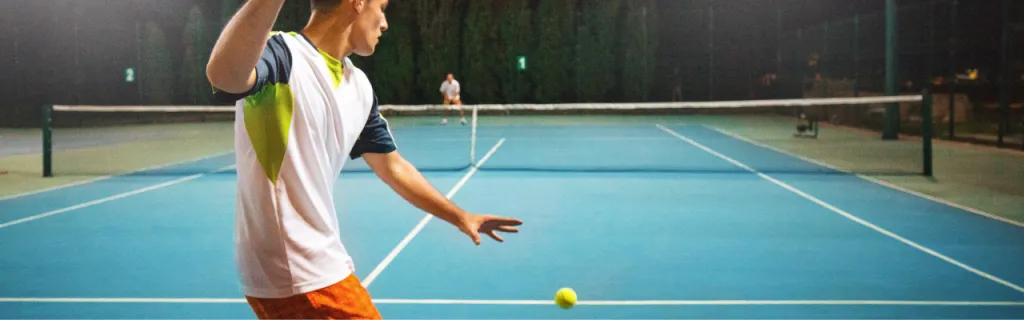
The loud vocalization some players make when hitting their shots. While controversial, research suggests grunting helps players coordinate their breathing, increase shot intensity, and maintain rhythm. Players like Maria Sharapova and Rafael Nadal are well known for it.
Half Court
The area around the service line, midway between the baseline and the net. Also called mid-court. Being caught in no-man’s land at half court is one of the most vulnerable positions in tennis because you’re too far from the net for clean volleys and too close for comfortable groundstrokes.
Hawk-Eye
A ball-tracking computer system using multiple cameras to reconstruct the ball’s trajectory and determine exactly where it landed. Hawk-Eye Live now makes automatic line calls at many professional events, replacing human line judges entirely.
Heavy Ball
A shot combining significant topspin with substantial pace. A heavy ball jumps off the court surface aggressively, pushing the opponent backward. Nadal’s forehand is the textbook example.
Hit on the Rise
Striking the ball before it reaches the peak of its bounce. Hitting on the rise takes time away from the opponent but requires exceptional timing. Andre Agassi was a master of this technique.
Hold (or Hold Serve)
Winning the game when you’re serving. Because the server has an inherent advantage, holding serve is the expected outcome. The real drama comes when someone breaks.
Hopper
A tennis ball hopper or basket is a practical piece of equipment for storing, picking up, and carrying tennis balls to the court. Essential for practice sessions and coaching.
I-Formation
A doubles positioning strategy where both the server and net player line up near the center of the court. The net player then moves left or right after the serve to confuse the returner about where the volley will come from.
In
A call indicating that the ball has landed within the boundaries of the playing area. In professional tennis, Hawk-Eye makes this determination automatically.
Inside-Out
When a player runs around their backhand side to hit a forehand crosscourt to the opponent’s backhand. This is one of the most common tactical patterns in modern tennis, used by players who have a significantly stronger forehand.
ITF
The International Tennis Federation, the world governing body of tennis. The ITF oversees the rules of the game, the Davis Cup, Billie Jean King Cup, and Olympic tennis. Learn more about tennis organizations.
Jam
Hitting the ball directly at the opponent’s body, denying them room to extend the racquet and make a clean swing. Jamming an opponent is an underused tactic that’s particularly effective against players with big swings.
Jump Smash
A smash hit while jumping into the air, used when the lob pushes the player slightly behind the ideal contact point. The jump allows the player to maintain an aggressive overhead angle. See our overhead guide.
Junk Ball
A shot hit without significant spin or pace, used to disrupt an opponent’s timing and rhythm. Junk balls are annoying to play against because they force the opponent to generate all their own power.
Kick Serve (or Kicker)
A serve hit by brushing up and over the back of the ball, creating topspin that makes the ball bounce high and kick toward the opponent’s shoulder. The kick serve offers excellent net clearance, consistent depth, and a challenging bounce, making it the most popular second serve on the professional tour.
Kill
An all-out power shot aimed at ending the point immediately. When you have a short ball and an open court, you go for the kill.
Lawn Tennis
The traditional form of tennis played on grass courts. The term “lawn tennis” distinguishes the outdoor game from real tennis (also called court tennis or royal tennis), which is played indoors on a very different court.
Let
A call to replay a point due to interference. The most common let occurs on serve when the ball clips the top of the net cord but still lands in the service box. The serve is simply retaken with no penalty.
Line Judge
An official positioned along a court line whose responsibility is to call whether shots land in or out. With electronic line-calling becoming standard, human line judges are disappearing from the professional game.
Lob
A high, arcing shot intended to sail over an opponent who is at the net. A well-placed lob is one of the most satisfying shots in tennis, and a poorly timed one is one of the easiest to punish.
Lob Volley
A volley played with a high, lobbing trajectory, used to send the ball over an opponent positioned close to the net. It requires exceptional touch and is one of the rarer shots in competitive play.
Long
An alternative call to “out” used specifically when a ball lands beyond the baseline.
Love
A score of zero in tennis. The term has been used since the late 1800s. The most popular theory is that those with zero points were still playing for the “love of the game.” A score of “30-love” means 30-0. Learn more about tennis scoring terminology in our scoring guide.
Love Game
A game won without the opponent scoring a single point (e.g., the server wins at 40-0).
Mac-Cam
A slow-motion camera replay system named after John McEnroe, who was famous for fiercely contesting umpire calls. The system allowed broadcasters and officials to review close line calls before electronic tracking became standard.
Masters Cup (ATP Finals)
The season-ending championship featuring the top 8 players in the ATP rankings. Now officially called the ATP Finals, it rotates between host cities and serves as the climax of the men’s professional season.
Match
The full contest between two players (singles) or two teams (doubles). Matches are typically best-of-three sets on the ATP/WTA Tour and best-of-five sets at men’s Grand Slams.
Match Point
A point that, if won by the leading player, ends the match. Match point is the highest-pressure moment in tennis. Saving match points and coming back to win is one of the most dramatic scenarios in the sport.
Mini-Break
In a tiebreak, winning a point on the opponent’s serve. Because tiebreaks are so tight, a mini-break often determines the outcome.
Mis-Hit
A shot where the ball contacts the racquet outside the sweet spot, usually hitting the frame or the edge of the strings. Mis-hits produce unpredictable results, sometimes accidentally becoming winners.
Mixed Doubles
A doubles format with one male and one female player on each team. Mixed doubles is played at all four Grand Slams and the Olympics.
Net
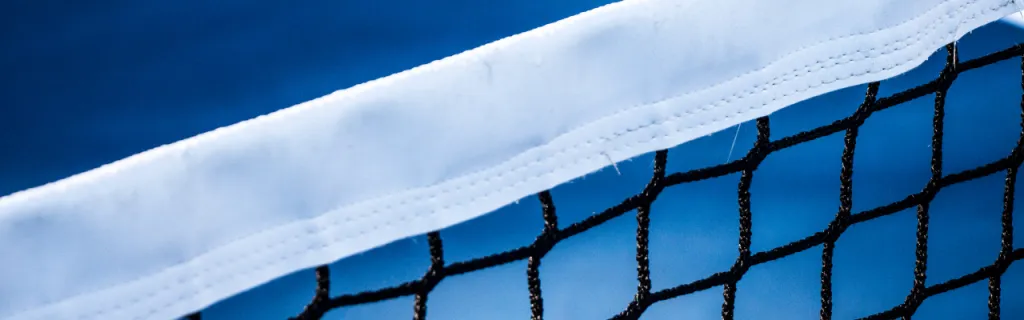
The barrier stretched across the center of the court, measuring 36 inches (91.4 cm) at the center strap and 42 inches (106.7 cm) at the net posts. The net defines the fundamental challenge of tennis: get the ball over the net and inside the lines.
Net Cord
The cord running along and supporting the top of the net. When a shot clips the net cord and drops over, it’s called a “net cord” and is considered part of normal play (except on serve, where it triggers a let).
Net Judge
An official responsible for detecting when a serve clips the net cord. Also called a net cord judge. Electronic net sensors have largely replaced this role.
Net Point
A point won or lost by a player who moved to the net, as opposed to staying on the baseline. “She won 85% of her net points” means she was highly effective when she came forward.
Net Posts
The vertical supports that hold the net in place, positioned 3 feet outside the singles sidelines for singles play. In doubles, the net posts are at the outer edge of the doubles sidelines.
No-Ad
A scoring format that eliminates the requirement to win by two points from deuce. When a game reaches 40-40, a single deciding point determines the winner. The receiver chooses which side to receive from. No-ad scoring is commonly used in doubles, college tennis, and some professional events to speed up match play.
Not Up
A call made when a player fails to hit the ball before it bounces twice. The point is awarded to the opponent.
Offensive Lob
A lob hit with topspin and purpose, intended to win the point outright by sailing over the net player and landing in. Unlike a defensive lob (hit high to buy time), an offensive lob is a calculated attacking shot.
Offensive Volley
A volley hit aggressively, usually from above the net height, intended to end the point. Good offensive volleys are hit with pace and angle to make them unreachable.
On Serve
Describes a set situation where neither player has broken the other’s serve. “They’re on serve at 4-3” means each player has held all their service games so far.
Open Era
The period of professional tennis beginning in 1968, when major tournaments first allowed both amateur and professional players to compete. All modern records and statistics are typically measured from the start of the Open Era. Learn more in our tennis history guide.
Open Racket
Holding the racquet so the hitting surface tilts upward (toward the ceiling). An open racket face adds backspin or underspin and is used for slice shots, drop shots, and volleys.
Open Stance
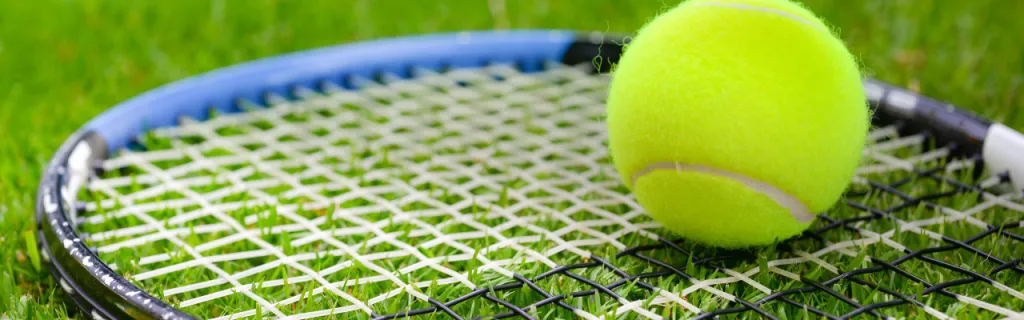
A hitting stance where the player’s feet are roughly parallel to the net, with the body facing forward rather than turned sideways. The open stance is the dominant footwork pattern in modern tennis because it allows faster recovery and more efficient hip rotation for topspin groundstrokes.
Open Tournament
A tournament where entry is available to any player who meets the qualification criteria, regardless of amateur or professional status. All four Grand Slams are “open” events.
Overhead
A shot hit above the head with a serve-like motion, typically in response to a lob. Also called a smash. The overhead is one of the most powerful shots in tennis when executed correctly. See our overhead guide.
Overrule
When the chair umpire reverses a call made by a line judge. Overrules are based on the umpire’s judgment that the original call was clearly incorrect.
Pace
The speed of the ball after it leaves the racquet. “She hit that with real pace” means the shot was struck hard and fast. Pace is a weapon, but only when combined with consistency and placement.
Pair
A doubles team of two players.
Partner
One of the two players on a doubles team.
Pass (or Passing Shot)
A groundstroke hit past an opponent who has moved to the net. Passing shots are the primary defensive weapon against net rushers and require precision and composure under pressure.
Percentage Tennis
A conservative strategy focused on keeping the ball in play and minimizing errors rather than going for winners. The idea is to make the opponent beat you rather than beating yourself. It’s not flashy, but it wins a lot of matches.
Pickup Shot
See half volley. A shot where the ball is hit immediately after it bounces, almost scooping it off the ground.
Poach
In doubles, when the net player moves across to intercept a shot intended for their partner. Poaching is an aggressive tactic that puts pressure on the opposing team and can swing momentum quickly.
Point
The smallest scoring unit in tennis. A point begins with the serve and ends when the ball goes out of play. Points accumulate into games, games into sets, and sets into the match.
Puddler
A player who relies heavily on chip shots, drop shots, and other soft, finesse-oriented shots rather than power.
Punch Volley
A volley hit with a short, compact, punching motion. The racquet never goes back past the shoulders. The punch volley is the standard technique for most net play situations.
Pusher
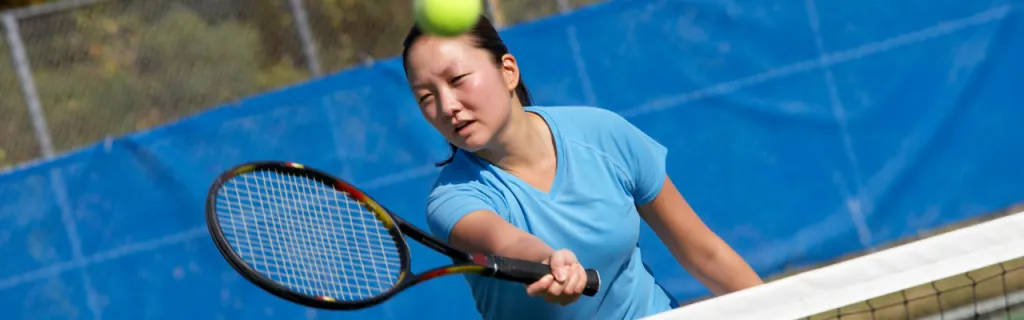
A player who returns everything with minimal pace but exceptional consistency and depth. Pushers frustrate opponents by refusing to miss, forcing them to hit one more ball than they want to. As annoying as pushers can be, learning to beat them teaches you patience and shot selection.
Putaway
An offensive shot hit to end the point when the player is in a dominant position. When you get a short ball and your opponent is out of position, the putaway finishes the job.
Qualies
Informal shorthand for the qualification rounds of a tournament.
Qualification Round
The pre-tournament competition that lower-ranked players must win to earn a spot in the main draw. Qualifying typically consists of two or three rounds, and “qualifiers” who make it through often become compelling underdog stories.
Qualifier (or “Q”)
A player who earned their place in the main draw by winning through the qualification rounds. Qualifiers are marked with a “Q” next to their name in tournament draws.
Qualifying Draw
The bracket for the qualification tournament, separate from the main draw.
Racket (or Racquet)
The primary piece of tennis equipment: a frame with an oval head and a network of interlaced strings used to strike the ball. Choosing the right racquet is one of the most important decisions for any player. Browse our racquet guides.
Rally
A sequence of shots where both players hit the ball back and forth over the net. The longest professional rallies can exceed 50 shots, though most points are decided in fewer than 10.
Ready Position
The athletic stance players adopt between shots: knees bent, weight forward, racquet held in front of the body. Every groundstroke, volley, overhead, and return begins from the ready position.
Receiver
The player to whom the server is serving. The receiver stands diagonally opposite the server, behind the baseline.
Referee
The head official of a tournament, responsible for enforcing all rules and regulations, managing the draw, scheduling matches, and ensuring the event runs fairly. The referee has authority over all chair umpires and line judges.
Reflex Volley
A volley hit instinctively, with no time to plan the shot. Reflex volleys happen when the ball comes too fast for the player to react deliberately, relying entirely on hand-eye coordination.
Retriever
A player who excels at getting every ball back, running down shots that seem unreachable. Similar to a counterpuncher, a retriever wins by making opponents hit one more shot than they’re comfortable with.
Return Ace
A return of serve that the server cannot reach or make contact with. Return aces typically come from aggressive returners facing weak second serves.
Reverse Twist
A serve with spin that causes the ball to bounce high and away from the receiver on the forehand side (when hit by a right-hander). It’s the opposite of a traditional kick serve.
Round
A stage in an elimination tournament. In a 128-player Grand Slam draw, there are seven rounds: first round through to the final.
Round Robin
A tournament format where every player or team plays against every other entry in their group. The ATP Finals uses a round robin group stage before the knockout semifinals.
Run Around (the Backhand)
Moving aggressively to the backhand side of the court in order to hit a forehand instead. Players with dominant forehands, like Nadal, routinely run around their backhands to take control of rallies with their strongest shot.
Sandbagger
A player who deliberately competes at a skill level below their actual ability in order to win easier matches. Sandbagging undermines fair competition and is frowned upon at every level of the sport.
Scoring System
Tennis uses a three-tier scoring structure: points build into games, games build into sets, and sets determine the match. The point progression within a game (15, 30, 40, game) is unique to tennis. See our full scoring guide for a complete explanation.
Second Flight
The trajectory of the ball after it bounces. The second flight is where surface-specific characteristics (clay’s high bounce, grass’s low skid) become most apparent.
Second Serve
The server’s second and final attempt at a successful serve after a fault on the first serve. Second serves are typically hit with more spin and less pace to ensure they go in, since a second fault loses the point.

Seed
A ranking-based designation assigned to the top players in a tournament draw, designed to keep them apart in the early rounds. The number of seeds varies by tournament size: Grand Slams seed 32 players.
Serve
The overhead shot that starts every point, hit from behind the baseline into the diagonally opposite service box. The serve is the only shot where you have complete control over the ball. Master it with our serve guide.
Server
The player whose turn it is to serve. Players alternate serving games throughout the match.
Serve and Volley
A strategy where the server follows the serve immediately to the net, looking to win the point with a volley. This was the dominant style through the 1990s but has become rare in the modern baseline era, used mainly as a surprise tactic.
Serve Plus One
A strategic pattern where the server plans the serve and the next shot as a coordinated sequence. For example, serving wide to open the court, then hitting the next ball into the open space.
Service Court
The two rectangular areas on each side of the net, bounded by the net, center service line, service line, and singles sideline. The serve must land in the diagonally opposite service court.
Service Line
The line running parallel to the net at 21 feet (6.4 m) from it, marking the back boundary of the service courts. See the full layout in our court dimensions guide.
Service Line Judge
An official responsible for determining whether serves land beyond the service line (too deep).
Set
A major scoring unit in tennis. A player wins a set by winning six games with at least a two-game lead (6-4, 6-3, etc.). If the score reaches 6-5, the leading player must win the next game to take the set 7-5, or the set goes to a tiebreak at 6-6.
Set Point
The point that, if won by the leading player, secures the set. “She’s serving for the set” means she’s one game away from winning it.
Shank
An unintentional mis-hit where the ball strikes the racquet frame rather than the strings, sending it in an unpredictable direction, often well beyond the court boundaries. Every player shanks occasionally, even the pros.
Shot
Any instance of a player making contact with the ball during play.
Sideline
The lines marking the side boundaries of the court. The singles sidelines are the inner lines, and the doubles sidelines are the outer lines.
Sideline Judge
A line judge positioned along one of the sidelines to call shots in or out.
Singles
The standard match format with one player on each side of the court. Singles matches use the narrower 27-foot court width (excluding the alleys).
Singles Court
The playing area for singles matches: 78 feet long by 27 feet wide.
Slice
A shot hit with underspin (and often some sidespin) that skims low over the net. The slice is used defensively to stay in rallies, as an approach shot, and as a variation to change the pace and rhythm of a point. The slice backhand is one of the most versatile shots in tennis.
Snap Volley
A volley hit with added velocity from a wrist snap at the point of contact. Used when a player wants to add extra pace to a volley, often to hit a winner.
Stop Volley
A very soft volley that barely clears the net and drops on the opponent’s side with minimal bounce. Essentially a drop volley, requiring excellent touch and timing.
Straight Sets
Winning a match without losing a single set (e.g., 6-3, 6-4 in a best-of-three match, or 6-4, 6-2, 6-1 in a best-of-five).
Strings
The interlaced material in the racquet head that makes contact with the ball. String type, tension, and gauge all significantly affect power, spin, and control. See our strings guide for a detailed breakdown.
Stroke
The motion used to hit the tennis ball. The four main stroke categories are the forehand, backhand, serve, and volley.
Sudden Death
A format variation in tiebreaks where a single decisive point determines the set winner if the tiebreak reaches a specific score. Not standard in most professional tennis but used in some special formats.
Sweet Spot
The area on the racquet face, typically between the center and the tip of the head, that produces the cleanest contact with the most power and least vibration. Finding the sweet spot consistently is a sign of solid technique.
Tanking
Slang for deliberately losing points, games, or an entire match. A player might tank a set strategically to conserve energy for the next one, or tank a match entirely, which is a violation of professional rules and can result in fines.
Tape
The canvas or fabric band covering the top of the net. When the ball hits “the tape” and falls over, it’s a legitimate shot during rallies (but triggers a let on serves).
Team Tennis
A competition format where groups of players compete as teams rather than individuals. World TeamTennis (WTT) in the United States is the best-known professional team tennis league.
Tennis Ball
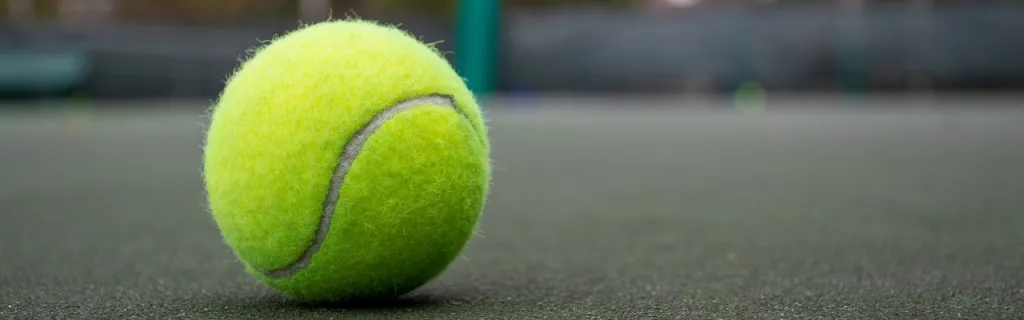
A pressurized rubber core covered with a felt cloth (wool mixed with up to 35% nylon), weighing approximately 2 ounces (56-59 grams). Yellow and white are the only approved colors. See our tennis balls guide for buying recommendations.
Tennis Elbow
A painful condition (lateral epicondylitis) caused by overloading the tendons in the elbow through repetitive wrist and arm motions. Common in tennis players who use poor technique or equipment that transmits too much vibration. An elbow brace can help manage symptoms.
Topspin
Forward rotation on the ball created by brushing up the back of the ball with the racquet. Topspin causes the ball to dip down faster, allowing players to hit harder while keeping the ball in the court. It also produces a higher bounce, pushing opponents behind the baseline. Topspin is the dominant spin type in modern tennis.
Tiebreaker
A special game played when the set score reaches 6-6. In a standard tiebreak, the first player to reach 7 points with a two-point lead wins the set. The serve alternates: the first player serves one point, then each player serves two points in succession. Tiebreaks were introduced to prevent sets from going on indefinitely.
Top Seed
The highest-ranked player in a tournament draw, based on current world rankings. The top seed receives the most favorable draw position and avoids facing other high seeds until the later rounds.
Touch
A player’s ability to hit soft, finessed, precisely controlled shots. “She has great touch at the net” means she can place delicate volleys and drop shots with accuracy.
Twist
A serve combining elements of both slice and topspin. The resulting spin makes the ball curve in the air and kick sideways after bouncing, making it difficult to return cleanly.
Two-Handed Backhand
A backhand where both hands grip the racquet. The two-handed backhand offers more stability, power, and topspin potential than a one-hander, which is why it’s the preferred technique for the majority of modern players.
Umpire
The chair umpire is the on-court official responsible for enforcing the rules during a match. They announce the score, make overrule calls, issue code violations, and serve as the final authority on the court.
Underspin
Backward rotation on the ball, where the bottom of the ball spins forward. Underspin (also called backspin) is produced by slice shots and causes the ball to float longer in the air and bounce lower.
Unseeded Player
A player whose ranking does not qualify them for a seeded position in the draw. Unseeded players can face any opponent in any round, including top seeds in the first round.
Upset
When a lower-ranked player defeats a higher-ranked opponent. Grand Slam upsets, especially in the early rounds, are among the most memorable moments in tennis.
Volley
A shot where the ball is struck before it bounces, typically while the player is positioned near the net. Volleys require quick reflexes, soft hands, and precise footwork. See our volley technique guide.
Wild Card (or “WC”)
A special entry into a tournament granted to a player who hasn’t qualified through rankings or qualifying rounds. Wild cards are typically given to promising young local players, returning stars recovering from injury, or former champions.
Winner
A shot that the opponent cannot reach and that ends the point. Winners are the result of excellent shot placement, power, or both.
Wrong-Foot
Hitting the ball in the opposite direction from where the opponent is moving, catching them off-balance and unable to change direction in time. Wrong-footing an opponent is a smart tactical play that rewards those who watch their opponent’s movement.
WTA
The Women’s Tennis Association, the governing body of women’s professional tennis. The WTA manages the women’s tour calendar, rankings, and prize money distribution.
X-Factor
An informal term for the rotational movement of the upper body during groundstrokes and serves, where the shoulders and hips separate to create torque. This coiling and uncoiling motion generates racquet head speed without relying on arm strength alone. You’ll often hear coaches tell players to “load the X-factor” during the backswing.
X-String Pattern
A less common stringing configuration where the crosses and mains create a denser, more closely spaced pattern near the center of the racquet face. An X-string pattern (such as 18x20) offers more control and a flatter ball response, while an open pattern (like 16x19) generates more spin. Most advanced baseliners experiment with both to find their preferred balance.
Yips
A sudden, unexplained inability to execute a stroke that the player normally hits with ease. The yips are psychological rather than physical, and they most commonly affect the serve. Guillermo Coria’s struggles with his serve in the 2004 French Open final remain one of the most well-known examples in professional tennis.
Yellow Ball
The standard tennis ball used in competitive play. The International Tennis Federation (ITF) approved the switch from white to optic yellow in 1972 because yellow was easier for television viewers to track. Despite the official color being yellow, the “is a tennis ball yellow or green?” debate continues to divide players to this day.
Yield the Net
To retreat from a net position back toward the baseline, usually because the opponent has hit a strong passing shot or lob that forces the net player to give up their advantageous court position. Yielding the net is sometimes the smart play, but coaches generally encourage players to hold their ground and volley whenever possible.
Zone, The
A mental state of peak focus and performance where a player feels almost automatic on court, reacting instinctively and executing shots with unusual precision. Athletes in other sports call it “flow state.” You can’t force yourself into the zone, but consistent preparation, solid routines, and confidence in your game make it more likely to happen. Learn more about the mental side of tennis.
Frequently Asked Questions
What does 'love' mean in tennis?
What is the difference between a fault and a double fault?
What does 'break of serve' mean in tennis?
What is a tiebreak in tennis?
What is the difference between a volley and a groundstroke?
What does 'deuce' mean in tennis?
More in Tennis Basics
Tennis Court Dimensions: Facts, Figures & Measurements
Complete guide to tennis court dimensions, including lines, areas, net height, and children's court sizes. All measurements per ITF rules.
The 4 Main Types Of Tennis Court Surfaces Explained
Learn how clay, grass, hard, and carpet courts affect ball speed, bounce, and playing style, plus tips for adapting your game to each surface.
Doubles Tennis Rules, Tips & Strategies
Master doubles tennis with our complete guide to serving rotation, court positioning, formations, net strategy, and winning tactics for every level.
The Ultimate Tennis Grips Guide To Improve Your Game
Learn every tennis grip from Continental to Western. Find out which grip suits your game, how to find your grip size, and what the pros use.

A Brief History Of Tennis, From The Beginnings To The Present
Explore the full history of tennis from medieval monks to the Open Era. Key milestones, legendary players, and how the sport became a global phenomenon.
Tennis Ratings Explained
Understand NTRP, UTR, and WTN tennis ratings. Learn how each system works, how they compare, and how to find your level for leagues and tournaments.