
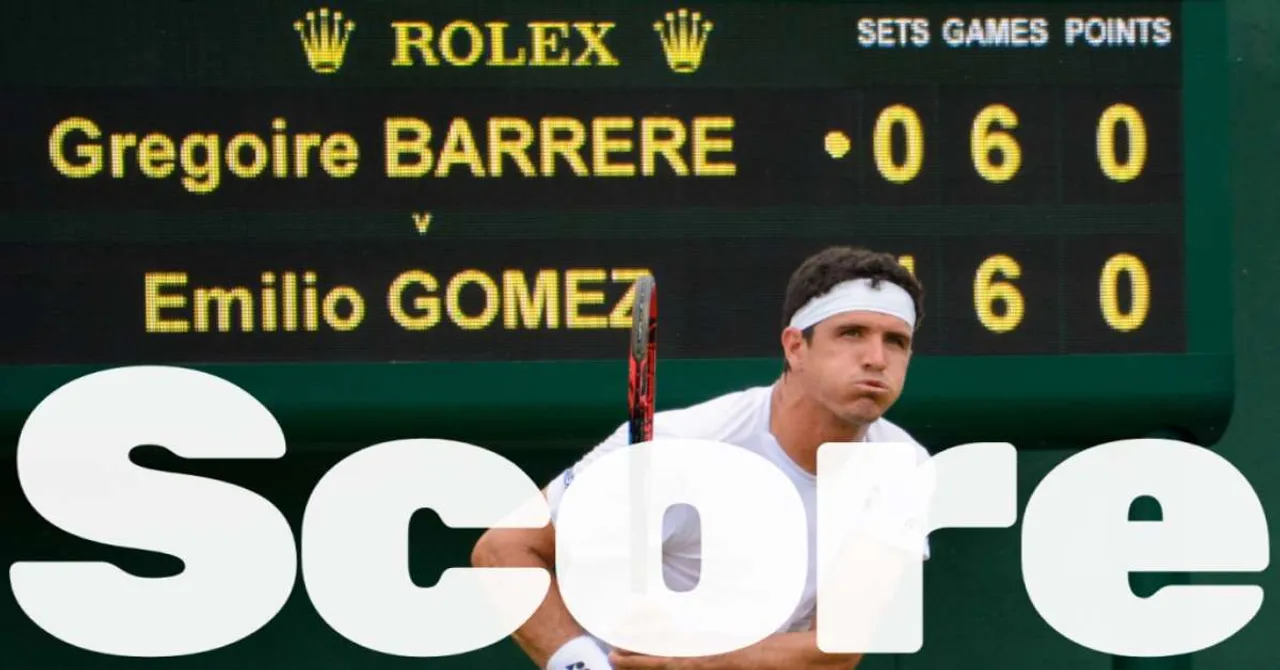
Tennis Scoring - Explained: Points, Games, Set & Match
Tennis scoring is one of the most unique counting systems in all of sports, using a sequence of love, 15, 30, and 40 instead of simple 1, 2, 3, and 4.
Because some points carry significantly more weight than others throughout a match, the tennis scoring system creates a unique kind of competitive pressure. A single point at deuce can be worth far more than a point at 40-0. As a coach, I find this is what makes tennis so mentally demanding and, frankly, so compelling to play.
Today, we’ll break down how tennis scoring works so that even complete beginners can follow along after reading this article. If you’re already familiar with some concepts, feel free to skip ahead using the navigation menu below.
How Does Tennis Scoring Work?
The tennis scoring system is built on three levels: points, games, and sets. Win enough points and you win a game. Win enough games and you win a set. Win enough sets and you win the match.
Scoring at a Glance
It sounds straightforward, but ties add complexity. When both players reach 40 in a game, the score becomes “deuce” and you need two consecutive points to win. When both players reach 6 games in a set, a tiebreak decides the winner. We’ll cover both in detail below.
Before Play Starts
Before the match begins, the players perform a coin toss. The winner can choose one of the following:
- To serve or receive first
- Which side of the court to start on (in which case the loser chooses to serve or receive)
- To defer the entire choice to their opponent
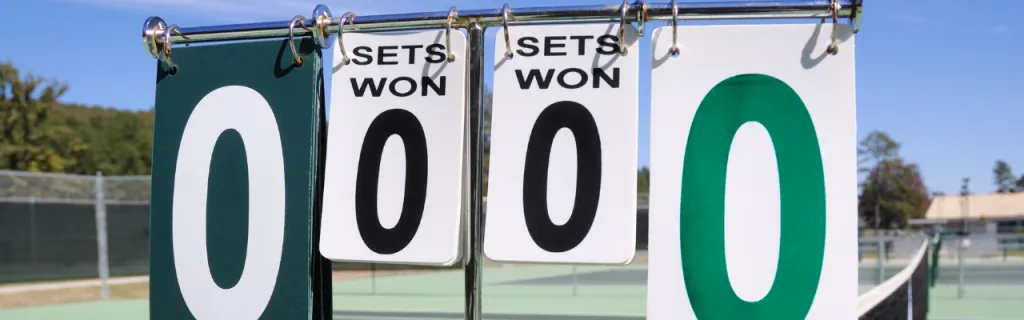
After the toss, players have a brief warm-up before the umpire signals the start of play. The match begins at 0 sets, 0 games, and 0-0 (love-all) in the first game.
The Tennis Scoring System Explained
How to Score a Game
A player needs to win at least four points to win a game. The points progress as follows: love (0), 15, 30, 40, game.
If both players reach 40, the score is called “deuce” rather than 40-40. From deuce, a player must win two consecutive points to take the game. The first point after deuce gives that player “advantage.” If the same player wins the next point, they win the game. If the other player wins it, the score returns to deuce.
I’ve seen professional matches where a single game lasted over 20 points because the players kept trading points at deuce. It’s one of the most thrilling situations in tennis.
Sample Game
The walkthrough below shows how scoring plays out in a game between Carlos Alcaraz and Jannik Sinner. It’s the first game of the match, and Alcaraz is serving.
Notice how the score went back to deuce twice before Alcaraz finally won two consecutive points to take the game.
How Are Points Won?
There are several ways to win a point in tennis:
- Winner: A shot so well-placed or powerful that the opponent cannot return it
- Double bounce: The ball bounces twice on the opponent’s side before they can hit it
- Double fault: The server misses both their first and second serve attempts
- Unforced error: The opponent hits the ball into the net or out of bounds without being pressured
- Forced error: The opponent misses a return after being put under pressure by a strong shot
- Code violation point penalty: The umpire awards a point to the opponent as a disciplinary measure
How to Score a Set
A set is won by the first player to reach six games with at least a two-game lead. So scores like 6-0, 6-1, 6-2, 6-3, and 6-4 are all straightforward set victories.
If the score reaches 5-5, a player must win 7-5 to take the set. If the score reaches 6-6, a tiebreak is played to decide the set (more on tiebreaks below).
The score in sets is called out by the server before each new game. For instance, if you won the first set, you’d announce “one-zero” before serving the first game of the second set.
How to Score a Match
A match is won as a best-of-three or best-of-five sets contest. In best-of-three, the first player to win two sets takes the match. If each player wins one set, a deciding third set is played.
Best-of-five sets (first to three) is used exclusively in men’s singles at Grand Slam tournaments and Davis Cup ties. Women’s singles, all doubles (outside of Davis Cup), and most regular tour events use best-of-three.
Changing Sides
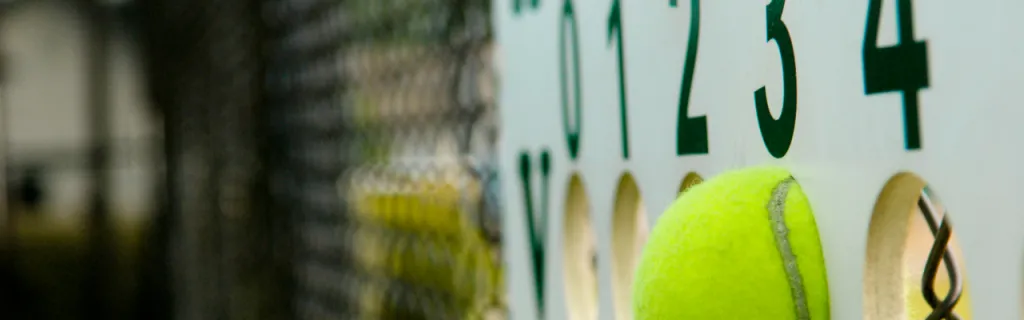
Players switch ends of the court after every odd game in a set: after the first game, the third, the fifth, and so on. This ensures that conditions like sun and wind are shared equally.
The player who served first in the set will receive in the second game, and service alternates every game throughout the set.
During a tiebreak, players switch ends after every six points. For example, you’d switch when the score reaches 3-3, then again at 6-6, and so on. Since a tiebreak functions as the 13th game of the set, players will also switch ends to begin the next set.
Match Scoring
Tennis matches are made up of points, games, and sets. The set format is either best-of-three (first to two sets) or best-of-five (first to three sets).
Best-of-five is exclusively used in men’s singles at Grand Slam tournaments (the Australian Open, French Open, Wimbledon, and US Open) and in Davis Cup ties. Every other professional match, including all women’s singles and doubles, uses best-of-three.
Tennis Scoring Terminology
Understanding these key tennis terms will help you follow any match:
Key Scoring Terms
- Point
- Smallest unit of scoring: love (0) → 15 → 30 → 40 → game
- Serve
- The shot that starts each point, hit diagonally into the service box
- Winner
- A shot so well-placed the opponent cannot reach or return it
- Error
- A missed shot caused by the player's own mistake (unforced error)
- Double Fault
- Server misses both first and second serve, losing the point
- Double Bounce
- Ball bounces twice before being returned, losing the point
- Game
- Won by scoring 4 points with a 2-point lead; deuce at 40-40
- No-Ad
- Format where the next point at deuce wins the game outright
- Set
- First to 6 games with a 2-game lead; tiebreak played at 6-6
- Tiebreak
- Played at 6-6, first to 7 points by 2 (scored 0, 1, 2, 3...)
- Super Tiebreak
- 10-point tiebreak used in the final set at all Grand Slams
- Deuce
- Score tied at 40-40; must win 2 consecutive points to take the game
Point Penalty/Code Violation: The chair umpire follows a graduated penalty system for rule violations. The first offense earns a warning, the second costs a point, and the third costs a game. After that, the umpire or tournament director may issue a default. Common violations include racket abuse, verbal abuse, audible obscenity, and coaching violations.

Tennis Scoring History
The tennis scoring system has its roots in medieval France, where the sport was called “jeu de paume” (game of the palm). In the 15th and 16th centuries, clock faces were reportedly used to track scores on court. Each player started at 12 o’clock, and the first point moved the hand to 15 (quarter past). The second moved it to 30 (half past), and the third to 45 (quarter to). The match was won when the hand returned to 12 (60 points, or “midnight”).
Over time, 45 was shortened to 40 to accommodate deuce situations. When the score tied at 40, a player winning the advantage point would move to 50, and then need to reach 60 to win. This created the two-point requirement after deuce that we still use today.
Whether this clock-face origin story is entirely accurate remains debatable among tennis historians. What we know for certain is that this scoring system has been in place since the Victorian era and shows no signs of changing. It’s one of the things that gives tennis its distinctive character.
FAQs
Why Do Some Tennis Players Say 5 Instead of 15?
5 is simply shorthand for 15. Recreational players often abbreviate to save time when calling the score, but you will never hear this on the professional tour where official scoring language (15, 30, 40, game) is always used.
Why Do They Say Love in Tennis Scoring?
The word “love” has been used to describe a score of zero since the late 1800s. The most widely accepted theory is that it derives from the informal phrase “for love,” meaning “without stakes being wagered.” Another theory suggests it comes from the French word “l’oeuf” (the egg), because a zero resembles an egg.
Why Do They Call 40-40 Deuce in Tennis?
The term deuce comes from the French “deux du jeu,” meaning two points away from winning the game. Players can be tied at 15-all or 30-all without any special designation, but at 40-all the score becomes deuce because both players need exactly two more points to win.
What Is the New Scoring System at Grand Slam Tournaments?
All four Grand Slams (Australian Open, French Open, Wimbledon, US Open) now use a uniform final-set tiebreak format. A 10-point tiebreak is played when the final set reaches 6-6 (the fifth set for men, the third for women). The winner must reach 10 points with at least a 2-point margin.
This replaced the older formats where each Grand Slam had different final-set rules. Wimbledon previously played advantage sets (no tiebreak, play until a two-game lead), while the US Open used a standard 7-point tiebreak. The unified 10-point format was adopted to balance competitive integrity with reasonable match lengths.

Ready to learn more about the sport? Check out our complete guide to tennis rules or brush up on tennis terminology.
Frequently Asked Questions
Why do some tennis players say 5 instead of 15?
Why do they say love in tennis scoring?
Why do they call 40-40 deuce in tennis?
What is the new scoring system at Grand Slam tournaments?
More in Tennis Basics

Tennis Court Dimensions: Facts, Figures & Measurements
Complete guide to tennis court dimensions, including lines, areas, net height, and children's court sizes. All measurements per ITF rules.

The 4 Main Types Of Tennis Court Surfaces Explained
Learn how clay, grass, hard, and carpet courts affect ball speed, bounce, and playing style, plus tips for adapting your game to each surface.
Doubles Tennis Rules, Tips & Strategies
Master doubles tennis with our complete guide to serving rotation, court positioning, formations, net strategy, and winning tactics for every level.

The Ultimate Tennis Grips Guide To Improve Your Game
Learn every tennis grip from Continental to Western. Find out which grip suits your game, how to find your grip size, and what the pros use.

A Brief History Of Tennis, From The Beginnings To The Present
Explore the full history of tennis from medieval monks to the Open Era. Key milestones, legendary players, and how the sport became a global phenomenon.

Tennis Ratings Explained
Understand NTRP, UTR, and WTN tennis ratings. Learn how each system works, how they compare, and how to find your level for leagues and tournaments.