
Tennis Rules Explained - An Essential Guide
Tennis rules govern everything from court dimensions and equipment specifications to scoring, serving, and match conduct.
Whether you’re picking up a racket for the first time or trying to follow along during a Grand Slam broadcast, understanding the rules makes the game click. I’ve coached beginners who felt overwhelmed at first, but once you see the logic behind each rule, it all starts to make sense.
We’ll cover everything you need to know: equipment regulations, court layout, scoring, serving, and match violations. If you’re already familiar with the basics, feel free to skip ahead to the section that interests you most.
Equipment
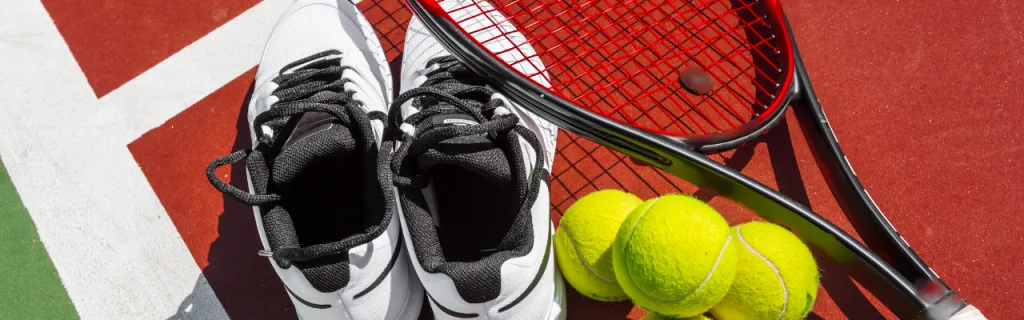
You won’t run into equipment violations often, but it helps to know the basics so you can play with confidence and legal gear.
Racket:
The ITF limits racket size to 29 inches in length (including the handle) and 12.5 inches in width. The hitting surface, made of crisscrossing strings on a flat plane, cannot exceed 15.5 inches long or 11.5 inches wide. These limits exist to prevent oversized frames from giving players an unfair advantage.
Ball:
A regulation tennis ball must measure between 2.5 and 2.63 inches in diameter and weigh between 56 and 59.4 grams. The ITF also tests bounce height: a ball dropped from 100 inches onto concrete must bounce between 53 and 58 inches.
Shoe:
Players can wear any color of tennis shoes as long as the soles don’t damage the court surface. The one notable exception is Wimbledon, where players must wear predominantly white tennis shoes.
Court
Dimensions & Layout
For a deeper look at measurements, check out our court dimensions guide. Here are the key numbers:
- 78 ft in length
- Singles Width: 27 ft
- Doubles Width: 36 ft
- Net at the Sides: 3.5 ft
- Net at the Middle: 3 ft
Court Lines and Their Purpose
Baseline: The lines at each end of the court that mark the lengthwise boundary. You serve from behind the baseline, and any ball landing beyond it is out.
Center Mark: A short mark splitting the baseline in half. It tells you where to position yourself before serving, either to the right (deuce side) or left (ad side).
Center Line: The line that divides each service area into two boxes, creating the deuce and ad service boxes. A serve landing on this line is considered good.
Net: The net stands 3 feet 6 inches at the posts and 3 feet at the center. Hitting the ball into the net counts as an out. If the ball clips the net cord and lands on the other side, it’s a valid shot, except on a serve, which gets a let and a redo.
Service Line: The horizontal line that marks the back boundary of the service boxes, separating the forecourt from the backcourt.
Singles Sideline: The inner lengthwise line that defines the playing boundary for singles and the width of the service boxes.
Doubles Sideline: The outermost lengthwise line, used only in doubles matches. The area between the singles and doubles sidelines is called the alley.
Surface:
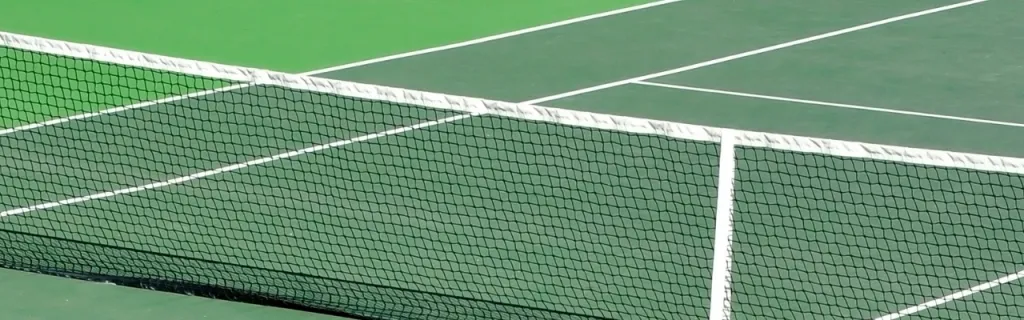
Tennis can be played on several different surfaces, each affecting ball speed, bounce height, and player movement. The ITF rates court pace from slow (level 1) to fast (level 5). The four main court surfaces are hard court, clay, grass, and artificial grass.
Match
Before playing the first point, either player or team spins a racket (or flips a coin). The winner chooses one of the following:
- To serve or to receive first
- Which side of the court to start from
- To defer the choice to the opponent (who cannot defer back)
The loser of the toss gets the remaining choice.
During the Match
Play is continuous from the first serve to the final point. However, the rules build in specific rest periods:
- Warm-Up: 5 minutes
- Between points: 25 seconds
- Changeover: 90 seconds when players switch ends
- Set break: 120 seconds at the end of each set
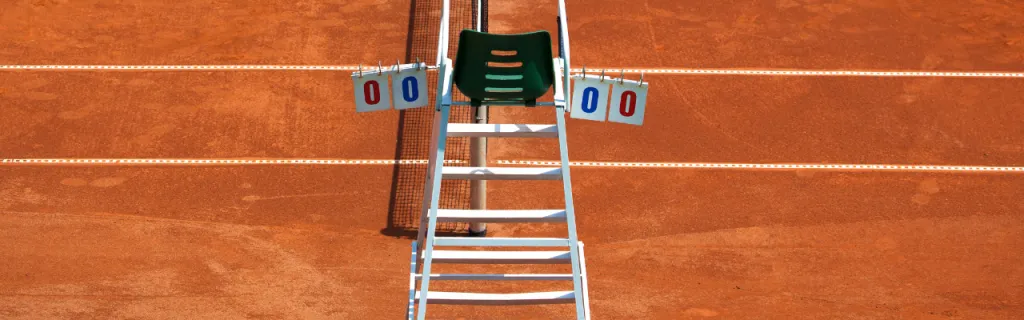
On the professional tour, the chair umpire enforces these strictly. In recreational tennis, you have more flexibility, but keeping a steady pace is good sportsmanship.
Scoring
The tennis scoring system tracks progress through three units: points, games, and sets. If you’re new to the sport, our dedicated scoring guide breaks each one down in detail.
Points:
Points follow a unique sequence: 0 (called “love”), 15, 30, 40, and then the game-winning point. If both players reach 40, the score is called “deuce.” From deuce, a player must win two consecutive points: the first is called “advantage,” and the second wins the game. If the player with advantage loses the next point, the score returns to deuce.
Games & Sets:
The first player to win 6 games wins the set, but you must lead by at least 2 games. If the set reaches 6-6, a tiebreaker is usually played (more on that below). Most matches are best-of-three sets, while Grand Slam men’s singles are best-of-five.
Line Calling:
- You make calls on your side of the net, promptly and clearly.
- A ball landing on the line is good.
- Give your opponent the benefit of the doubt on close calls.
- If you can’t call a ball out with confidence, it’s in.
- In doubles, if you and your partner disagree, the ball is called in.
- Your opponent is always entitled to a clear, audible call.
- Spectators should never make line calls.
- If a loose ball rolls onto the court, call a let. The server gets two serves.

Challenges:
Many professional tournaments use electronic line review. Here are the key rules:
- Each player receives two challenges per set to review line calls.
- A successful challenge preserves your challenge count.
- An unsuccessful challenge costs you one of your remaining challenges.
- Each player gets one additional challenge during a tiebreak.
- Challenges do not carry over between sets.
- You can only challenge the final shot of a rally.
Tiebreak:
A tiebreak begins when a set is locked at 6-6. The first player to reach 7 points wins, provided they lead by at least 2 points. If it reaches 6-6 in the tiebreak, play continues until one player establishes a two-point lead. For a detailed breakdown of tennis scoring including tiebreak serving order, see our full guide.
Serving
The serve starts every point, and the serving rules are among the most detailed in the sport. For a deeper look at serve technique, check out our dedicated guide.
Where to Stand:
Stand behind the baseline to serve. A small center mark divides the baseline in half. On points with an even total score (0-0, 15-15, 30-0, etc.), you serve from the right side (deuce court). On odd-score points, you serve from the left side (ad court).
Alternating Sides:
After each point, the server switches between the deuce and ad sides. This continues until the game ends.
Where to Hit the Ball:
You must hit the ball diagonally over the net into the opposite service box. From the deuce side, you serve into the opponent’s deuce service box, and vice versa.
How Many Serves Do You Get?
You get two attempts per point. The first serve is your opportunity to be aggressive. If it misses, you play a second serve, which most players hit with more spin and margin for safety.
Faults:
A “fault” occurs when the serve doesn’t land in the correct service box. Common causes include missing the box entirely, hitting the net without the ball going over, or stepping on or past the baseline before contact (a “foot fault”). After one fault, you get a second serve. Two faults in a row (a “double fault”) give the point to your opponent.
Service Let:
If the ball clips the net cord but still lands in the correct service box, it’s called a “let,” and you replay the serve without penalty. Any player can call a let, but the call must come before the return of serve is struck. On an obvious ace that clipped the net, call the let immediately.
Violations
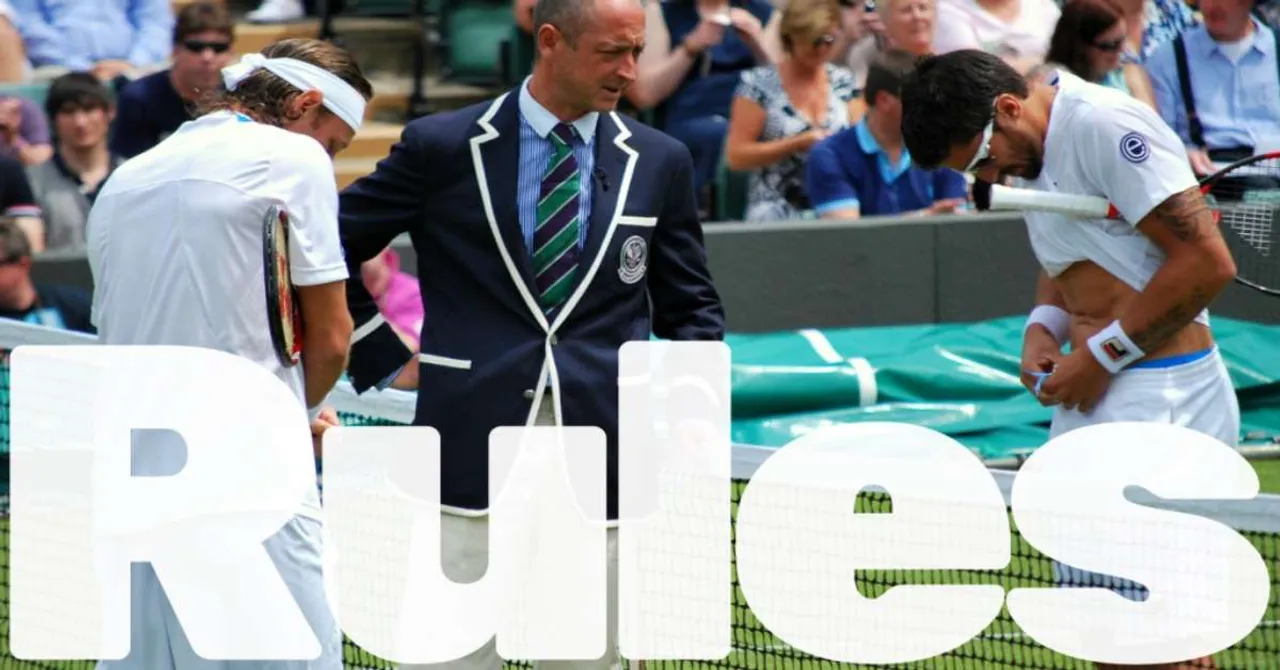
Professional tennis has a structured code of conduct. Violations follow a progressive penalty system: first offense is a warning, second is a point penalty, and further offenses can result in game penalties or disqualification. Players like John McEnroe, Serena Williams, and Nick Kyrgios have all been penalized under these rules during their careers.
Ball Abuse: Hitting or kicking a ball deliberately or recklessly out of the court, into the stands, or in any dangerous direction. You’ll see this when a frustrated player swats a ball away after losing a point.
Racket or Equipment Abuse: Slamming, throwing, or intentionally breaking a racket or other equipment. This is probably the most common violation on tour.
Physical Abuse: Any physical contact with an official, opponent, spectator, or anyone else at the tournament site.
Verbal Abuse: Directing insults at another player, an official, a spectator, or a coaching staff member.
Audible Obscenity: Using profanity loud enough for others to hear, regardless of the language.
Visible Obscenity: Making offensive gestures visible to spectators, officials, or opponents.
Best Efforts: A player must compete to the best of their ability. If the umpire determines a player is deliberately not trying to win, they can be penalized. This rule is rarely enforced but exists to protect the integrity of the sport.
Coaching: On-court coaching is not permitted during a match in most ITF and ATP/WTA events outside of designated coaching windows. Any verbal or visual communication between a player and their coach can be flagged.
Timing Violation: Exceeding the allowed time between points (25 seconds), taking too long during changeovers, or extended bathroom breaks can result in a time violation. On the ATP tour, the shot clock makes this easy to track.
Final Thoughts
You’ve made it through the complete rundown of tennis rules. Understanding these rules puts you ahead of most casual fans and gives you the confidence to step on court knowing exactly what’s expected.
We didn’t cover every edge case, as the full ITF rulebook runs over 30 pages. You can find the complete rules on the International Tennis Federation website or the United States Tennis Association website. But for playing or watching, what you’ve read here covers the essentials.
If you want to keep building your knowledge, check out our guide to tennis scoring and our glossary of tennis terms.
FAQs
What Is the Difference Between the Rules for Doubles and Singles?
The biggest difference is the number of players: two in singles, four in doubles. In doubles, the court is wider because the alleys on both sides are in play after the serve.
Most other rules stay the same. There is no requirement for partners to alternate shots. Each player serves once every four games, and the serving order rotates consistently throughout the set.
What Is the Objective of Tennis?
The objective is to win enough points to win a game, enough games to win a set, and enough sets to win the match. You do this by hitting the ball over the net so it lands within the court boundaries in a way your opponent cannot return.
Is Coaching Allowed During a Tennis Match?
According to the ITF rulebook, coaching is not permitted during matches in either singles or doubles. Any verbal or nonverbal exchange between a player and coach can be interpreted as coaching. Coaches cannot communicate from the stands or from courtside.
The exception is during authorized breaks, when a coach may speak to the player on the same side of the court. Some exhibition events and lower-level tours have experimented with more open coaching rules, but the standard remains no coaching during play.
Can You Touch the Net in Tennis?
No. While a point is in play, you cannot touch the net, net post, or cross onto your opponent’s side of the court. If you do, or if anything you’re wearing or carrying touches the net, your opponent wins the point. This applies even if you’ve already hit a winning shot.
Can You Hit Your Opponent with the Ball in Tennis?
There is nothing in the rulebook prohibiting you from aiming at your opponent. It is a valid strategy, particularly at the net in doubles. If the ball touches a player or anything they’re wearing or carrying (excluding the racket), that player loses the point.
What Happens if You Drop Your Racket in Tennis?
You must maintain control of the racket while making contact with the ball. Throwing or releasing the racket to reach a shot is not allowed. However, if the racket slips from your hand after you’ve made contact, the ball remains in play and the point continues normally.
Frequently Asked Questions
What is the difference between the rules for doubles and singles?
What is the objective of tennis?
Is coaching allowed during a tennis match?
Can you touch the net in tennis?
Can you hit your opponent with the ball in tennis?
What happens if you drop your racket in tennis?
More in Tennis Basics
Tennis Court Dimensions: Facts, Figures & Measurements
Complete guide to tennis court dimensions, including lines, areas, net height, and children's court sizes. All measurements per ITF rules.
The 4 Main Types Of Tennis Court Surfaces Explained
Learn how clay, grass, hard, and carpet courts affect ball speed, bounce, and playing style, plus tips for adapting your game to each surface.
Doubles Tennis Rules, Tips & Strategies
Master doubles tennis with our complete guide to serving rotation, court positioning, formations, net strategy, and winning tactics for every level.

The Ultimate Tennis Grips Guide To Improve Your Game
Learn every tennis grip from Continental to Western. Find out which grip suits your game, how to find your grip size, and what the pros use.

A Brief History Of Tennis, From The Beginnings To The Present
Explore the full history of tennis from medieval monks to the Open Era. Key milestones, legendary players, and how the sport became a global phenomenon.
Tennis Ratings Explained
Understand NTRP, UTR, and WTN tennis ratings. Learn how each system works, how they compare, and how to find your level for leagues and tournaments.