

Tennis Ratings Explained
Tennis ratings are numerical scores that measure your current playing ability, making it easier to find competitive matches and track your improvement over time.
If you’ve ever shown up to a league match and realized your opponent was way out of your league (in either direction), you understand why ratings matter. A good rating system puts you on the court with players who challenge you without overwhelming you.
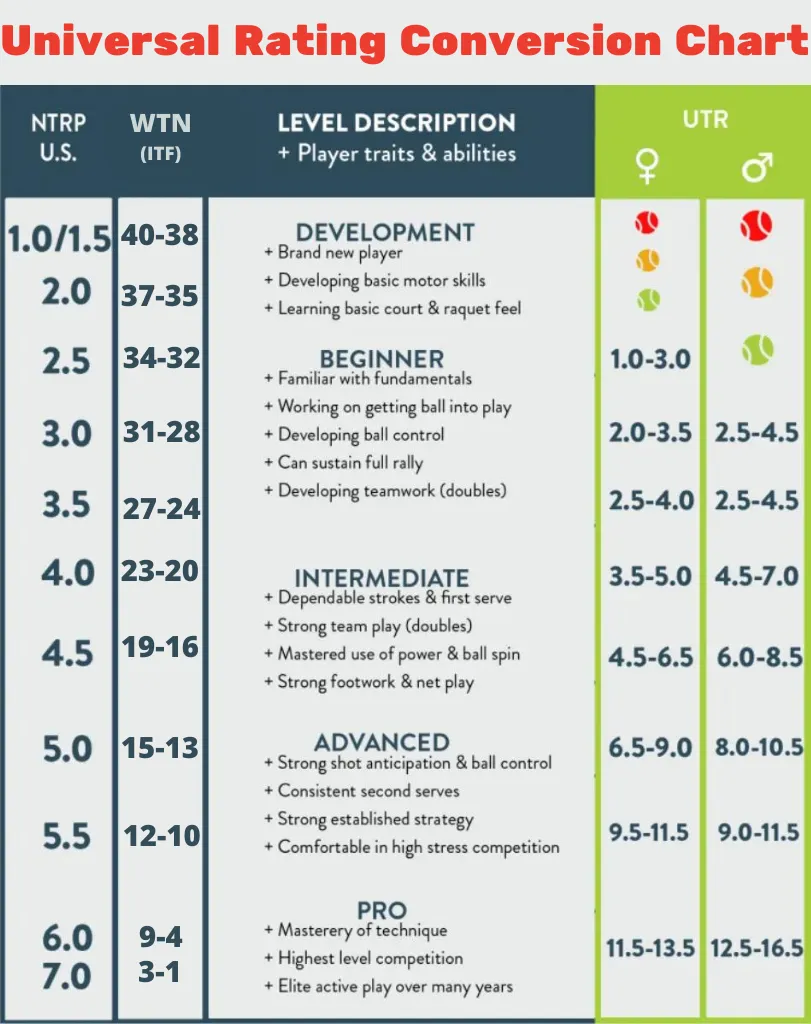
Three main systems exist today: the USTA’s NTRP, the Universal Tennis Rating (UTR), and the World Tennis Number (WTN). Each takes a different approach, and the chart below shows roughly how they correlate. I’ll break down each system so you can figure out where you stand.
National Tennis Rating Program (NTRP)
The NTRP is the most widely used rating system in the United States. The USTA created it in the 1970s when adult recreational tennis was booming and labels like “beginner, intermediate, advanced” no longer captured the range of ability on public courts across the country.
The system exists because age alone is a poor predictor of skill. I’ve coached players in their 60s who hit cleaner backhands than college players. What matters is how you actually perform on court, and that’s what NTRP measures.
NTRP ratings range from 1.5 (true beginner) to 7.0 (touring professional), increasing in 0.5 increments. Each level corresponds to specific skills and match characteristics. After just a few competitive matches, the system generates a reliable rating that adjusts gradually based on your results.
One important detail: you can self-rate when you first join a USTA League, but don’t sandbag. If you rate yourself too low hoping for easy wins, the USTA will catch it and nullify your results retroactively. Be honest, and you’ll have more competitive, enjoyable matches.

Determine Your NTRP Rating
Not sure where you fall? Take this quick quiz to get an estimated rating across all three systems, or read through the level descriptions below to self-assess.
Find Your Tennis Rating
Answer 6 questions about your game to get an estimated rating across all three systems.
How long can you sustain a rally with a player at your level?
1/6Alternatively, start at 1.5 and read through each level description below. Picture yourself playing against someone of the same gender and similar ability. Choose the level where you meet all the criteria, including those from every level below it.
1.5 You’re brand new to tennis and still working on making contact with the ball consistently. Most of your focus is on getting the ball over the net and into play.
2.0 You’ve spent some time on court but have clear stroke weaknesses. You can play both singles and doubles and are comfortable enough to rally, even if the rallies are short.
2.5 You’re starting to read where the ball is going, though your court coverage is limited. You can sustain a slow-paced rally with players at your level, and you’re beginning to understand positioning.
3.0 You’re fairly consistent on medium-paced shots, but you struggle with directional control, depth, and power. Not all your strokes are reliable. In doubles, one-up, one-back is your go-to formation because net play still feels risky.
3.5 Your strokes are becoming more dependable, and you can direct moderate shots with some intention. You’re starting to move to the net more in doubles, your court coverage has improved, and you’re working on teamwork with your partner. This is where the majority of USTA League players land.
4.0 You have consistent strokes with directional control and depth on both forehand and backhand sides. You can use lobs, overheads, approach shots, and volleys with some success. Your serve occasionally forces errors. The main thing holding you back is impatience, cutting rallies short by going for too much too soon. In doubles, real teamwork is evident.
4.5 You’re learning to control tempo and use power and spin intentionally. Your footwork is solid, you can adjust your game plan based on your opponent, and your first serve has real pace and accuracy. Second serves land consistently. The weakness at this level is overhitting on difficult shots, trying to do too much with balls that call for a smarter play.
5.0 You anticipate well and often have one outstanding weapon you can build your game around. Short balls become winners or forced errors. You can execute drop shots, half volleys, and overhead smashes under pressure. Your second serve has good depth and spin.
5.5 Power or consistency (or both) has become a genuine weapon. You can switch strategies mid-match and remain reliable under pressure. At this level, you’re competing seriously in regional and sectional tournaments.
From 6.0 to 7.0
A 6.0 player has typically trained extensively for national-level competition at the junior or collegiate level and holds a sectional or national ranking. A 7.0 player is world-class, competing on the ATP or WTA professional tours.

Junior NTRP
Junior NTRP ratings use a finer scale, measured in tenths from 2.0 to 7.0 (so 2.0, 2.1, 2.2, and so on). This extra precision matters for younger players whose skills can change rapidly.
A junior needs four matches against rated players to generate an initial rating. From there, the rating recalculates after every match over a rolling 18-month window, with more weight given to recent results. The more matches played, the more accurate the rating becomes.
For informal events, juniors can self-rate. Players within 0.5 of each other are generally considered compatible opponents, though at that gap the higher-rated player will win more often.
For more details, visit the official USTA ratings page.
Universal Tennis Rating (UTR)
The Universal Tennis Rating has become the gold standard for comparing players across borders. Unlike NTRP, which is U.S.-centric, UTR evaluates every player on the same 16-point scale regardless of age, gender, or country. A UTR of 10 means the same thing whether you’re a 14-year-old junior in Spain or a 45-year-old league player in California.
UTR is purely results-based. Your rating updates after every match, factoring in your opponent’s strength and the score margin, not just wins and losses. This makes it the most dynamic of the three systems and particularly valuable for competitive juniors, college recruits, and recreational players who want real-time feedback on their progress.
Professionals, collegiate athletes, juniors, and recreational players all use UTR. It’s increasingly adopted by tournament organizers and college coaches as the go-to metric for evaluating talent.
Visit the official UTR website to look up your rating or create a profile.
World Tennis Number (WTN)
The World Tennis Number (formerly known as the International Tennis Number, or ITN) is the ITF’s global rating system, introduced in 2001 and updated significantly in recent years. It rates players on a scale from WTN 1 to WTN 40.
WTN 1 represents a player at the highest level, someone with an ATP or WTA ranking or equivalent playing standard. WTN 40 is an absolute beginner. WTN 10 represents a player who can serve and return on a full court with a standard ball, roughly the entry point for competitive play.
The WTN system is designed to work alongside national rating systems rather than replace them. If you travel internationally or compete in ITF events, your WTN gives opponents and organizers a universal reference point for your ability.
Visit the official WTN website to learn more.

FAQs
Why use NTRP ratings?
NTRP ratings ensure you play against opponents of a similar skill level, which leads to better competition, more personal challenge, and more enjoyment on court. The system is ideal for player placement in group lessons, USTA Leagues, tournaments, and other organized programs.
What is the difference between a rating and a ranking?
A rating is a numerical measure of your skill level, calculated from your match results. A ranking shows your relative position compared to other players on a list. Think of it this way: your rating tells you how well you play, while your ranking tells you where you stand among others in your region or nationally.
When and how does a player get a self rating?
Before enrolling in a USTA League program, a player without a computer rating must self-rate. Visit tennislink.usta.com and choose USTA League from the navigation menu. Select “self-rate” under “Find NTRP Rating Info” and read through the level descriptions carefully. Be honest with yourself. Choosing too low a rating backfires when the USTA adjusts your results.
How does UTR compare to NTRP?
Both are computer-generated scores, but their calculations differ significantly. Your NTRP rating factors in your year-end rating, your opponent’s rating, and the margin of victory or loss. UTR, on the other hand, recalculates after every match on a rolling basis and uses a 16-point scale that works across age, gender, and geography. UTR tends to be more responsive to recent form, while NTRP provides a stable year-to-year benchmark.
Frequently Asked Questions
Why use NTRP ratings?
What is the difference between a rating and a ranking?
When and how does a player get a self rating?
How does UTR compare to NTRP?
More in Tennis Basics

Tennis Court Dimensions: Facts, Figures & Measurements
Complete guide to tennis court dimensions, including lines, areas, net height, and children's court sizes. All measurements per ITF rules.

The 4 Main Types Of Tennis Court Surfaces Explained
Learn how clay, grass, hard, and carpet courts affect ball speed, bounce, and playing style, plus tips for adapting your game to each surface.

Doubles Tennis Rules, Tips & Strategies
Master doubles tennis with our complete guide to serving rotation, court positioning, formations, net strategy, and winning tactics for every level.

The Ultimate Tennis Grips Guide To Improve Your Game
Learn every tennis grip from Continental to Western. Find out which grip suits your game, how to find your grip size, and what the pros use.

A Brief History Of Tennis, From The Beginnings To The Present
Explore the full history of tennis from medieval monks to the Open Era. Key milestones, legendary players, and how the sport became a global phenomenon.

Tennis Rules Explained - An Essential Guide
Learn the essential tennis rules for singles and doubles, including scoring, serving, faults, tiebreaks, line calls, violations, and court layout.