

The Ultimate Tennis Grips Guide To Improve Your Game
A tennis grip is the way you hold your racket, and it directly controls the angle of the racket face at contact, the amount of spin you can generate, and the power behind every shot.
The first step to tennis success is understanding how to hold the racket for each stroke. Your grip changes the angle of the racket face when you make contact with the ball, which is why the same swing can produce completely different results depending on how you hold the handle.
If you’re a beginning player, this guide will help you learn the grips behind every major shot. If you’ve been playing for some time and are looking to improve, you may discover a grip adjustment that takes your game to the next level.
Below, we cover every grip from continental to western, including their advantages and disadvantages, which pros use them, and how to find the right grip size for your racket. Feel free to skip ahead to the topic of your choice.
Find Your Ideal Grip
Which stroke are you looking to improve?
Grip History
Because grass courts are the quickest surface and produce the lowest bounce, the continental grip was ideal for striking balls below the hips. Wooden rackets were the norm through the seventies, and their smaller heads and heavier frames didn’t generate much power on their own.
Players controlled their shots with sound technique and a touch of spin, making the continental grip the foundation of every player’s game. As the sport grew more competitive and fitness routines improved, players began looking for ways to hit harder and with more spin.
The introduction of spin-friendly polyester strings in the nineties changed everything. Players could swing faster, generate more topspin, and still keep the ball in the court. Combined with the shift away from grass as the primary playing surface, racket and string technology drove a fundamental change in how players gripped their rackets.
The eastern forehand grip appeared first, making it easier to generate spin and ushering in a dominant baseline game. The semi-western grip gained popularity in the eighties, with players like Andre Agassi hitting almost entirely from behind the baseline. It didn’t stop there as players experimented with the western grip.
Grip Fundamentals
Before diving into the individual strokes, you need to understand how to hold a tennis racket correctly. Start by identifying two key landmarks on your hand.
The knuckle at your index finger and your heel pad are the two key markers on the palm side of your hand. The handle of a tennis racket is octagonal, with eight sides known as bevels. The bevels provide a reference point for various grip types and a comfortable shape to hold the racket.
The Grip Octagonal Shape
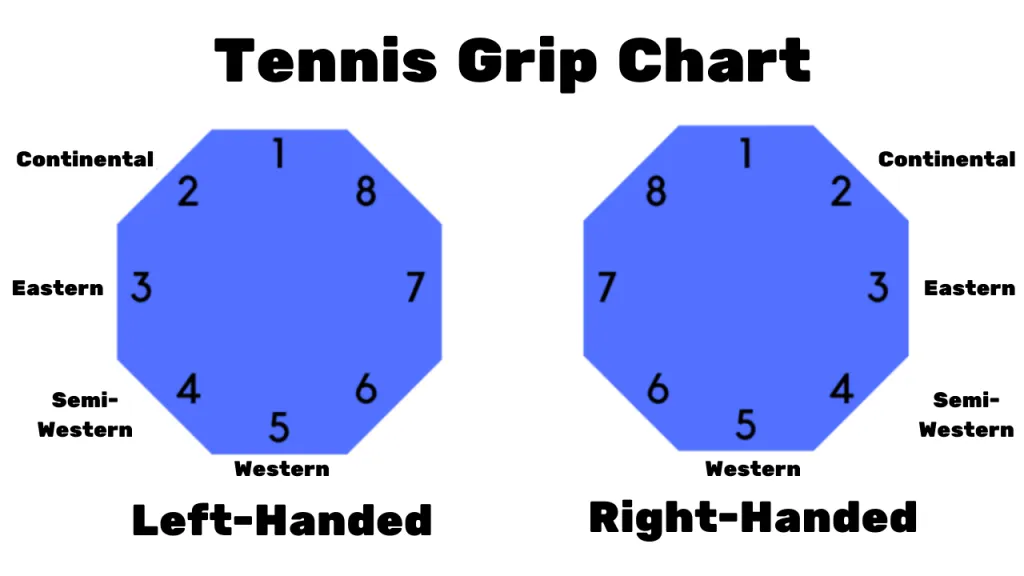
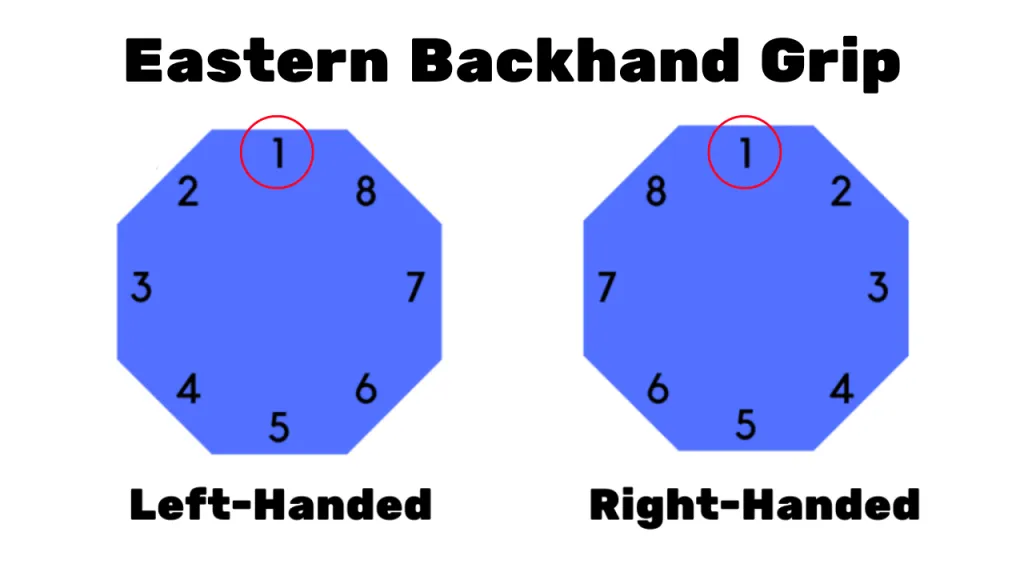
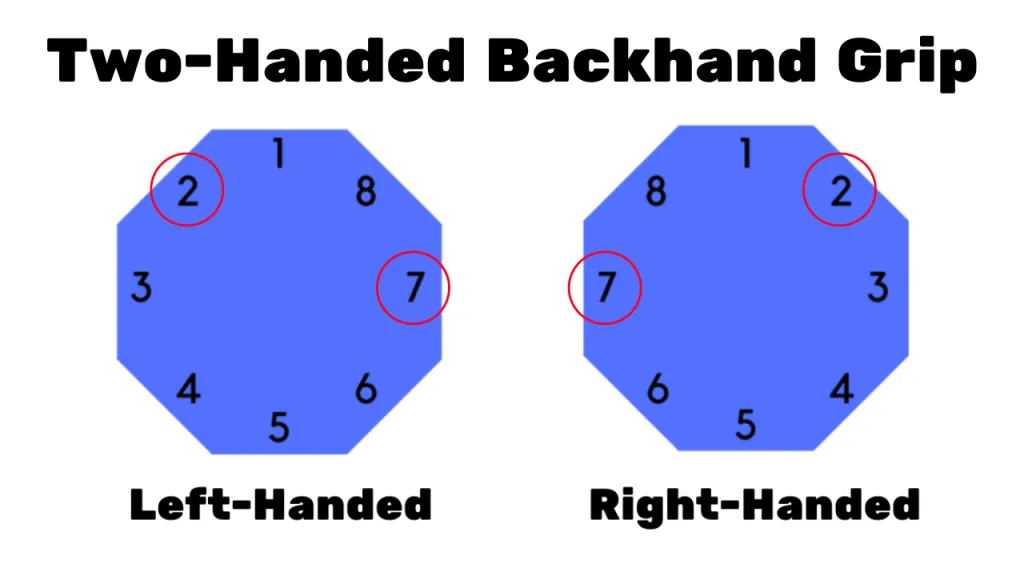
The bevels on the bottom of the racket handle are numbered 1 through 8, with number 1 being the top bevel. They are numbered counter-clockwise for right-handed players and clockwise for left-handed players.
As a result, if you’re a righty who rotates the racket counter-clockwise, the next bevel that faces up is #2. The same would be true as a lefty if you rotated it clockwise.
Grip Types
The continental grip was dominant in the early days of the sport. Wooden racquets with natural gut strings were the norm. Until 1974, three of the world’s most prestigious championships, including Wimbledon, the Australian Open, and the US Open, were all played on grass.
Continental Grip
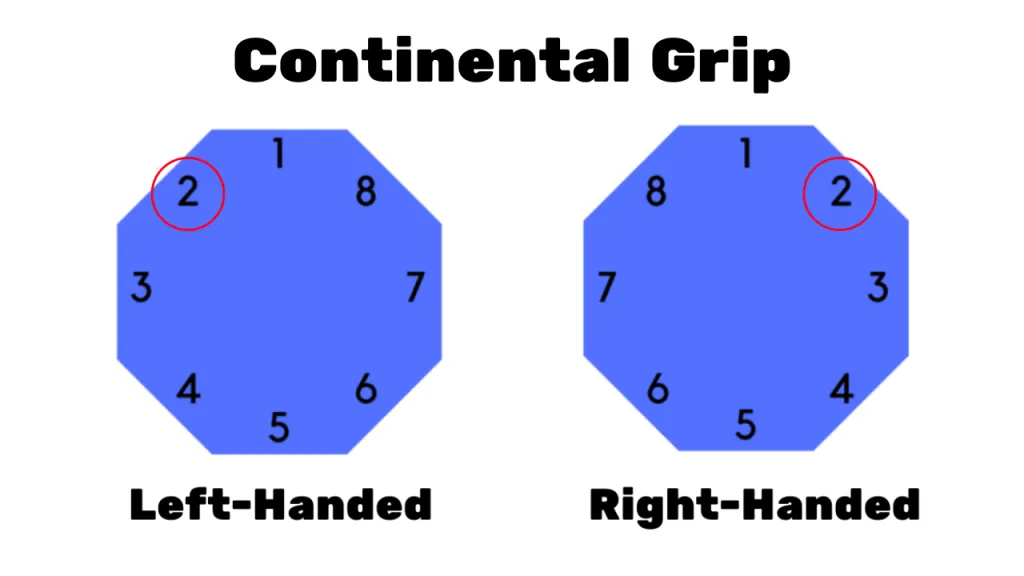
This versatile grip is used for your serve, volley, overhead, slice, chip, drop shot and defensive shot. To find the Continental grip, place your index knuckle and heel pad on bevel number 2. You are in the right position if your thumb and fingers form a V across the top of the handle.
Advantages:
- Its neutral position works for both forehand and backhand shots, making it ideal for quick volleys at the net without changing your grip
- Lets you snap your wrist easily on contact for serves and overheads, generating more power without extra strain on your arm
- Great for defending against low shots like slice backhands, drop shots, wide balls, and even high balls that bounce to about shoulder height
Disadvantages:
- Not ideal for generating topspin, making it difficult to hit spin shots consistently
- Requires significant grip and wrist strength
- Needs precise balance and shoulder turn to make solid contact
- The contact point is closer to the body, which can cause players to hit the ball late
Who Uses the Continental Grip?
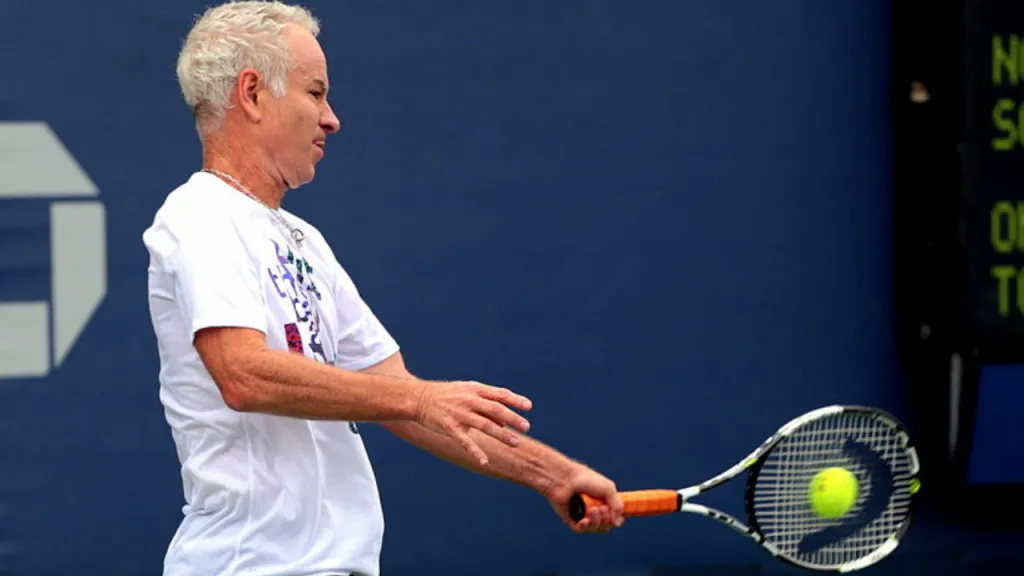
Martina Navratilova, Stefan Edberg, John McEnroe, Rod Laver, Margaret Court, Billie Jean King.
Eastern Forehand Grip
This grip feels comfortable and natural to most players, especially beginners picking up a racquet for the first time. For that reason, most coaches teach the Eastern forehand grip as a starting point before moving on to other grips.
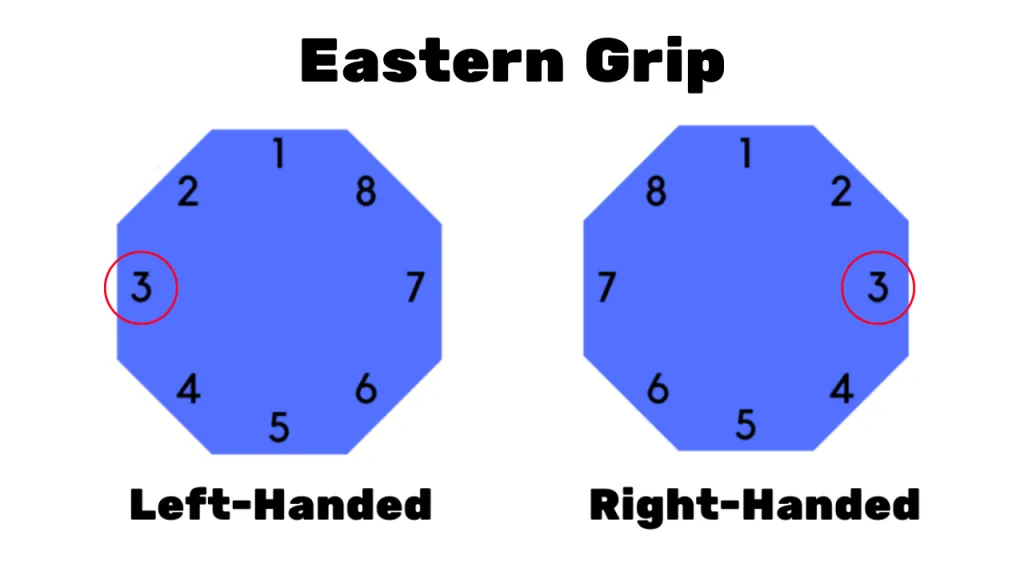
To find the Eastern grip, place the palm-side knuckle of your index finger on bevel number 3 (or the seventh bevel if you are a lefty).
Advantages:
- Easy to learn and allows comfortable transitions to other grips during a point
- Enables aggressive play with low net clearance and quick advances to the net
- Helps flatten out the ball for consistent ball striking in competitive match play
Disadvantages:
- High-bouncing balls are difficult to control
- Challenging to generate topspin consistently
- Less net clearance increases the chances of missing long or hitting the net
- Flattened shots tend to produce shorter rallies, which can be a drawback when you need to stay in points
Who Uses the Eastern Forehand Grip?
Roger Federer, Pete Sampras, Chris Evert, Steffi Graf, Stefanos Tsitsipas, Grigor Dimitrov, Juan Martin del Potro, Roberto Bautista Agut, Petra Kvitová, Lindsay Davenport, Angelique Kerber.

Eastern Backhand Grip
The eastern backhand grip is the most popular choice for a one-handed backhand and is found by placing your heel pad and index knuckle on bevel number one. This grip allows for significant spin and control. An interesting detail is that the eastern backhand grip uses the exact same hand position as the western forehand grip, just on the opposite side of the racket.
Advantages:
- Excellent control and the ability to generate heavy topspin
- Quick and easy transition to the continental grip for volleying at the net
- Great for hitting a kick serve
Disadvantages:
- High-bouncing balls are difficult to handle, especially on clay courts
- Requires more wrist and forearm strength than a two-handed backhand
- Less power than a two-handed grip, making it harder to redirect pace on fast shots
Who Uses the Eastern Backhand Grip?
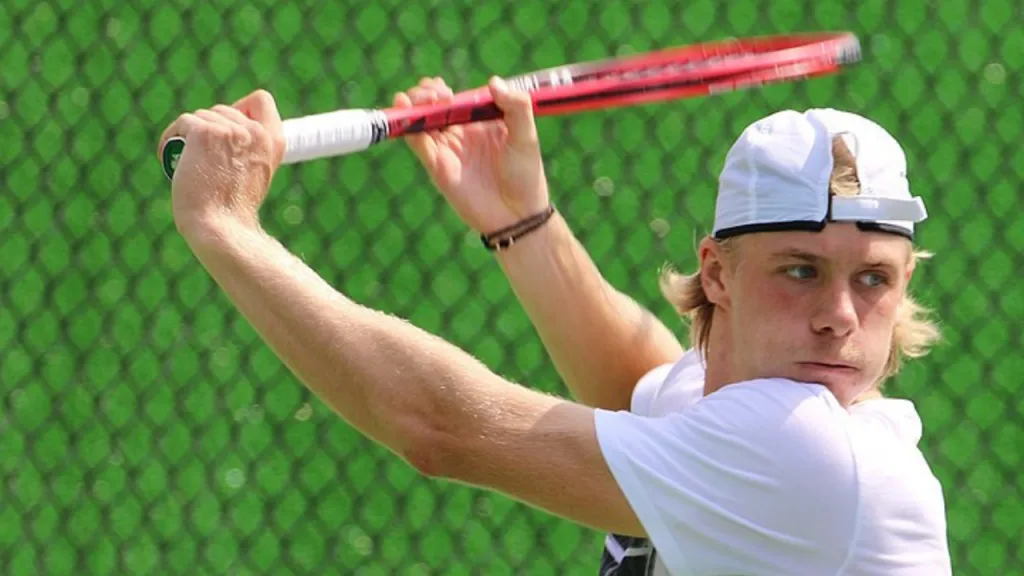
Roger Federer, Stan Wawrinka, Chris Evert, Pete Sampras, Steffi Graf, Stefanos Tsitsipas, Dominic Thiem, Denis Shapovalov.
Semi-Western Grip
The Semi-Western forehand grip is currently one of the most common forehand grips among tennis pros and is often called the modern forehand grip. It sits halfway between the traditional Eastern grip and the more extreme Western grip used by power baseliners.
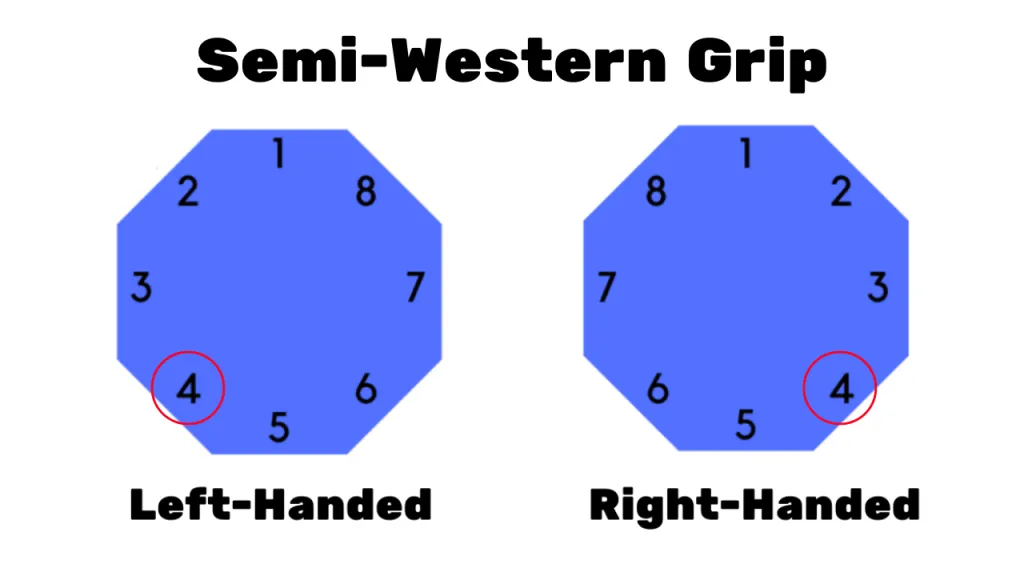
The contact point with this grip falls between hip and shoulder height, a little further out in front of the body than the Eastern forehand. To find it, put the palm-side knuckle of your index finger on the fourth bevel (or on the sixth bevel if you are a lefty).
There is also a Semi-Western backhand grip, found by placing your heel pad and index knuckle on bevel number eight. If you already play your forehand with a Semi-Western grip, you won’t need to switch grips for the backhand since the ball is struck with the same face of the racket.
Advantages:
- Generates both solid power and heavy topspin, the best of both worlds
- Players can hit the ball much higher over the net, increasing control and consistency
- The extra net clearance provides a larger margin for error, allowing more aggressive baseline play
Disadvantages:
- Hitting extremely low balls is difficult, especially on fast surfaces like grass
- Transitioning quickly from a forehand to a volley grip when approaching the net can be challenging
Who Uses the Semi-Western Grip?
Carlos Alcaraz, Serena Williams, Novak Djokovic, Rafael Nadal, Ashleigh Barty, Andy Murray, David Nalbandian, Ivan Ljubičić, Fernando González, James Blake, Marat Safin, Emma Raducanu.
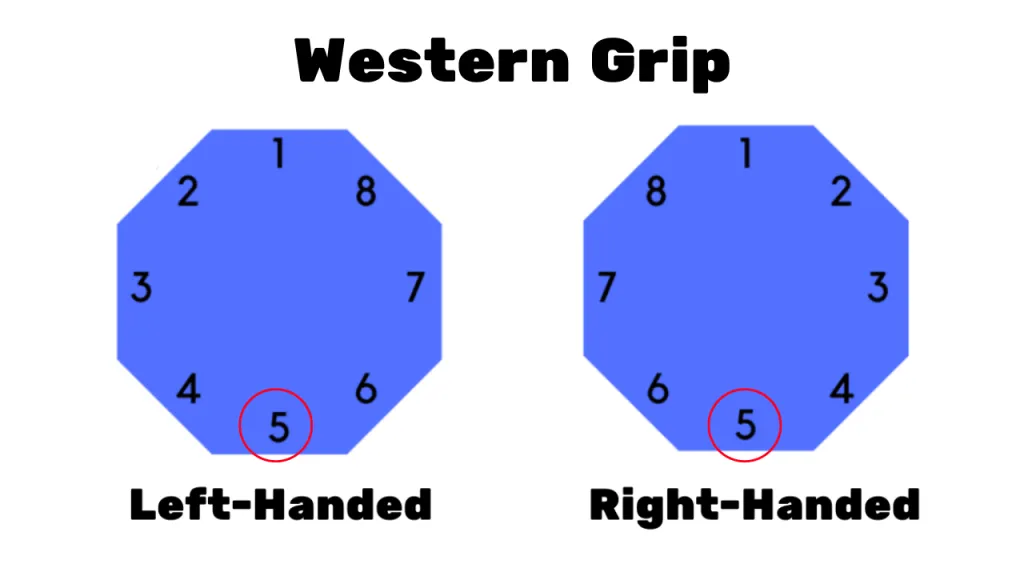
Western Grip
The Western forehand grip, sometimes called a full-western grip, is a more extreme variant of the Semi-Western grip that naturally generates enormous amounts of topspin. It works best for baseline players on slower court surfaces like clay, allowing them to deal with high-bouncing balls more easily and hit powerful shots while keeping the ball in the court.
Because the racket face is slightly closed at contact, this grip can be difficult for low balls and fast grip changes at the net. It can also be tough for beginners to master. To find the Western grip, place the palm-side knuckle of your index finger on the fifth bevel whether you play with your right or left hand.
Advantages:
- Generates the most topspin of any grip, more than any other forehand option
- High net clearance allows a more aggressive playing style while increasing the margin for error
- The heavy topspin creates a high, fast bounce that puts opponents under pressure, particularly on clay and other slow surfaces
Disadvantages:
- Low balls are extremely difficult to hit, particularly on fast surfaces like grass
- Takes more time to switch to an Eastern or Continental grip when approaching the net
- Requires excellent timing and precision
- Difficult to hit flat shots and clean winners
- Can strain the wrist and forearm over time, potentially leading to chronic injuries
Who Uses the Western Grip?
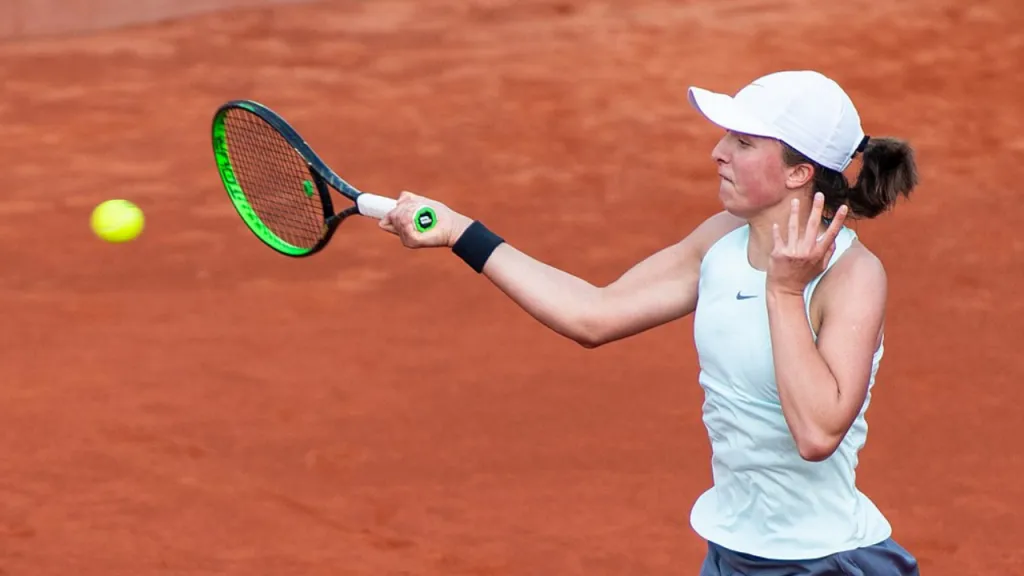
Karen Khachanov, Kyle Edmund, Jack Sock, Kei Nishikori, Robin Soderling, Jim Courier, Ernests Gulbis, Florian Mayer, Nick Kyrgios, Iga Swiatek, Coco Gauff, Alexander Zverev.
Double-Handed Backhand Grip
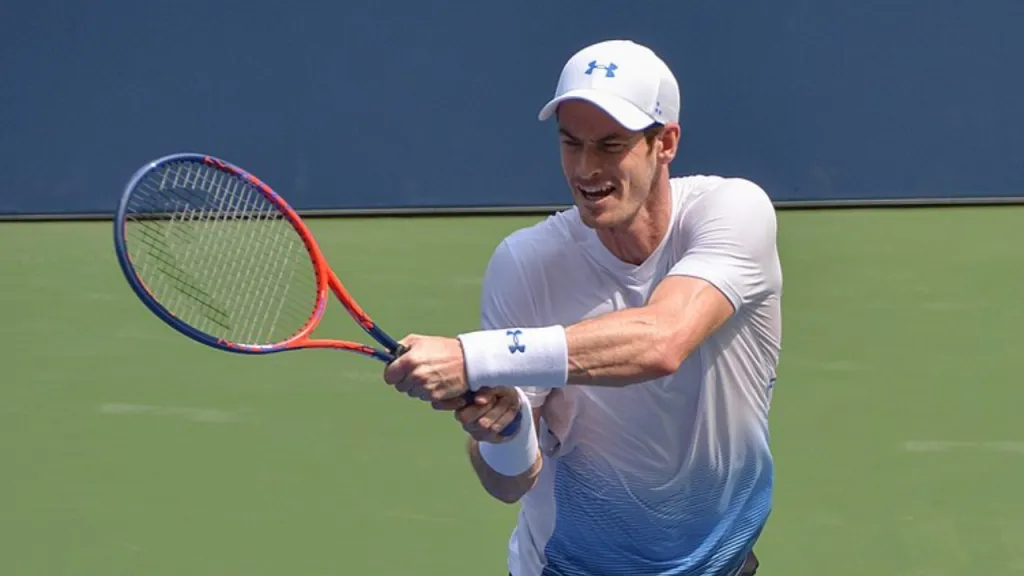
The two-handed backhand is a powerful, stable, and consistent stroke that has become the dominant backhand choice on today’s tour for both pros and juniors. The most common two-handed backhand grip uses a Continental grip on your dominant hand and an Eastern forehand grip on your non-dominant hand.
Advantages:
- Easier to learn since the second hand provides extra strength and stability
- Greater control because both arms drive through the ball together
- Easier to generate power since the non-dominant hand is essentially in a forehand position
- Excellent for returning serves and can be hit comfortably in an open stance
Disadvantages:
- Takes longer to set up compared to a one-handed backhand
- Less reach, making it harder to retrieve wide balls hit into the corners
- Can limit the ability to hit effective slices, as most players switch to one hand for the slice backhand
Who Uses the Double-Handed Backhand Grip?
Andre Agassi, Novak Djokovic, Marat Safin, David Nalbandian, Andy Murray, Serena Williams, Monica Seles, Rafael Nadal, Ashleigh Barty, Aryna Sabalenka, Jimmy Connors, Daniil Medvedev, Alexander Zverev.
Grip Selection
The tennis grips you use have a huge impact on your playing style because your grip defines how much spin and power you can generate. No single grip is better than another. You should pick a grip that fits how you want to play.
If you play a more aggressive game, use a grip that lets you hit through the ball and put more pace on it (think Rublev or Sinner). If you prefer consistency, select a grip that generates more spin (think Alcaraz or Nadal). Like choosing a racket or a playing style, your grip should match your tennis game and skill level.
There is no right or wrong grip. It depends on the situation and the type of player you are. If you’re not sure where to begin, here are solid starting recommendations:
- Forehand: Semi-Western
- Backhand: Eastern
- Serve, Volleys, Backhand Slice: Continental
These grips work well for most players, but don’t limit yourself. Experiment and find what feels right for your game.
Grip of The Pros
As a tennis professional and coach, I understand my students’ irritation when constantly corrected or coached on the “ideal” tennis racket grip. Although it may appear redundant, grips in tennis are there for a reason. The goal is for each player to be able to perform the shot chosen with ease and precision.
Most pros on tour today have slight variations of the five main tennis grips to suit their style of play. The selection of tennis grips is ultimately up to the player and what best matches their playing style.
Grip Size
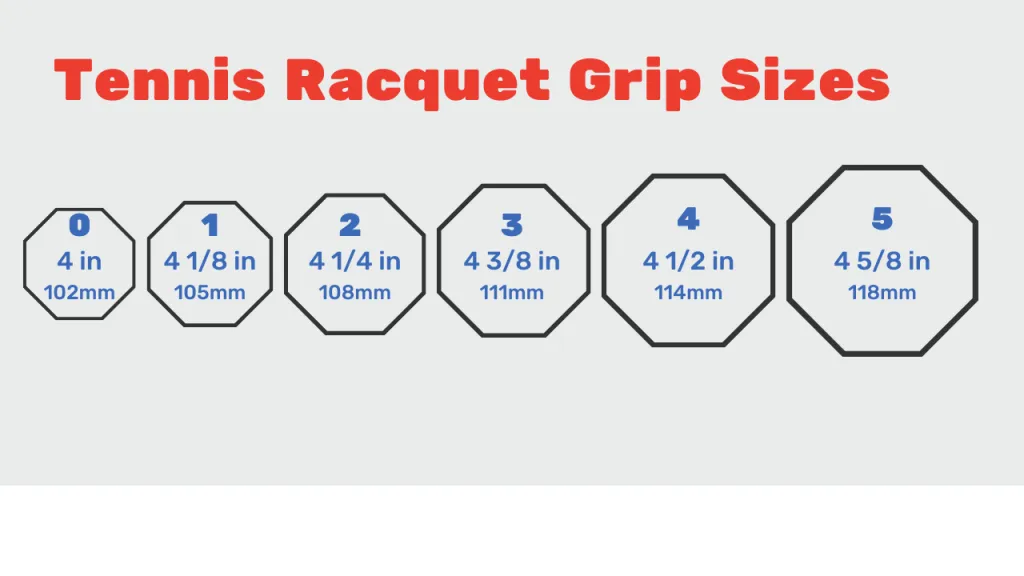
Now that we’ve covered the best ways to hold a tennis racket, let’s discuss another crucial aspect: grip size. Each racket is available in various grip sizes, and selecting the right one matters more than you might think.
A grip that’s too small will require extra strength to keep the racket from twisting in your hand. A grip that’s too large makes switching grips and generating spin difficult. Over time, playing with the wrong grip size can lead to ailments like tennis elbow. When shopping for a racquet, you’ll usually come across the following grip sizes:
Find Your Grip Size
There are two main methods for determining the grip size of a tennis racket:
The Index Finger Method:
This is the most common way of evaluating grip size and is especially handy if you’re testing racquets in a store. Simply grasp the racquet handle and look at the space between your fingertips and your palm.
The gap should be roughly the width of your index finger. Once you’ve found a close match, try one size larger and one size smaller to confirm. Comfort is the ultimate guide here, so go with whichever grip size feels best in your hand.
The Ruler Method:
If you’re looking to buy a tennis racquet online and don’t have the opportunity to personally feel the grip, measuring the size of your hand with a tape measure or ruler is an excellent way to determine the size of your tennis grip.
Simply open your hand with your fingers fully extended to measure your grip size with a ruler, and you’ll notice two wide lines going almost horizontally across the palm of your hand. Align the bottom lateral crease with the end of your ruler or measuring tape and measure to the tip of your ring finger.
Grip Size Calculator
Measure from the bottom lateral crease of your palm to the tip of your ring finger, then enter the measurement below.
What if I’m in Between Sizes?
It’s completely normal to fall between sizes. If you’re “in-between” and not still growing, go with the smaller size and add an overgrip to build it up. An overgrip typically increases the size by 1/16 of an inch. A grip that’s too large, on the other hand, cannot easily be reduced unless you manually shave the handle down.
What About Finding the Right Grip Size for Juniors?
Choose the slightly larger grip size for juniors, as children may likely grow into a grip size that is a little too big for them at first.
Overgrips
The last thing to consider is your racket’s overgrip. Overgrips are thin, cloth-like tapes wrapped over the original grip of a tennis racket, providing extra comfort, stability, and sweat absorption.
There are dozens of options from various manufacturers, but they all fall into three categories: dry, tacky, and all-around.
Dry Overgrips:
Dry overgrips are ideal for players who sweat heavily or play in humid conditions. They absorb moisture effectively, allowing you to maintain control even when your hands are soaked. I’ve cracked a few rackets over the years after they slipped out of my grip mid-serve. It’s a terrible feeling, and dry overgrips help prevent that.
The best dry grips I’d recommend are from Tourna Grip. The trade-off is that they’re thinner and wear out faster, so you’ll need to replace them more frequently.
Tacky Overgrips:
Tacky overgrips have a “sticky” feel that gives you a firm hold on the racket at all times. They’re usually well-cushioned and last longer than dry grips. I used tacky overgrips for most of my career because I liked the secure feeling they provided. Since I never had issues with excessive sweating, they were the perfect fit for me.
Tourna Grip and Wilson both make excellent tacky overgrips. The Tourna Grip is the tackiest option, while the Wilson overgrip is slightly less expensive.
All-Purpose Overgrips:
All-around overgrips are a hybrid of dry and tacky. They start tacky and transition to a drier feel after a few sessions. Babolat’s Pro Tour overgrips are a great option in this category because they combine a tacky feel with solid absorption.
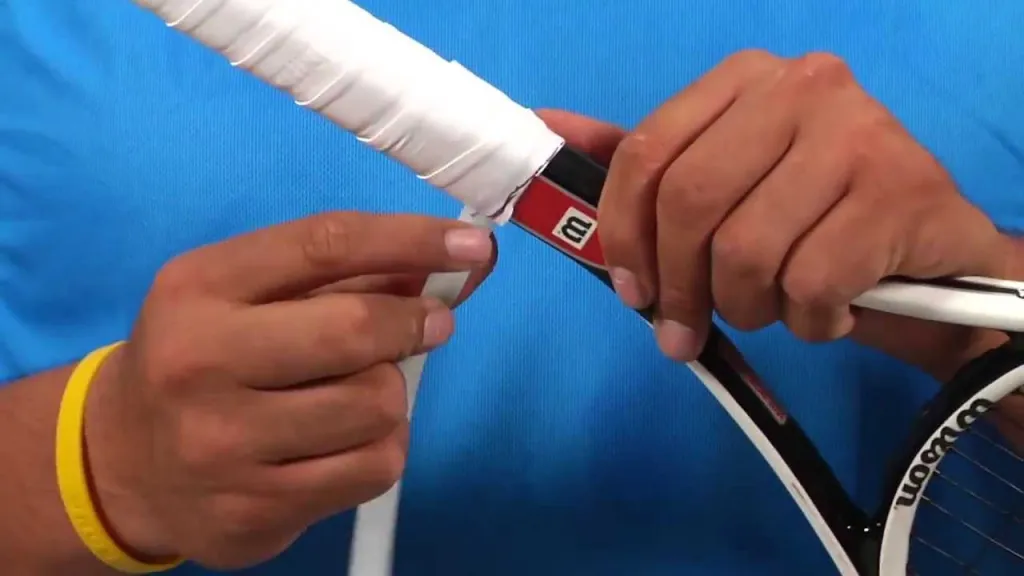
Regripping:
If your overgrip feels worn, slick, or too thin, it’s time to replace it. You can also layer an overgrip to make the handle slightly thicker.
Overgrips versus Replacement Grips
Tennis involves constant movement, so your hands will sweat. Over time, regular use and perspiration wear down the grip on your racket handle. You have two options: overgrips or replacement grips.
Overgrips are a quick, affordable fix. Many players apply one immediately on a new racket to preserve the underlying grip. They’re designed for shorter-term use and should be replaced roughly once a month for recreational players.
Replacement grips are a more permanent solution. They replace the original grip entirely and last about twice as long as overgrips, though they cost roughly twice as much. I’ve seen tour pros swap their grips between sets during matches, so don’t hesitate to change yours whenever it starts to feel slick.
The choice between overgrips and replacement grips comes down to personal preference. Either way, a fresh grip makes a noticeable difference in feel and control.
Final Thoughts
Your grip is the foundation of every shot you hit. Whether you’re a beginner picking your first racket or an experienced player looking to refine your technique, understanding the different grips gives you the tools to experiment and find what works best for your game. There is no one-size-fits-all answer, and that’s what makes it worth exploring. If you have any questions, let us know.
FAQs
What Is the Most Popular Grip in Tennis?
The most common forehand grip for regular players is the semi-western forehand tennis grip and full-western forehand tennis grip, both enabling them to hit topspin shots at their convenience. The advantage of these forehand tennis grips is that it allows for a lot of wrist motion while allowing the player to hit through the ball.
The Continental grip, often known as the chopper grip, is the foundation of any beginning tennis player’s game. Because this grip is good for shots such as serves, slices, volleys, and overheads, beginners use it for every stroke to avoid changing grips during a point or rally. These days the two-handed backhand grip is the most common backhand grip.
What Grip Does Novak Djokovic Use on His Forehand and Backhand?
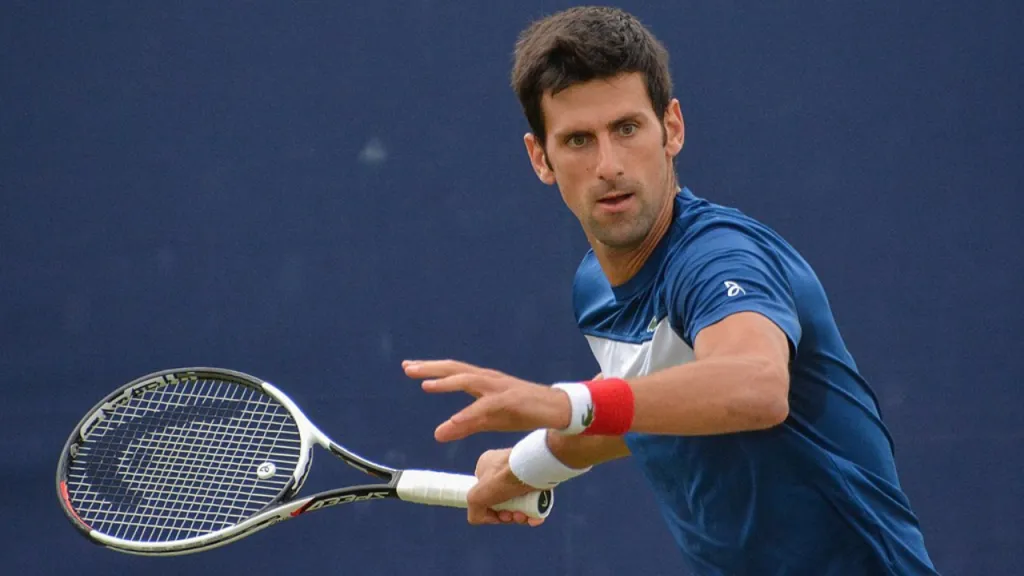
Novak Djokovic uses a semi-western grip on his forehand side. For his two-handed backhand, Novak uses the standard continental or western grip (for his dominant right hand) and an eastern grip with his non-dominant left.
What Grip Does Roger Federer Use for His Forehand and Backhand?
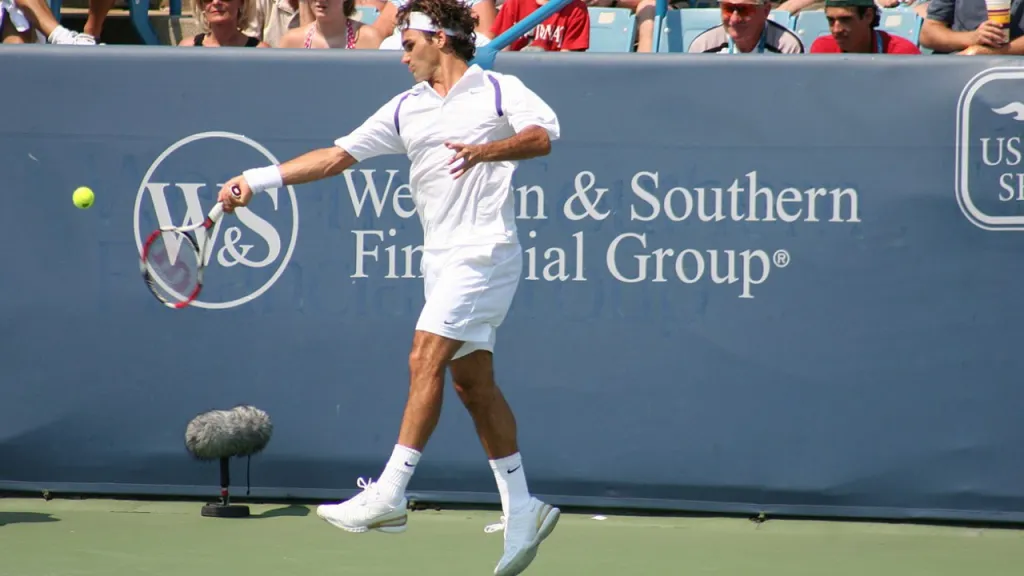
Federer has a modified eastern grip for his forehand. It is somewhere between the standard eastern forehand grip and the standard semi-western grip. Roger uses the standard backhand grip on his one-handed backhand, an eastern backhand grip.
What Grip Does Rafael Nadal Use for His Forehand and Backhand?
Rafael Nadal hits his forehand with a semi-western grip. For his two-handed backhand, he uses a continental grip for his dominant hand and a semi-western grip for his non-dominant hand, a variation of the traditional eastern grip for the non-dominant hand.
What Grip Does Carlos Alcaraz Use for His Forehand and Backhand?
Carlos Alcaraz hits his forehand with a semi-western grip that sits close to the eastern position, giving him both heavy topspin and the ability to flatten out the ball when needed. For his two-handed backhand, he uses a continental grip on his dominant right hand and an eastern grip with his non-dominant left.
Frequently Asked Questions
What is the most popular grip in tennis?
What grip does Novak Djokovic use on his forehand and backhand?
What grip does Roger Federer use for his forehand and backhand?
What grip does Rafael Nadal use for his forehand and backhand?
What grip does Carlos Alcaraz use for his forehand and backhand?
More in Tennis Basics

Tennis Court Dimensions: Facts, Figures & Measurements
Complete guide to tennis court dimensions, including lines, areas, net height, and children's court sizes. All measurements per ITF rules.

The 4 Main Types Of Tennis Court Surfaces Explained
Learn how clay, grass, hard, and carpet courts affect ball speed, bounce, and playing style, plus tips for adapting your game to each surface.
Doubles Tennis Rules, Tips & Strategies
Master doubles tennis with our complete guide to serving rotation, court positioning, formations, net strategy, and winning tactics for every level.

A Brief History Of Tennis, From The Beginnings To The Present
Explore the full history of tennis from medieval monks to the Open Era. Key milestones, legendary players, and how the sport became a global phenomenon.

Tennis Ratings Explained
Understand NTRP, UTR, and WTN tennis ratings. Learn how each system works, how they compare, and how to find your level for leagues and tournaments.

Tennis Rules Explained - An Essential Guide
Learn the essential tennis rules for singles and doubles, including scoring, serving, faults, tiebreaks, line calls, violations, and court layout.