
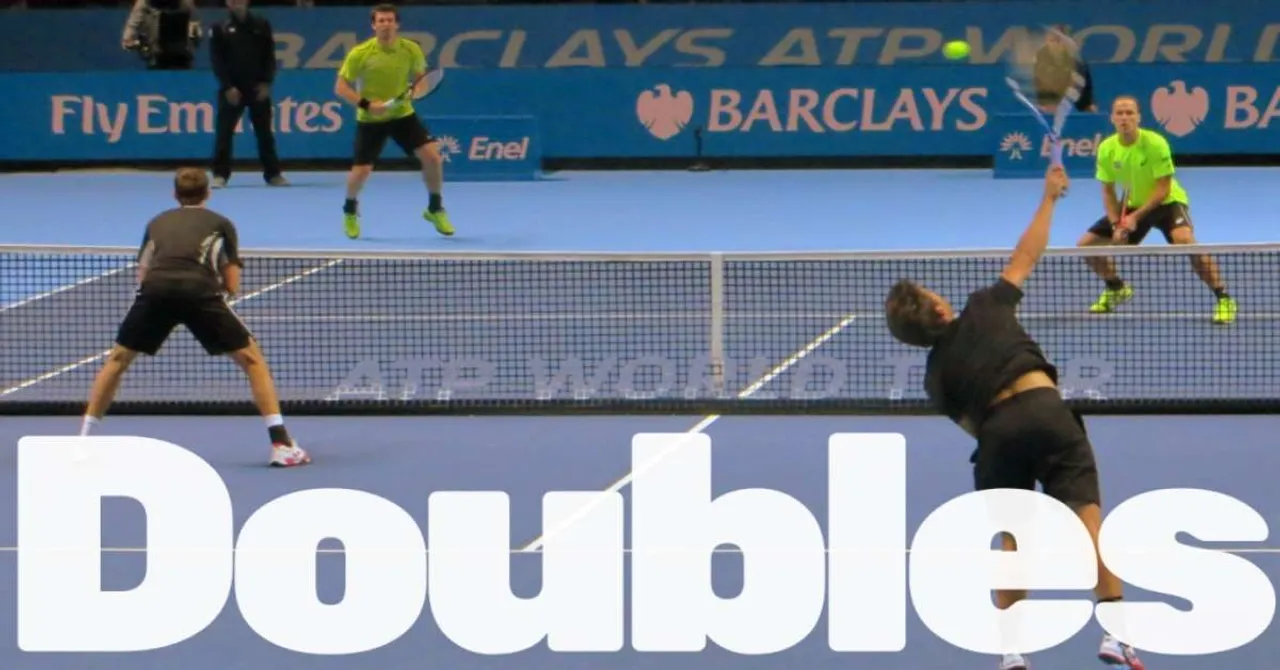
Doubles Tennis Rules, Tips & Strategies
Doubles tennis is a two-on-two format that rewards teamwork, communication, and smart positioning over raw singles ability.
If you’ve spent most of your time playing singles, stepping onto a doubles court can feel like learning a different sport. The court is wider, there’s a partner to coordinate with, and the tactics shift dramatically toward net play and angles. I’ve coached players who were strong singles competitors but struggled in their first doubles matches simply because they tried to do everything themselves.
This guide covers everything you need to know, from the rules and serving rotation to formations, strategy, and choosing the right partner. We’ll assume you’re already familiar with the basics of tennis scoring and general play. Feel free to skip ahead to the section that interests you most.
- The doubles court uses the alleys (tramlines), making it 36 feet wide instead of 27
- Serves follow a 4-player rotation that stays consistent throughout each set
- Communication before, during, and after every point is the foundation of good doubles
- The four main formations are Standard, I-Formation, Australian, and Two Back
- Dominating the net is the single most effective doubles strategy at every level
Doubles vs. Singles
Each player covers less court in doubles since there are two of you, but don’t mistake that for easier tennis. Doubles demands a different skill set: quick reflexes at the net, precise communication, and the ability to think as a unit rather than an individual.
The objective stays the same: win points, games, sets, and ultimately the match. Most singles tennis rules apply to doubles with a few key exceptions.
The biggest difference is court size. The doubles alleys (tramlines) come into play, making the court 36 feet wide instead of 27. Keep in mind that the alleys are only in play once the ball has been served, so serves must still land within the singles service box.
Doubles Serving Rotation
Serves rotate between teams, but instead of a 2-player rotation like in singles, doubles uses a 4-player rotation that stays consistent throughout each set. Let’s use an example: Rublev/Medvedev vs. Tsitsipas/Alcaraz.
Medvedev is the first to serve on his team, and Tsitsipas is the first to serve on his side. Via a coin toss, the Tsitsipas/Alcaraz team serves first. Here’s how the rotation plays out game by game:
This 4-game rotation repeats for the entire set
Each player rotates to serve every fourth game until the set is completed. At the start of the following set, teams can choose which player serves first for their side, establishing a new rotation. My recommendation: let the player with the better serve go first. Setting the tone early with a strong service game puts immediate pressure on the opponents.
Where to Receive?
(Deuce Court vs. Advantage Court) Before the set begins, teammates must choose whether to receive serves in the right service court (deuce court) or the left service court (ad court). Once decided, each player may only return serves from their designated side for the remainder of that set. You cannot switch service courts to receive until the set is over.
After that, teammates can swap sides at the start of each new set. During play, teammates can stand anywhere on the court as long as the designated returner is the one who hits the return. The returner usually stands behind the baseline to receive serves, while the partner stays in or close to the adjacent service box.
When both players are right-handed, I typically suggest putting the player with the stronger backhand on the ad (left) side, since many crucial points at deuce are played there.
Communication
In doubles, communication is everything. Only one player on a team can hit the ball at any given time. If both players swing and both rackets make contact, the opposing team wins the point. However, if only one racket makes contact, play continues normally.
This doesn’t mean you have to take turns hitting the ball. One player might opt to cover the entire court and hit every ball following the serve in an effort to win the point. But calling “mine” or “yours” early and clearly prevents the most common doubles mistake: two players watching a ball sail past because neither committed to it.
I tell my students to communicate before, during, and after every point. Discuss your plan before the serve, call balls during the rally, and talk about what worked or didn’t between points.
Tiebreaker
The doubles tiebreaker follows the same scoring and regulations as the singles tiebreaker, with one exception: the 4-player serving rotation continues. After the first point is completed, the 2-point rotation begins.
Here’s how it works using our earlier example. The serving rotation is still in effect, and Tsitsipas is next in line to serve. Notice this rotation is point by point, not game by game:
This rotation repeats until one team wins by 2+ points
This rotation repeats until one team wins the tiebreaker. To win, a team must reach at least 7 points with a 2-point margin. Final scores might look like 7-2, 7-4, 9-7, 13-11, or even 24-22.
Alternative Doubles
Mixed Doubles
Mixed doubles follows the same rules as standard doubles, with one difference: each team consists of 1 man and 1 woman. Mixed doubles is featured at all four Grand Slams and the Olympics.
Canadian Doubles
Canadian doubles is a creative way to play with 3 players. Two players compete against one. The key rule difference: the team of 2 can only hit within the singles court boundaries, while the solo player can use the full doubles court on the 2-player side. It’s a fun format for practice sessions when you have an odd number of players.
Australian Doubles
Another 3-player format where one player faces a doubles team, but the singles player rotates each game. It’s a great way to work on both singles and doubles skills in the same session.
Positioning and Formations
Getting your positioning right is one of the first things to master in doubles. Here are the fundamentals using a standard formation:
- When serving: Stand a few feet from the doubles alley. This lets you cover your half of the court and handle wider returns comfortably.
- When your partner serves: Stand near the center of the service box on the opposite half. This positions you to hit volleys at the right height, cover the tramline on your side, and react to lobs over your head.
- When your partner returns: Take a step back from the service line. If the opponent volleys, you’ll have time to cover the court or move forward for a volley of your own.
- When returning serve: Stand as you would for a singles return, but shade slightly toward the doubles alley to cover a wider serve.
These are starting positions for the traditional formation. As you progress, you’ll want to experiment with more advanced formations. Below is an overview of each one, including benefits, drawbacks, and when to use them.
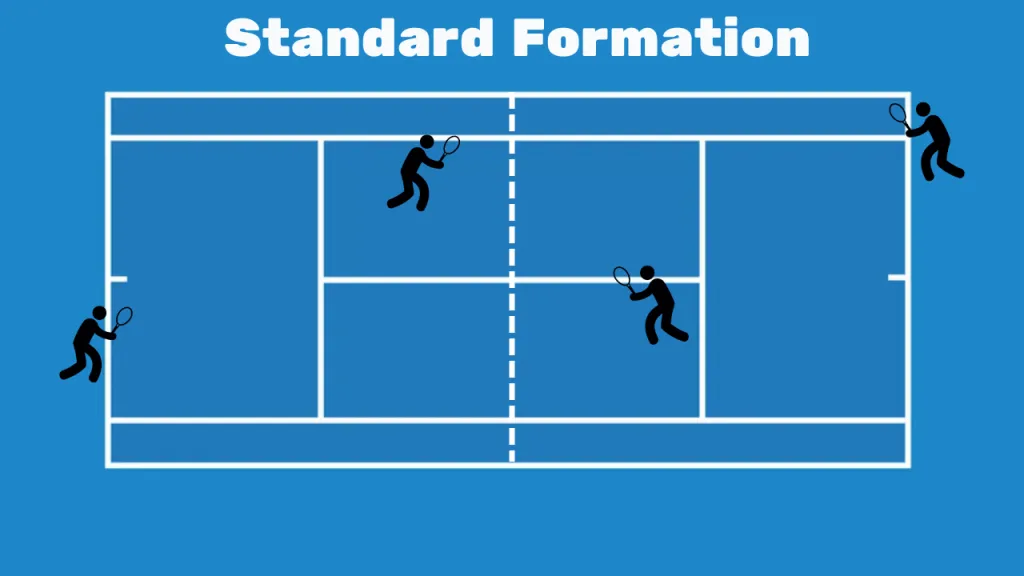
Standard Formation
The most common doubles formation at every level. Both teams have one player at the baseline and one at the net. The net players stand diagonally across from each other, allowing the baseliners to rally crosscourt.
Advantages:
A fairly neutral formation that covers the court well without leaving large gaps. It balances offense and defense: the net player can be aggressive while the baseline player covers deeper crosscourt shots and lobs.
Disadvantages:
It can be too neutral. If your net player isn’t active enough, your opponents will rally crosscourt comfortably and work their way to the net unchallenged.
When to use it:
This should be your default formation. It works for most players and situations. Mix in advanced formations occasionally to keep your opponents guessing.
I-Formation
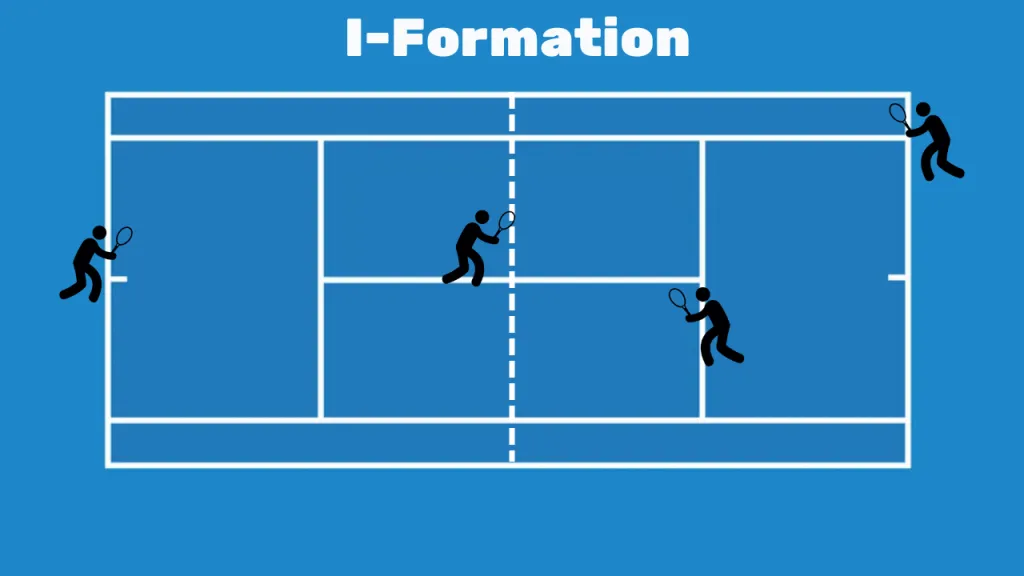
A more advanced setup where the net player crouches on or near the center service line, and the server stands near the baseline center. Before each point, the players agree through hand signals which direction the net player will move after the serve.
Advantages:
The net player can be more aggressive when poaching, and the opponents won’t know which side the net player will end up on. This uncertainty often forces returners into errors.
Disadvantages:
The net player opens up more of the court and is more exposed to the return. Both players need to be comfortable with quick lateral movement.
When to use it:
When your opponents are consistently returning crosscourt and keeping the ball away from your net player in the standard formation.
Australian Formation
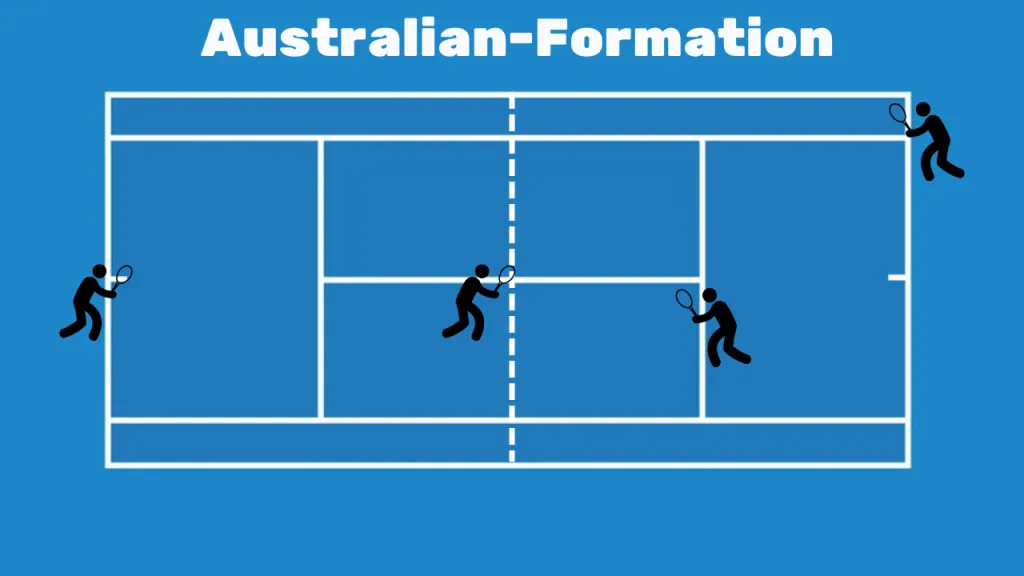
Both the server and net player line up on the same side of the court, deliberately leaving half the court open. This aggressive formation forces the returner to hit down the line.
Advantages:
Lining up on the same side as the server lets the net player cover the crosscourt return. The returner is forced down the line, which is a more difficult and lower-percentage shot.
Disadvantages:
You’re leaving half the court open. If your opponent has a good down-the-line return or the server doesn’t hit a quality serve, you’ll pay for it.
When to use it:
When your opponent is too comfortable returning crosscourt and you want to disrupt their rhythm by forcing the return down the line.
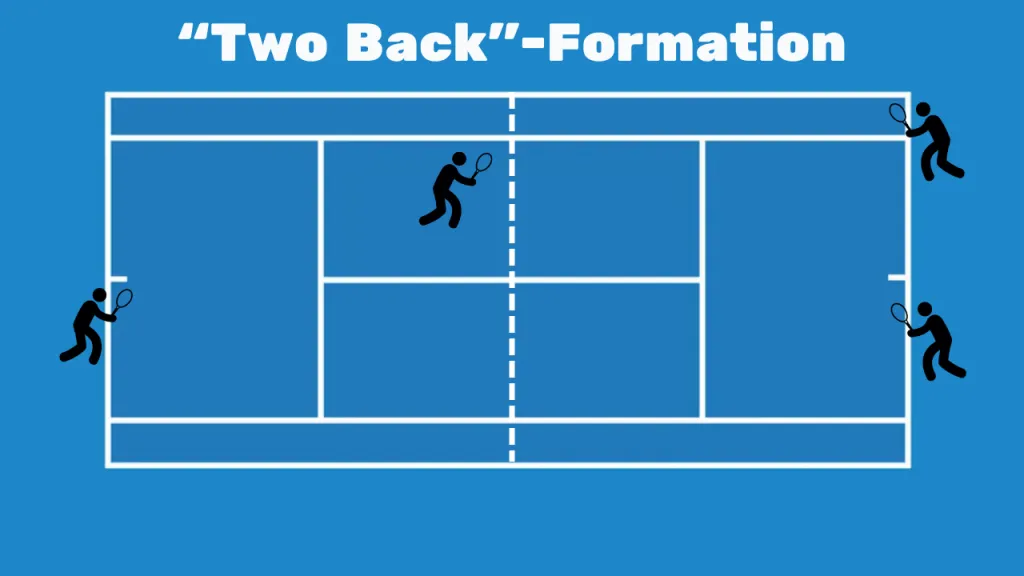
“Two Back” Formation
Both players position themselves at the baseline. This is primarily a return formation, used when one or both players are getting bullied at the net.
Advantages:
Two players back gives you more time to react to your opponents’ shots. It’s especially useful against big servers when you’re struggling to get the return back in play.
Disadvantages:
You surrender the net entirely, giving your opponents more space to hit into and more angles to work with. You’ll need to rely on solid groundstrokes and well-timed approaches.
When to use it:
When you or your partner are getting targeted at the net, or against a team with a dominant serve that makes the standard return position uncomfortable.
Tennis Doubles Strategy
Here are the core strategies that work at practically every level of doubles play:
Court Positioning
Knowing where to position yourself is one of the first things beginners should learn. In singles, you cover the entire width of the court yourself. In doubles, the court is wider, but you’re only responsible for your half. You must trust your partner to handle balls hit their way, and they need to trust you.
Even with that division, there’s plenty of uncertainty. Your court position shifts constantly as the point develops. Calling “mine” or “yours” saves you from those moments where a ball sails between two players who both hesitated.
When both players are right-handed, the player with the stronger backhand usually receives on the advantage (left) side, since that’s where pressure points tend to occur.
Timing and Movement
Timing matters as much as positioning. Here are the key moments:
- First serve return: Stand at or near the baseline, not too far from the singles sideline. This lets you cover serves to both your forehand and backhand.
- Second serve return: Move closer to the net. Second serves are typically slower, so stepping inside the baseline lets you return aggressively and cut off angles.
- Partner receiving: Stand near the service line on the opposite side. This protects the court from an angled volley by the opposing net player.
- Partner serving: Position yourself in the center of the service box opposite the returner. You’re set up to put away a weak return.
The key is being receptive to constant positional adjustments as the point unfolds.
Team Communication
I cannot emphasize this enough: doubles is a team sport. It doesn’t matter how talented you are individually. If you and your partner can’t collaborate, your chances of winning drop significantly.
You and your partner should agree on serving direction, formations, and net play before each point. Some teams use hand signals during the match. Others simply talk between points. Find what works for you. The teams that communicate well have more fun and win more matches.
Capitalize on Your Team’s Strengths
Every player has strengths and weaknesses. If you’re the stronger server between the two of you, serve first. If your partner has a killer backhand, have them cover the ad (left) side.
Doubles is about the team, but the team is made up of two individuals. Plan how each player’s strengths create opportunities for the team as a whole.
Prey on Your Opponents’ Shortcomings
Exploiting an opponent’s weakness is part of competitive tennis, just like any other sport. As the match progresses, observe what causes your opponents the most trouble. When you spot a weakness, take advantage of it.
To be clear, I’m not talking about launching groundstrokes directly at the net player’s body. This is more about recognizing a poor second serve and attacking it when you’re in position, or noticing a weak backhand volley and consistently directing the ball there. Sportsmanship always comes first.
Stay on Your Feet
Many doubles beginners plant their feet and wait. That’s a recipe for getting caught flat-footed. Tennis is a sport of constant movement and quick decisions.
Do a split step every time the ball is struck. It’s a small hop that keeps you light and ready for whatever comes next. The net is where most doubles points are decided, and balls come fast up there. Standing still is not an option.
Use the Angles
This strategy is especially effective when volleying and hitting overheads. In doubles, you have the full width of the court to work with, including those alleys. Use sharp angles to push your opponents off the court. If you have the chance to hit a well-placed angled volley, take it.
The Lob
A lob is a dramatic change of pace that sends the ball high over the net player into the back of the court. Hit it as high as possible with topspin for maximum effectiveness. A well-timed lob catches your opponents off guard and forces them to abandon their net position.
The lob is vastly underappreciated in doubles. It takes time to master, but the payoff is worth it. I find lobs are most effective in the middle of a long rally when your opponents are locked in at the net. Don’t be afraid to throw one in. It can cause havoc and keep the other team guessing.
Avoid “No Man’s Land”
No Man’s Land is the area between the baseline and the service line. It’s an awkward position where deep shots land at your feet and you’re too far from the net to volley cleanly. You often end up hitting half-volleys, which are among the most difficult shots in tennis.
Either commit to the net or stay back at the baseline. Lingering in No Man’s Land gives you the worst of both worlds.
Avoid the Opposing Net Player
As a general rule, keep the ball away from the opposing net player during baseline rallies. If they can get their racket on the ball, they have a chance to end the point. Rally crosscourt to your opponent’s baseline player instead, keeping the point alive while allowing your own partner to be aggressive at the net.
Hit to the Backhand of the Weaker Player
Targeting the weaker opponent will earn you more points over the course of a match. Beyond that, aim for their backhand volley specifically. Backhand volleys produce more errors than forehand volleys for the vast majority of players, making it a high-percentage target.
Hit Deep Groundstrokes
When rallying from the baseline, keep your groundstrokes deep. This pins your opponent back and prevents them from approaching the net. Deep shots also increase the likelihood of forcing an error, setting up your partner for a put-away volley.
Hit the Ball to the Net Player’s Feet
When you have the chance to attack, aim for the opponent’s feet. Volleying from below the net’s height is far more difficult than hitting a chest-high volley. Even skilled volleyers will struggle to do anything aggressive with a ball at their shoes.
The result is often a weak, floating reply that your partner can put away. This is one of the most reliable tactics for generating errors in doubles.
Attack the Center
If both opponents are at the net and you’re stuck at the baseline, consider hitting straight down the middle of the court rather than attempting a risky passing shot or lob. A center shot forces your opponents to decide quickly who takes the ball, which often leads to confusion. It also limits their volleying angles, making a winning shot much harder for them.
Dominate the Net
Taking the net is the most effective doubles strategy at every level. It puts immediate pressure on your opponents, takes away their time, and shrinks the court they can hit into. They’re forced into higher-risk shots like passing shots down the line or defensive lobs.
The best doubles teams in the world, from the Bryan Brothers to Krejcikova/Siniakova, have all built their games around controlling the net. If you and your partner can get comfortable up there, you’ll win significantly more points.
Net Strategy
Because you’ll be spending a lot of time at the net, developing a good net strategy can make or break a match. There are three general tactics:
Poaching:
A poach is when the net player crosses the center service line to intercept the ball and hit a volley. It works especially well early in a match because few players will attempt a down-the-line shot right away. If the serve exposes the returner’s weakness, you should get a relatively easy volley to put away.
Pinching:
This is when the net player moves diagonally toward the middle of the net during a crosscourt rally, closing down the space. It forces your opponents into more difficult shots and increases the chance of an error.
Faking:
You act like you’re going to poach, then recover toward the doubles alley. The key is making sure your opponent sees the movement early, giving yourself time to recover and catch their shot. This forces returners into hesitation and errors.
Keep in mind that pinching and faking both expose your half of the court, so use them selectively. When you do get a volley, aim into open space if there is any. If both opponents are well-positioned at the net, go down the middle and target their feet.
Serve Strategy
Serving in doubles is less about aces and more about setting up your partner for a volley. Communicate with your partner before each point, either at the baseline or through hand signals, about where you plan to serve.
Option 1: Serve to the weakness.
Target your opponent’s weaker side, which is typically the backhand. As the match progresses, you may notice they struggle with forehand returns, can’t return down the line, or have more trouble with slower second serves than your first serve.
Option 2: Play to your strengths.
If you can’t identify a clear weakness, use your most effective serve to set up your partner. Serving down the T reduces the angles you’ll face on the return and gives your partner more room to poach. A well-placed serve also makes serve-and-volley more viable, putting your opponents under immediate pressure.
Return Strategy
A poor return in doubles gets punished immediately by the opposing net player. Having a solid return strategy is critical.
One of the most common doubles mistakes is trying to do too much on the return. Instead, focus on getting the ball back and keeping it away from the net player. Your goal is to start the point and set up your partner, not hit a winner off the return.
A reliable target is the middle net strap. It’s the lowest point of the net, giving you a slightly greater margin for error. Hitting there also removes angles, making it harder for your opponents to hit a winning volley. Even if the server is coming in behind the serve, a low return to the center forces a difficult first volley at their feet.
If the opposing net player starts poaching aggressively, go down the line with your return occasionally. You don’t have to hit a winner, just keep them honest and prevent them from cheating toward the middle every point.
Choosing a Partner
Before committing to a doubles team, consider two things: skills and personality.
You and your partner don’t need to be equally talented. What matters is finding someone whose strengths complement your weaknesses. Two great servers who can’t sustain a rally won’t win many matches. A strong net player paired with a solid baseliner, on the other hand, creates natural balance.
Personality matters just as much. A team can have all the talent in the world, but if the two players don’t see eye to eye or can’t encourage each other through tough moments, the partnership won’t last. Look for someone who stays positive under pressure and communicates openly.
There’s no perfect partner. Every doubles team has its own dynamic, and the best partnerships develop over time through trust and shared experience.
Final Thoughts
Doubles tennis adds a layer of strategy, teamwork, and excitement that singles simply can’t replicate. The fast-paced action at the net, the coordination between partners, and the satisfaction of executing a well-planned point together make doubles one of the most enjoyable ways to play tennis.
Whether you’re competing in a league or just having a hit-and-giggle with friends, I hope this guide gives you the confidence to step out there and play with purpose. If you have questions about doubles tactics or want to share what’s working for your team, we’d love to hear from you.
FAQs
Which is harder, singles or doubles tennis?
Doubles is more complex strategically, requiring coordinated positioning, formations, and constant communication. Singles is more physically and mentally demanding because you cover the entire court alone and have no one to lean on between points.
In singles, consistency with your groundstrokes and the ability to cover the full court are paramount. In doubles, net comfort, reliable volleys, and smart shot placement matter more than raw athleticism.
Who are the best doubles teams in tennis history?
Bob and Mike Bryan (119 titles, including 16 Grand Slams), Martina Navratilova and Pam Shriver (79 titles, 20 Grand Slams), John McEnroe and Peter Fleming, Serena and Venus Williams, Todd Woodbridge and Mark Woodforde (The Woodies), Natasha Zvereva and Gigi Fernandez, John Fitzgerald and Anders Jarryd, Rajeev Ram and Joe Salisbury, Nicolas Mahut and Edouard Roger-Vasselin, Barbora Krejcikova and Katerina Siniakova, Paul Haarhuis and Jacco Eltingh, Jonas Bjorkman and Max Mirnyi.
What makes a good doubles player in tennis?
A strong doubles team moves as a unit, shifting together to follow the ball rather than playing as two individuals. They understand how to set up their partner to win the point and how to divide the court to cover the majority of shots.
Effective communication is the foundation. The best doubles players plan strategies, provide encouragement, and adjust tactics between points. It also helps to have an attacking game with quick reflexes at the net.
How many sets are in a doubles match?
Doubles matches are typically best-of-three sets. In most professional tournaments, including Grand Slams, a 10-point match tiebreak replaces the third set.
Can you switch sides in tennis doubles?
Yes, but once you choose your receiving side at the start of a set, you must stay on that side for the entire set. You’re free to switch sides between sets.
Is scoring different in doubles tennis?
Most singles tennis rules apply to doubles, with a few exceptions. The doubles alleys are in play after the serve, making the court wider. On the professional tour and in most tournaments, doubles uses no-ad scoring, meaning a single deuce point (with the receiving team choosing which side to receive on) decides the game.
How do you score a tiebreaker in doubles tennis?
The first team to win 7 points with at least a 2-point margin wins the tiebreaker. The first server serves once from the deuce court. After that, each server serves twice, starting from the ad court. Service alternates after every two points. Teams switch ends every six points (at scores like 4-2, 6-6, etc.).
Extra Resource
Here’s a helpful video overview of doubles strategy and positioning:
Frequently Asked Questions
Which is harder, singles or doubles tennis?
Who are the best doubles teams in tennis history?
What makes a good doubles player in tennis?
How many sets are in a doubles match?
Can you switch sides in tennis doubles?
Is scoring different in doubles tennis?
How do you score a tiebreaker in doubles tennis?
More in Tennis Basics
Tennis Court Dimensions: Facts, Figures & Measurements
Complete guide to tennis court dimensions, including lines, areas, net height, and children's court sizes. All measurements per ITF rules.

The 4 Main Types Of Tennis Court Surfaces Explained
Learn how clay, grass, hard, and carpet courts affect ball speed, bounce, and playing style, plus tips for adapting your game to each surface.

The Ultimate Tennis Grips Guide To Improve Your Game
Learn every tennis grip from Continental to Western. Find out which grip suits your game, how to find your grip size, and what the pros use.

A Brief History Of Tennis, From The Beginnings To The Present
Explore the full history of tennis from medieval monks to the Open Era. Key milestones, legendary players, and how the sport became a global phenomenon.
Tennis Ratings Explained
Understand NTRP, UTR, and WTN tennis ratings. Learn how each system works, how they compare, and how to find your level for leagues and tournaments.
Tennis Rules Explained - An Essential Guide
Learn the essential tennis rules for singles and doubles, including scoring, serving, faults, tiebreaks, line calls, violations, and court layout.