

Tennis Court Dimensions: Facts, Figures & Measurements
Every competitive advantage in tennis starts with knowing your court.
Tennis is a game of angles, and the player who understands how much space they have to work with makes better tactical decisions. I always tell my students to think of the court in zones, not just as one big rectangle. When you know that the doubles alley is only 4.5 feet wide, you realize how precise your passing shots need to be. This guide covers every official measurement, from baseline to net, so you can use the court’s geometry to your advantage.
Standard Tennis Court Dimensions
The “Rules of Tennis,” published annually by the International Tennis Federation (ITF), specify the precise dimensions of a regulation tennis court. Every measurement in this article is based on the official ITF Tennis Rules, the same standard used at every Grand Slam and ATP/WTA tournament worldwide.
Key Tennis Court Dimensions
A full tennis court measures 78 feet (23.77m) long by 36 feet (10.97m) wide. However, only doubles matches use the entire width. The singles court is 78 feet long and 27 feet (8.23m) wide, which means those doubles alleys sit unused during singles play. Let’s break down each component of the court.
| Measurement | Feet | Meters |
|---|---|---|
| Court Length | 78 ft | 23.77 m |
| Singles Width | 27 ft | 8.23 m |
| Doubles Width | 36 ft | 10.97 m |
| Net Height (center) | 3 ft | 0.914 m |
| Net Height (posts) | 3.5 ft | 1.07 m |
| Service Box Depth | 21 ft | 6.40 m |
| Service Box Width | 13.5 ft | 4.11 m |
| Doubles Alley Width | 4.5 ft | 1.37 m |
| Baseline to Service Line | 18 ft | 5.49 m |
Interactive Court Diagram
Hover over or tap any zone to see its dimensions. Use the toggles to compare tennis court size with pickleball and children’s courts.
Hover over or tap any zone on the court to see its dimensions
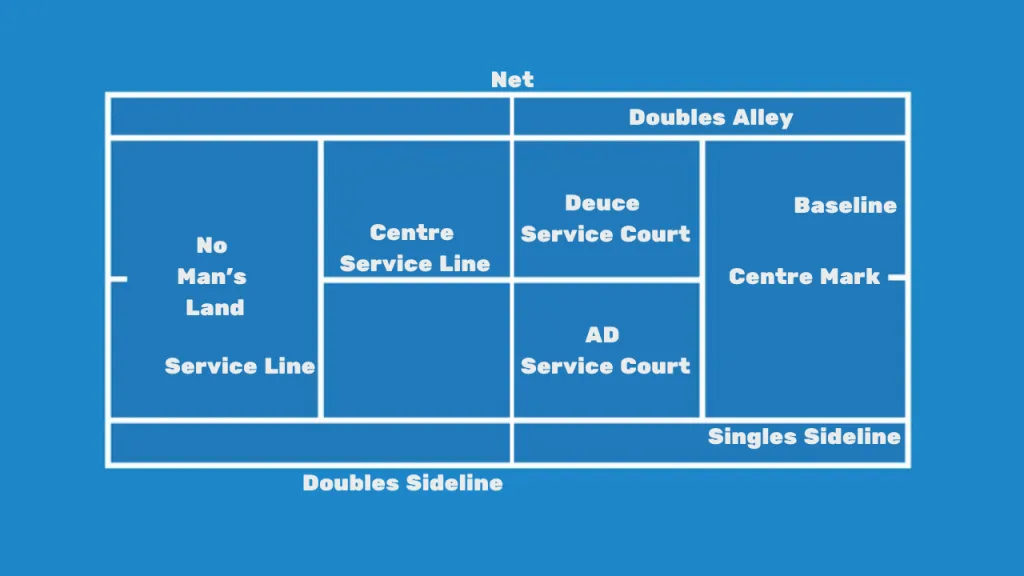
Lines of a Tennis Court
- Baseline 27 ft / 8.23m (Singles) 36 ft / 10.97m (Doubles)
- The baseline runs parallel to the net and defines the back boundary on each side. Most rallies in modern tennis happen within a few feet of this line. Players like Novak Djokovic and Iga Swiatek build their game around controlling the baseline.
- Center Mark 4 in / 10 cm long
- Players must serve diagonally from the correct side of the court. The center mark, a small 4-inch line at the midpoint of each baseline, divides the deuce and ad sides.
- Service Line 27 ft / 8.23m wide
- The service line runs parallel to the net, exactly 21 feet (6.40m) from it, marking the midway point between the net and the baseline. Any serve that lands beyond this line is out.
- Center Service Line 21 ft / 6.40m long
- The center service line runs perpendicular to the net, dividing the two service boxes and defining the deuce and advantage sides of the court.
- Singles Sidelines 39 ft / 11.89m long
- The singles sidelines mark the outer boundary of the singles court, sitting 13.5 feet (4.11m) from the center on each side. They run the full length from baseline to baseline.
- Doubles Sidelines 39 ft / 11.89m long
- The doubles sideline runs along the court’s outer edges when the court’s full width is used for doubles play.
The white lines that mark the court are also uniform in thickness. All court lines should be at least 2 inches (5cm) wide, with the baseline up to 4 inches (10cm) wide.
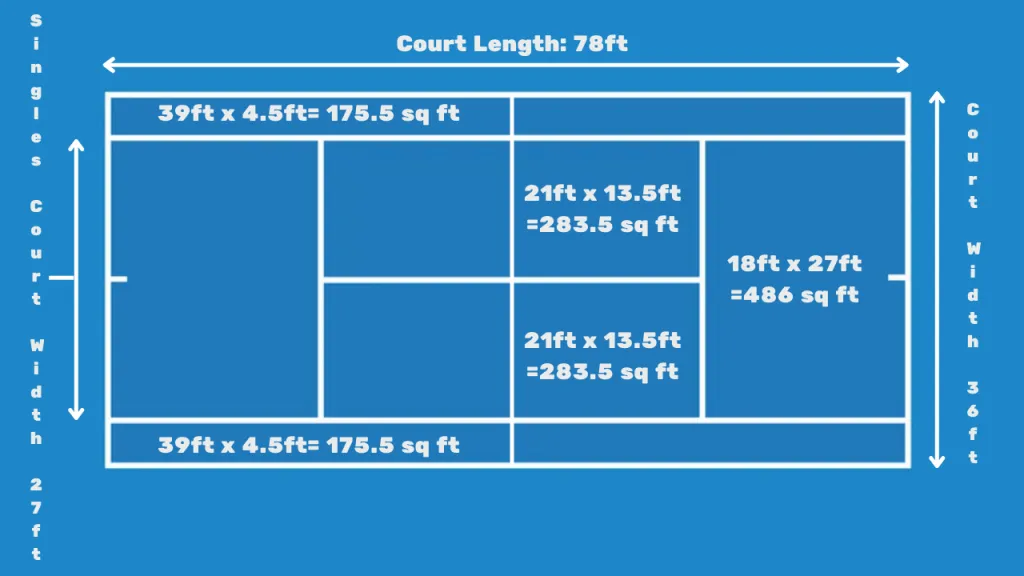
Areas of a Tennis Court
- Total Court Area Singles: 2,106 sq ft Doubles: 2,808 sq ft
- The singles court covers 2,106 sq. ft (195.7 sq m), while a doubles court covers 2,808 sq. ft (260.9 sq m). That extra 702 sq. ft from the doubles alleys changes the game significantly.
- Service Boxes 21 ft x 13.5 ft / 6.40m x 4.11m
- Each service box is 21 feet long and 13.5 feet wide. The center service line divides the area between the net and service line into two equal boxes, one on the deuce side and one on the ad side.
- Backcourt / No Man’s Land 18 ft x 27 ft / 5.49m x 8.23m
- This area between the baseline and the service line is the largest zone on the court. It’s called “no man’s land” because standing here leaves you vulnerable to balls at your feet. Most coaches, myself included, teach players to either commit to the net or stay behind the baseline.
- Doubles Alleys 39 ft x 4.5 ft / 11.89m x 1.37m
- Each doubles alley is 39 feet long and just 4.5 feet wide. These narrow strips on either side of the court are only in play during doubles. At 4.5 feet, they require precise shot placement to exploit.
Tennis Net Dimensions
The net divides the court into two equal halves and spans the full width between the net posts. A steel cable threaded through the top keeps it taut, and a center strap anchors the net to the court surface.
The ITF standard net height is 3.5 feet / 1.07m (42 inches) at the posts and 3 feet / 0.914m (36 inches) at the center, with a total width of 42 feet (12.80m) between the posts. That 6-inch dip in the center is why you’ll often see players aim passing shots down the middle. It’s the lowest point of the net and gives the best margin for error.
Final Thoughts
Understanding your court’s dimensions gives you a real edge. When you know that the service box is only 13.5 feet wide, or that the net dips 6 inches in the center, you start making smarter shot selections. Take these numbers to the court, visualize the zones, and use the geometry to your advantage.
If you’re still building your tennis foundation, check out our complete guide to tennis rules and scoring.
Frequently Asked Questions
What is the tennis court size for children?
What about the area outside the playing court surface?
Are there different sizes of tennis courts?
How many court surfaces are there?
What is the width of the lines on a tennis court?
What is the height of an indoor tennis court?
How much space is required to construct a tennis court?
What is the difference between indoor and outdoor tennis?
Are all tennis courts the same size?
How many pickleball courts can you put on a tennis court?
How much does it cost to build a tennis court?
More in Tennis Basics

The 4 Main Types Of Tennis Court Surfaces Explained
Learn how clay, grass, hard, and carpet courts affect ball speed, bounce, and playing style, plus tips for adapting your game to each surface.
Doubles Tennis Rules, Tips & Strategies
Master doubles tennis with our complete guide to serving rotation, court positioning, formations, net strategy, and winning tactics for every level.

The Ultimate Tennis Grips Guide To Improve Your Game
Learn every tennis grip from Continental to Western. Find out which grip suits your game, how to find your grip size, and what the pros use.

A Brief History Of Tennis, From The Beginnings To The Present
Explore the full history of tennis from medieval monks to the Open Era. Key milestones, legendary players, and how the sport became a global phenomenon.

Tennis Ratings Explained
Understand NTRP, UTR, and WTN tennis ratings. Learn how each system works, how they compare, and how to find your level for leagues and tournaments.

Tennis Rules Explained - An Essential Guide
Learn the essential tennis rules for singles and doubles, including scoring, serving, faults, tiebreaks, line calls, violations, and court layout.